

Raimar Stange
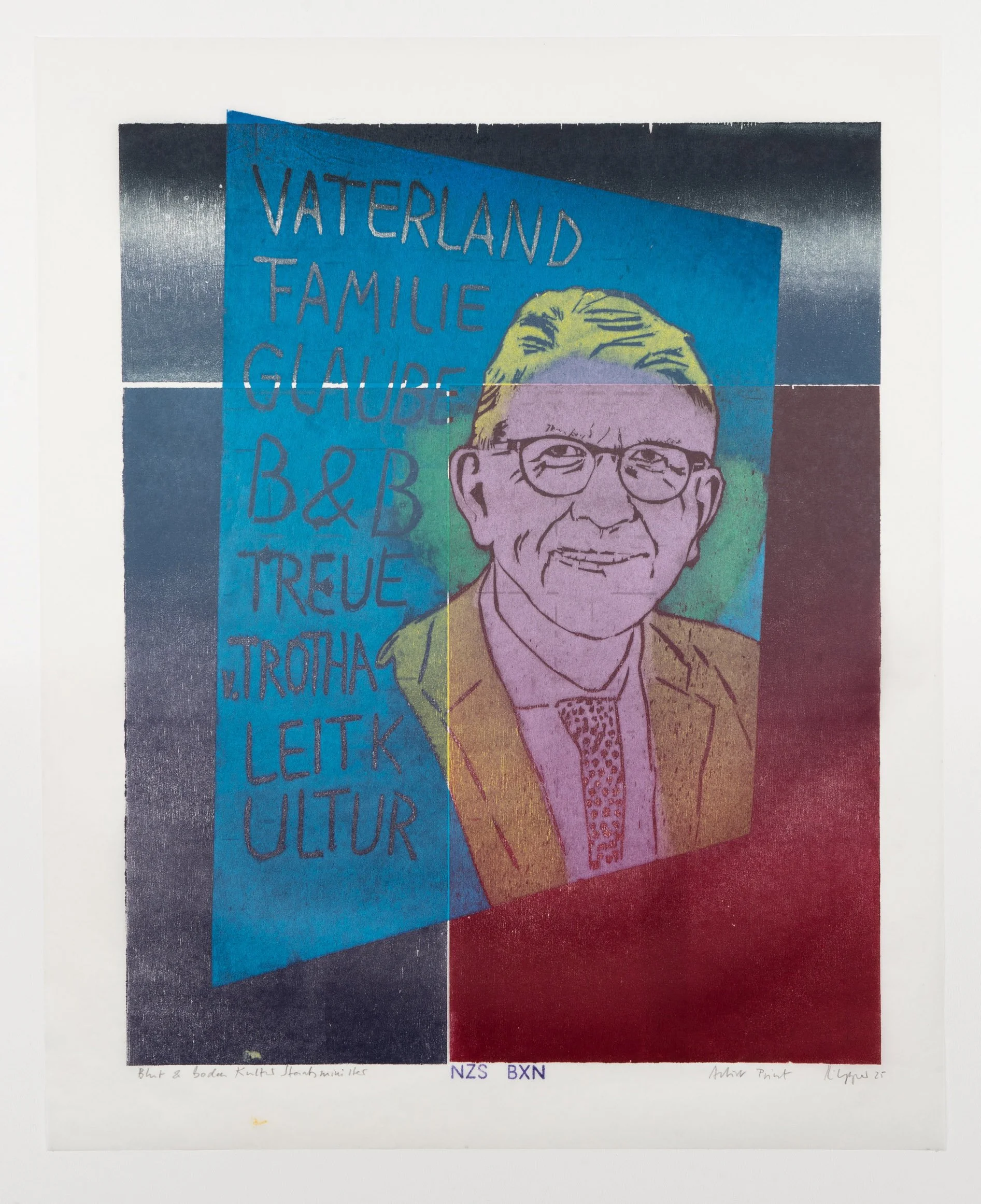
Thomas Kilpper, Blut & Boden Kulturstaatsminister, (Blood & Soil) 2025. Kilpper’s portrait of Germany’s Minister of State for Culture, Wolfram Weimer, is crossed by a vocabulary of fatherland, family, faith, loyalty and “Leitkultur.”
“At last, Wolfram Weimer is taking on the left-wing cultural establishment!” stated the German daily newspaper DIE WELT at the start of the year. Since taking office as Germany’s Minister of State for Culture in May 2025, Wolfram Weimer has waged a culturally conservative – or, as others put it, “right-wing populist” – culture war with unwavering determination. He initially articulated his view of culture in small doses, which accumulated over time. He began by praising the medium of painting, arguing that German painters had “been consistently world-class over the last 40 years” and had achieved this “without state subsidies” (DIE WELT). A few weeks later however, he categorically dismissed more advanced art forms that were no longer exclusively object-based, claiming they displayed anti-Semitic views – an accusation that has gained traction in Germany in this context since Documenta 15. He also stated that they represented “radical feminist, postcolonial, eco-socialist culture of outrage” and “left-wing alarmism” (Süddeutsche Zeitung). According to the Minister of State for Culture, art must assert itself in a manner consistent with market and social norms; under no circumstances should it take on a political or system-critical stance. Furthermore, advanced art is not art for everyone; Weimer therefore explicitly calls for e.g.“more films for the masses” (Stuttgarter Zeitung). He also initiated the so-called “Pop Summit” at the Federal Chancellery, where pop musicians, representatives of the music industry and streaming services negotiated better remuneration for musicians. (Claiming that products of the culture industry are ‘close to the people’ whilst demonising works from the art world as elitist is a common strategy in right-wing circles. On the one hand, this contrast fails to recognise that products of the cultural industry primarily serve the profit interests of a small number of companies and are by no means ‘authentic’ expressions of ordinary people; on the other hand, the art world must certainly accept the accusation of being ‘elitist’ – the idea of a ‘culture for all’ (Hilmar Hoffmann) from the 1960s and 70s, for example, has long since ceased to play any role today.)
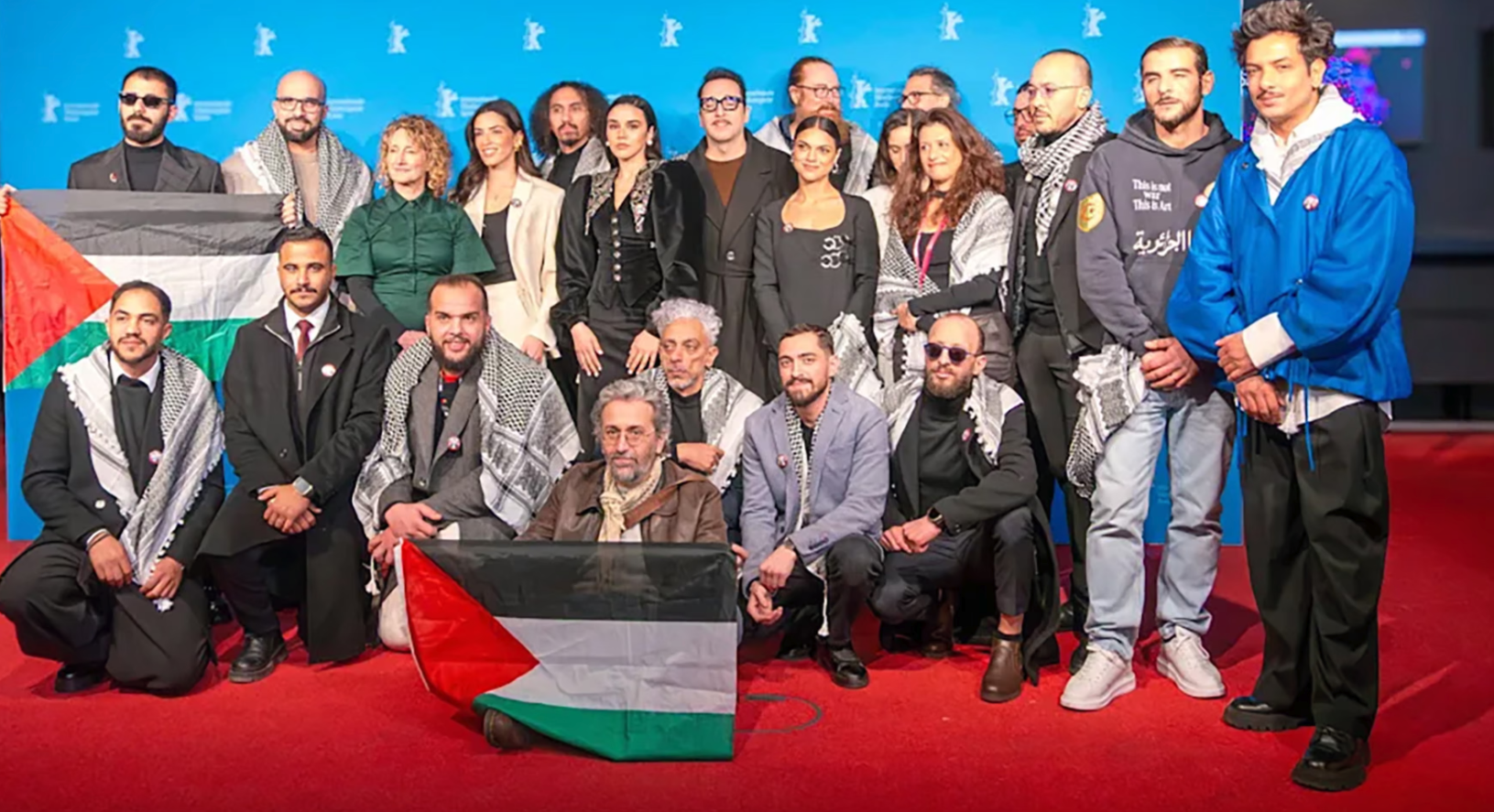
The photograph shows Tricia Tuttle in green with the Chronicles From the Siege crew. According to sources cited by Bild, Wolfram Weimer, the culture commissioner, decided to relieve Tuttle of her duties after seeing not only the speeches but also a picture taken a week earlier. Photograph: Berlinale
The Minister of State for Culture quickly followed up his aggressive words with action. For example, in the wake of alleged incidents of anti-Semitism at this year’s Berlinale, he called for the resignation of Tricia Tuttle, the director of the Berlin Film Festival. Shortly afterwards, he excluded three “extremist” bookshops from the “German Book Trade Prize”. He then followed this by ordering the Office for the Protection of the Constitution to begin investigating the composition of juries within the arts sector. However Weimer, who had incidentally never been professionally involved in culture prior to his term in office, also struck what were supposedly laudatory notes: he was probably the first German Minister of State for Culture to travel to Vienna for the popular Eurovision Song Contest, in support of the German and Israeli entries, thereby summing up his populist, socially conservative stance.
How, you might ask, is the art world responding to Weimer’s attacks, which threaten to undermine artistic freedom in Germany? MONOPOL magazine aptly observes: “No stance, no conviction anywhere” and laments the art world’s passivity in the face of the current shift to the right in cultural policy. The majority seem to think they can sit the situation out, underestimating the danger and, moreover, fearing that resistance will result in even greater cuts to state funding. Only those directly affected dare to voice their criticism, more or less openly. The director of a major Berlin exhibition venue explained his inaction to me as follows: “We’re not a political party, after all.” It is precisely the prestigious art world – and not just in Germany! – that still sees itself as committed to “autonomous”, and thus largely apolitical art, and has consequently developed hardly any practical ability to respond resiliently to politically precarious situations.
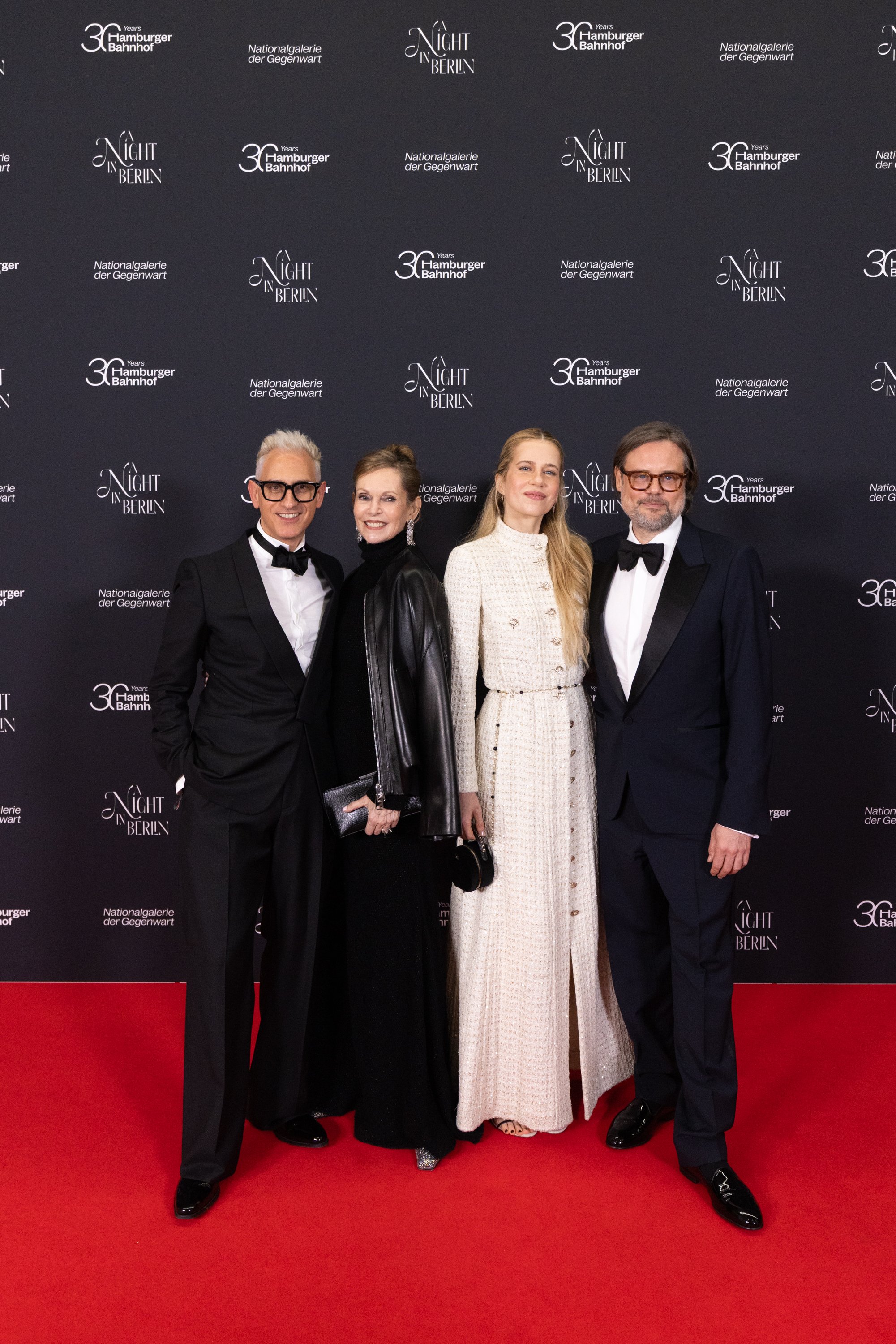
Sam Bardaouil and Till Fellrath, Directors of Hamburger Bahnhof – National Gallery of Contemporary Art, with Monique Burger and Christine Wuerfel-Stauss, Members of the Leadership Council of Hamburger Bahnhof International Companions eV © Hamburger Bahnhof – National Gallery of Contemporary Art, Ivan Erofeev
Berlin’s “Hamburger Bahnhof – Nationalgalerie der Gegenwart” is attempting to respond to the dramatically changed situation by seeking new, supposedly more reliable partners to fund the institution. To this end, a lavish American-style charity gala entitled “A Night in Berlin”, complete with red carpet, was organised in March. Guests included film stars and international art luminaries such as Cate Blanchett and Olafur Eliasson as well as influential collectors. “Fundraising as usual,” say some – “going to bed with the Happy Few,” say others. The museum’s current exhibition speaks volumes and demonstrates that such questionable endeavours do indeed have consequences, made clear in the recent programming at “Hamburger Bahnhof”. In collaboration with Chanel (!) Lina Lapelyte’s installation “We Make Years Out of Hours” has been realised in the large main hall of the former railway station. 400,000 wooden cubes, each measuring 10 x 10 x 10 cm, are piled on the floor, which visitors and performers are free to arrange into whatever shapes they choose. A senseless game of pushing blocks around is on offer, a bit of fun for fun’s sake – but is this really an ‘open work of art’ (Umberto Eco) or merely a performative form of occupational therapy distracting people from their real problems? In any case, ‘We Make Years Out of Hours’ cannot be understood as a ‘culture of outrage’ in Wolfram Weimer’s sense.
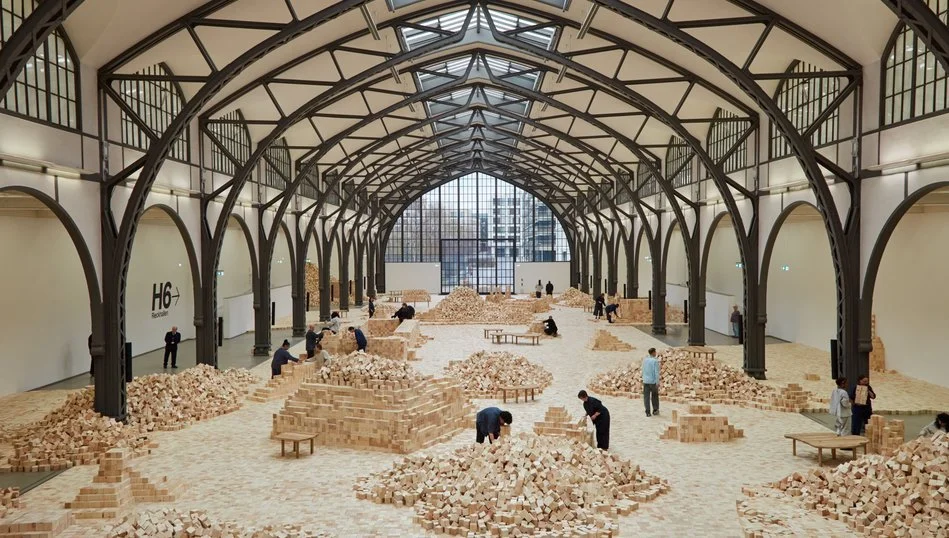
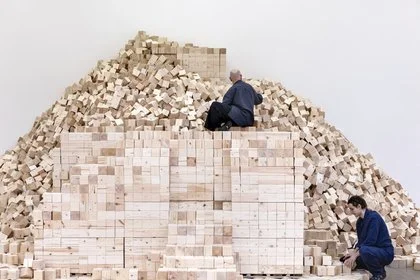
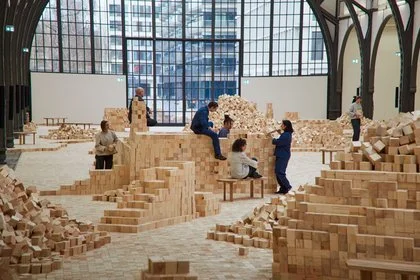
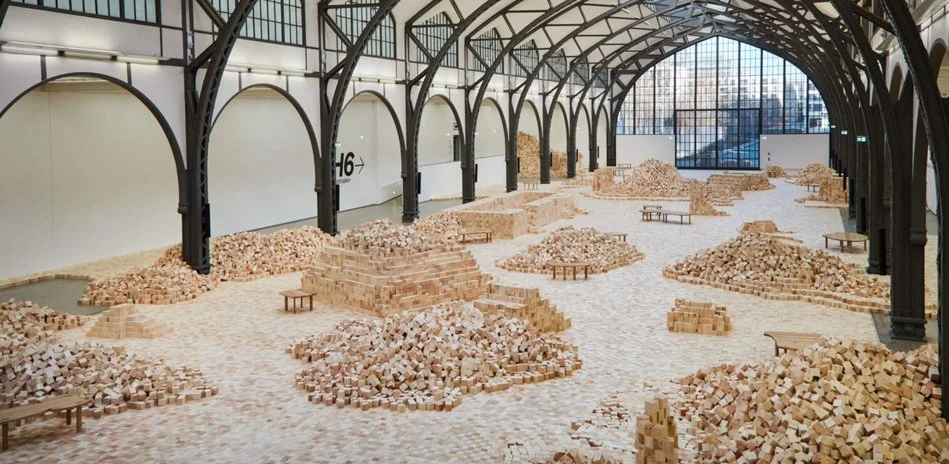
Lina Lapelytė. We Make Years Out of Hours, exhibition view Hamburger Bahnhof – Nationalgalerie der Gegenwart, Berlin, 2026 © Lina Lapelytė. VG Bild-Kunst, Bonn 2026. Photo: Staatliche Museen zu Berlin, Nationalgalerie / art/beats, Florian Mag
Surprisingly, the German Pavilion at this year’s Venice Biennale has also been designed entirely in line with the Minister of State for Culture’s vision. According to the pavilion’s website, the artists Henrike Naumann, who passed away a few weeks before the opening, and Sung Tieu aim, with their installation ‘Ruin’, to reflect on ‘the aftermath of a once-divided country and the socio-political upheavals from the post-reunification years of the 1990s to the present day’. For this project, Sung Tieu transformed the pavilion’s exterior to resemble a GDR prefabricated concrete building, whilst Henrike Naumann painted the interior mint green – the colour used in the Russian army barracks in East Germany.
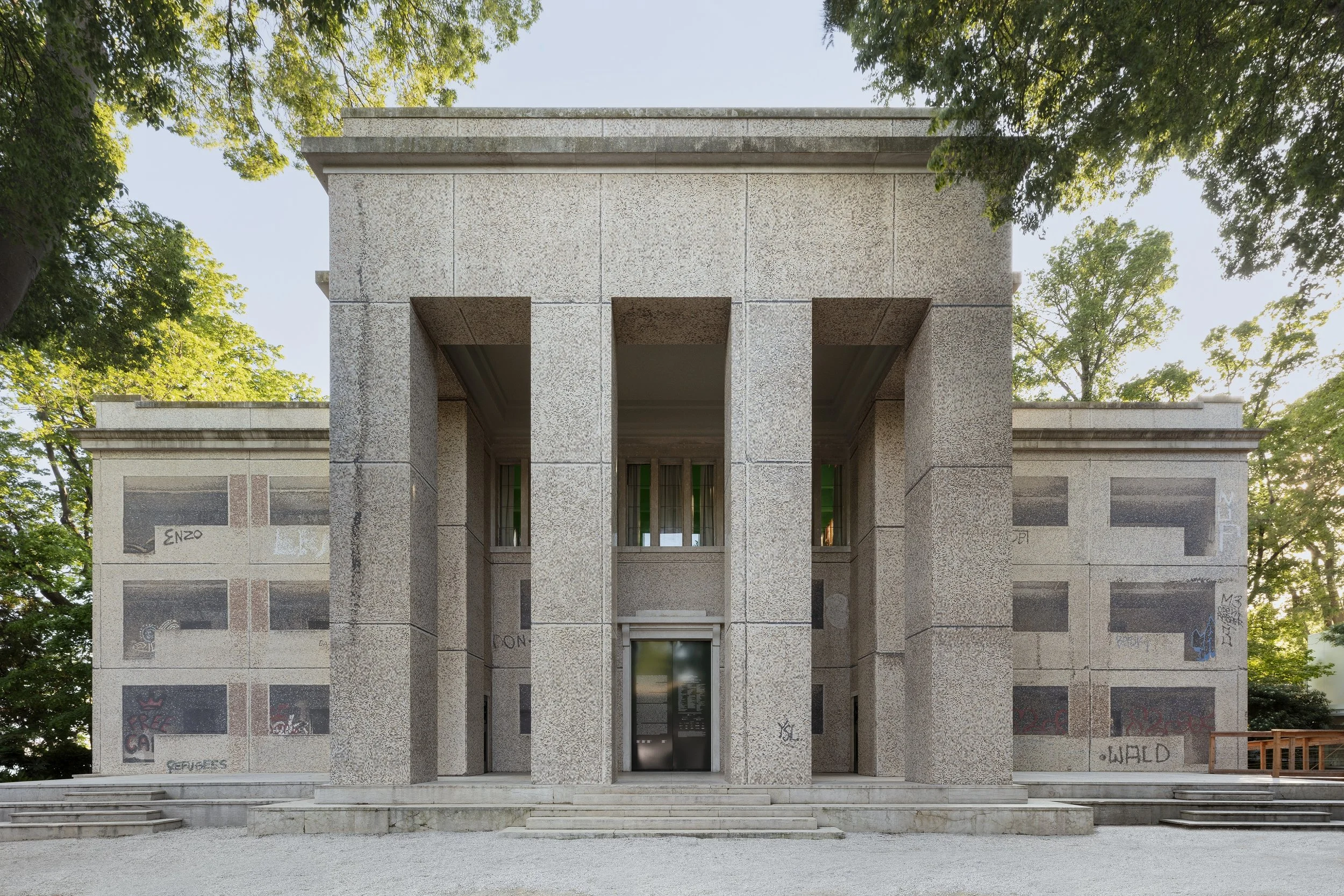
Sung Tieu, Human Dignity Shall Be Inviolable, 2026. Courtesy the Artist. Photo: Andrea Rossetti
Naumann then hung items such as halved chairs on the wall; arranged like a timeline in a design museum, intending to make history legible through the medium of furniture. Both artists grew up in the GDR and incorporate autobiographical elements into “Ruin”; Tieu displays glass casts of her mother’s hands and feet, intended to allude to the heavy physical labour her mother was forced to perform for years in the GDR. With her performance “Trümmerfrauen”, Naumann draws a connection between the founding of the GDR and the “Third Reich”, with the “Trümmerfrauen” symbolising the heroic clearance of war damage in Germany following the Second World War. The fatal flaw in the conception of “Ruin” is that the themes of globalisation and postcolonial reality – immensely present and decisive factors in Germany’s history in the 20th and 21st centuries – are treated as merely peripheral. Thus, whilst the history of Vietnamese guest workers in the GDR is briefly touched upon in “Ruin”, it is dealt with in a highly abbreviated manner solely from the perspective of “exploitation by the authoritarian state regime”, that is, primarily embedded within the thoroughly negative critique of the “workers’ and peasants’ state” that pervades “Ruin”. As a result, this concept aligns perfectly with Wolfram Weimer’s vision of a culture of remembrance, which focuses on the Nazi era and the SED (Socialist Unity Party of Germany) dictatorship but, unlike his predecessor Claudia Roth, explicitly excludes postcolonial themes. Weimer was quick to praise the German Pavilion “as a highlight of this year’s Biennale” (www.kulturstaatsminister.de/service/mediathek). He certainly could not find any “left-wing alarmism” here. This is also because, unlike the Austrian Pavilion, the German Pavilion did not close its doors in solidarity with the pro-Palestine demonstration that took place during the ‘Professional Days’ in Venice, but instead dutifully carried on with business as usual. Such a timid stance is unfortunately typical of a large section of the German art world.
Raimar Stange works as a freelance critic and curator based in Berlin and currently focuses on topics such as right-wing populism and the climate crisis.
Double-click to edit...