Recognition – Curiosity – Community
Erlend Hammer
In visual artist Birgitte Sigmundstad’s excellent 2025 documentary The New Museum – about the long, drawn-out process of constructing and re-opening the National Museum in Oslo – there is a remarkable scene. The Danish art historian Karin Hindsbo, who was director of the museum from 2017 to 2023, is in a meeting with a group of curatorial staff and is trying to understand the procedure of whether the museum should contain two or three “French rooms” when the museum reopened. Hindsbo repeatedly asks how the decision on this is made. Her difficulty understanding the decision process is very interesting because of how it shows how excessive bureaucracy clouds how the “curation” of the museum's collection has taken place over the last few years. The same year that Sigmundstad’s documentary came out, this very question would become exceedingly obvious and relevant.
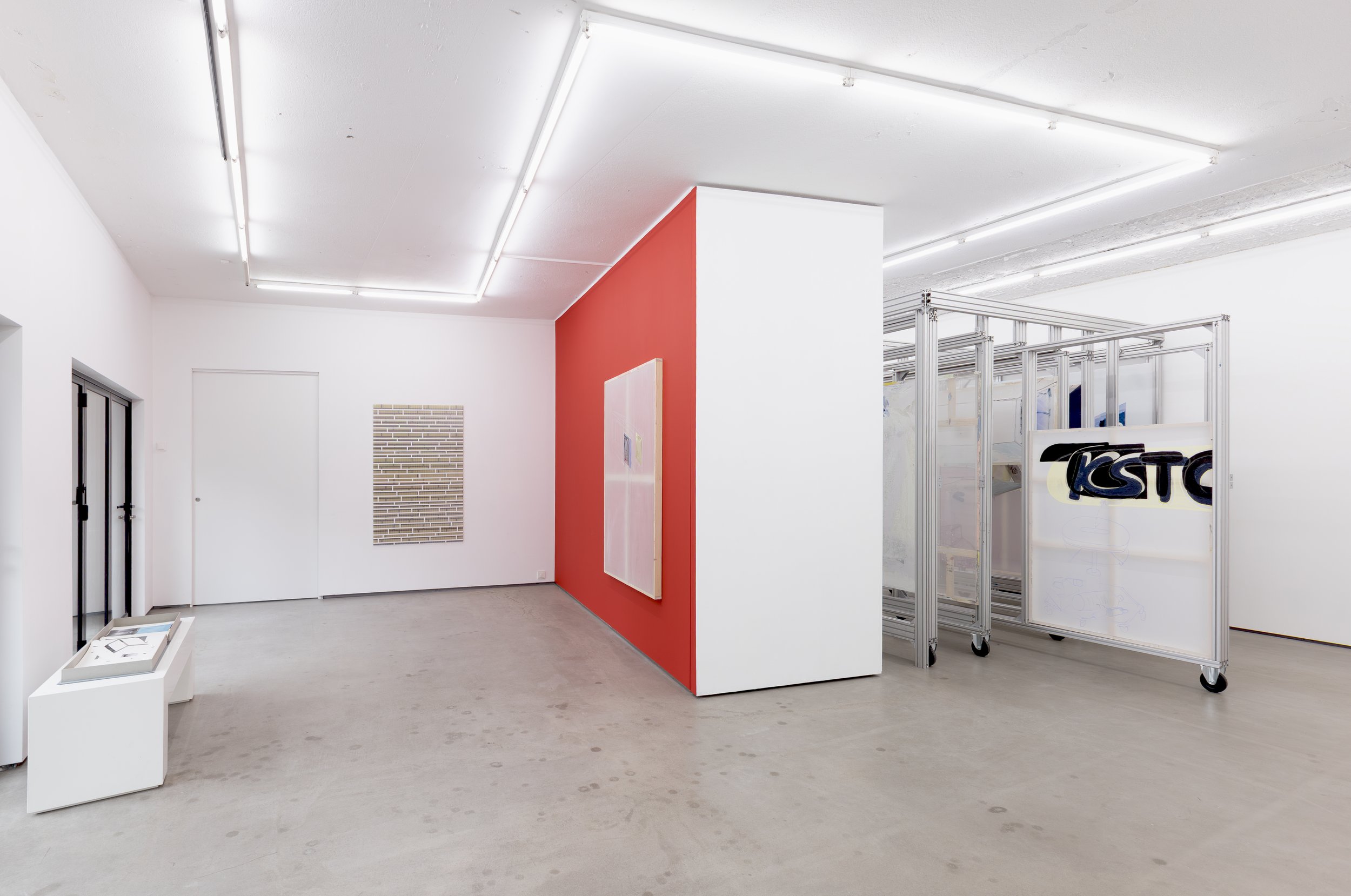
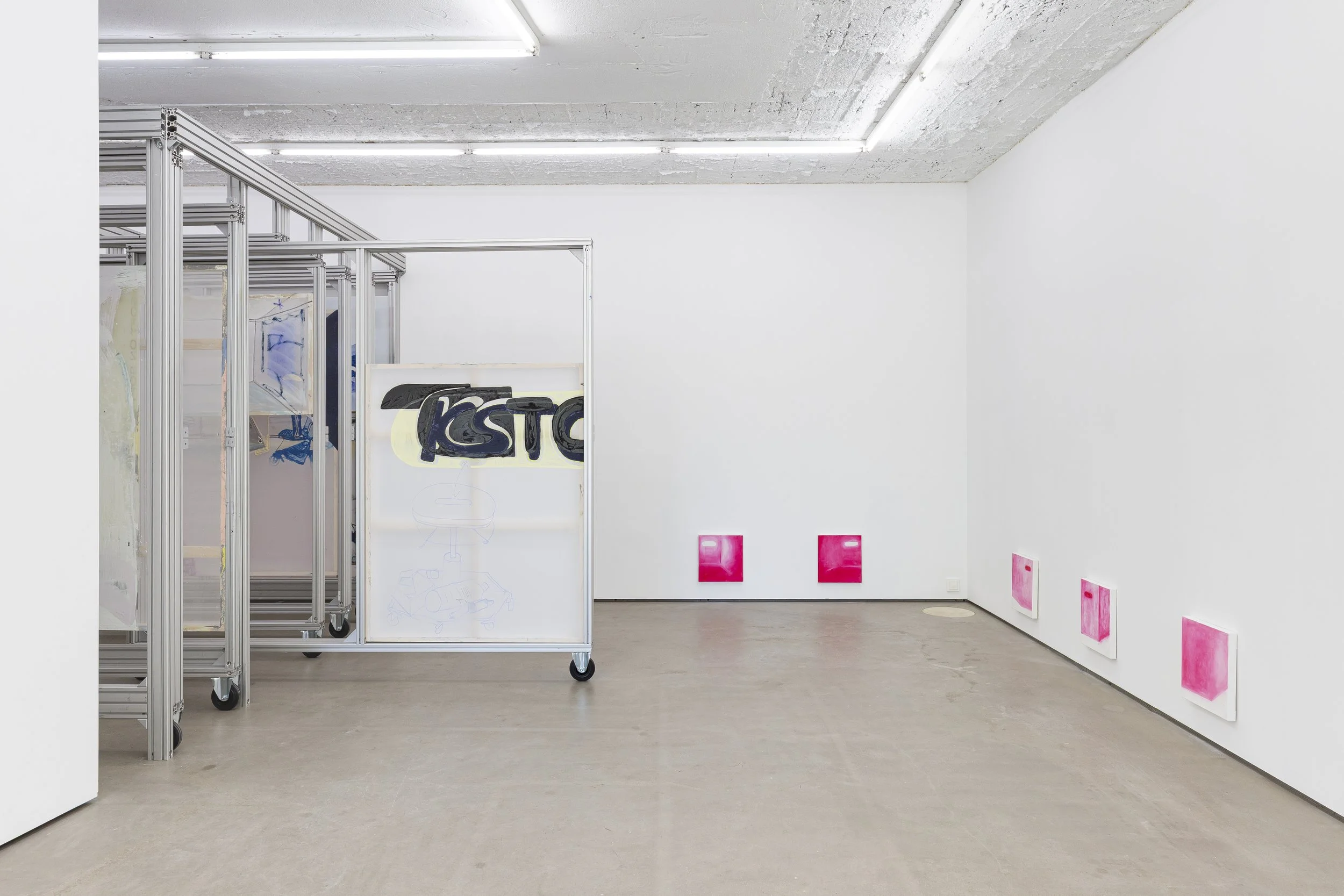
Installation images from LNM, Oslo and the exhibition named Anerkjennelse – Nysgjerrighet – Felleskap (Recognition - Curiosity - Community). From left to right: work by Øystein Aasan, Wenche Gulbransen, Victor Lind, Joel Billekvist, Clara Claussen. Curated by Randi Thommessen in dialogue with Øystein Aasan, May-June 2026. Photos: LNM
The current exhibition at LNM (Norwegian Association of Painters) in Oslo takes this problematic as its starting point. The show’s title, Recognition – Curiosity – Community, refers to the “core values” of the National Museum, and positions the show as a commentary on an extremely bitter conflict that throughout 2025 seemed to be tearing the museum apart from the inside. The exhibition’s most important gesture is not internal to the works, but institutional, reflected primarily in the title. LNM, a small artists’ association with limited means, places itself in direct critical relation to the mammoth institution down the street. This is the David and Goliath structure of the exhibition: not an attempt to overpower the National Museum, but to expose how fragile its language of values becomes when tested against its own actions.
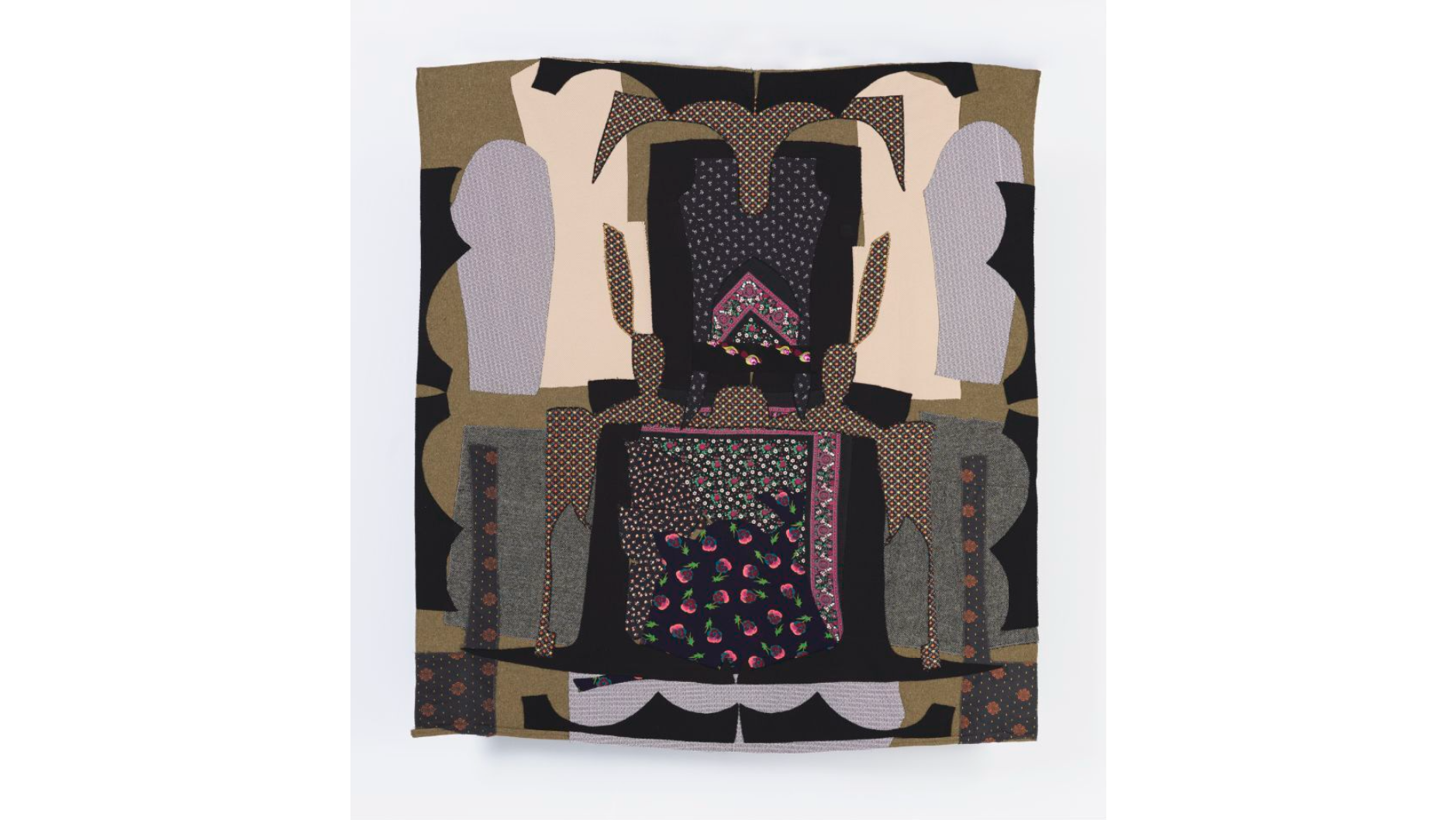
Noa Eshkol, Mourning Carpet (After the Ma’alot School Massacre), 1974, Nasjonalmuseet, Norge
The conflict at the museum that exposed this to an unusual degree began with the slight re-hanging of one specific room in the museum collection’s Room 76, where in May of 2025 the decision had been made to include the 1974 work Mourning Carpet (After the Ma'alot School Massacre) by the Israeli artist Noa Eshkol. Room 76 bears the title “On the Barricades,” and most of the works on display are by mainly Norwegian leftist artists from the 1970s, based on issues like anti-imperialism, opposition to war, feminism, and socialism, with artists such as Kjartan Slettemark, Per Kleiva, Victor Lind, Morten Krogh, and Wencke Mühleisen. On the Norwegian left, support for Palestine has been extremely strong ever since the Six-Day War in 1967. The reaction to including this work, seemingly very much in opposition to the general logic of the room, both internally and from the outside, was immediate and very strong.
After the horrific attacks by Hamas on October 7, 2023, it quickly became clear that Israel, already a supremely dominant military power having occupied Gaza and the West Bank for decades, was about to respond to the attack in a way that could hardly be called proportional. In April 2024, an anonymous group of employees at the National Museum called for support to be shown for the Palestinian people, whose cultural heritage was in danger of being wiped out by the Israeli bombing of Gaza. In May 2024, yet another new director (Ingrid Røynesdal, a graduate in political science with no experience from the visual arts) and then chair of the board, Maria Moræus Hansen, responded by saying that the museum should not be political. One should not mark support for Gaza's Palestinian population, as this would be to go beyond the museum's mandate. Many immediately responded that this seemed to contradict how the museum facade had been covered in yellow and blue lights as a response to Russia’s invasion of Ukraine in February of 2022.
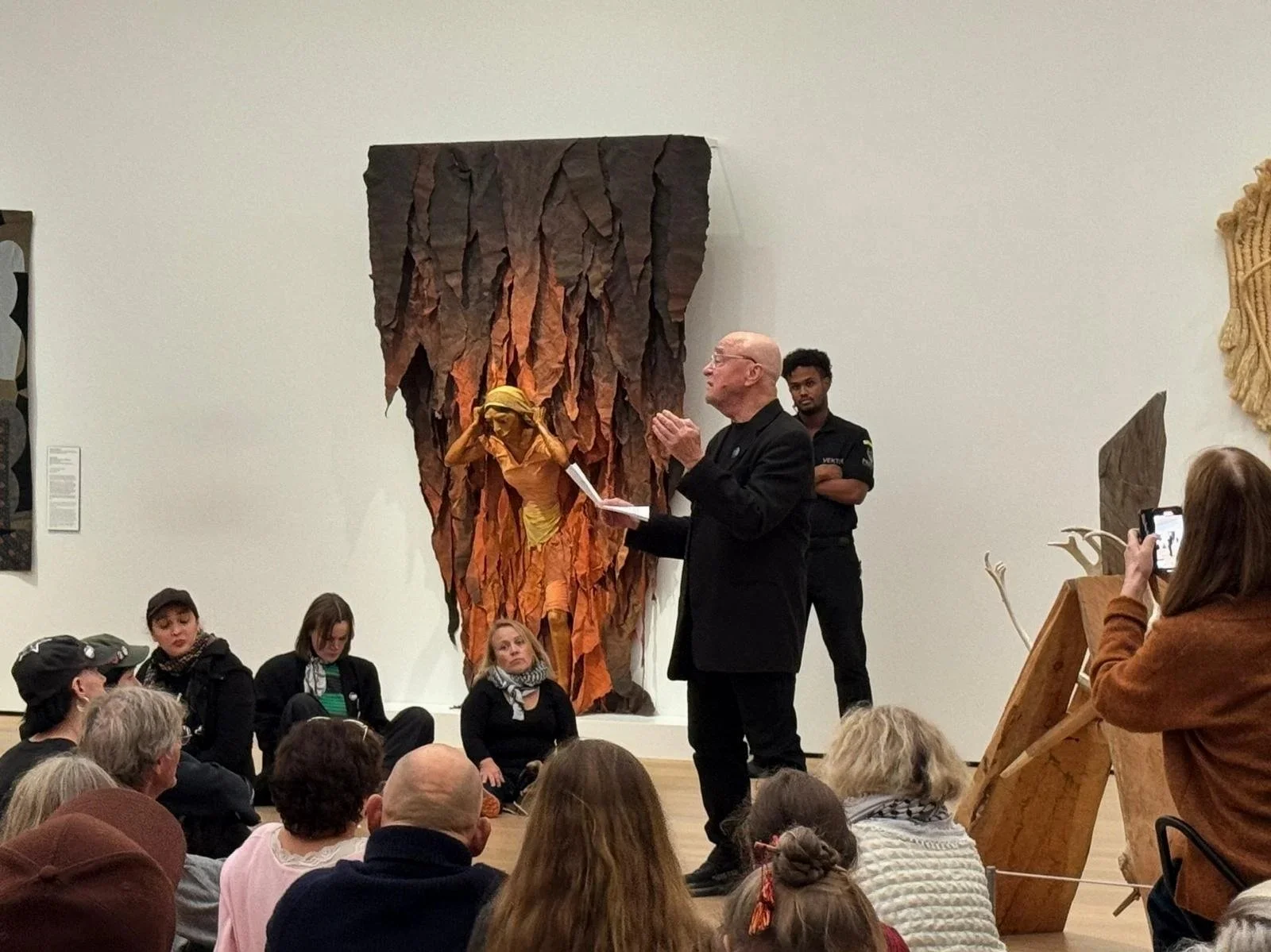
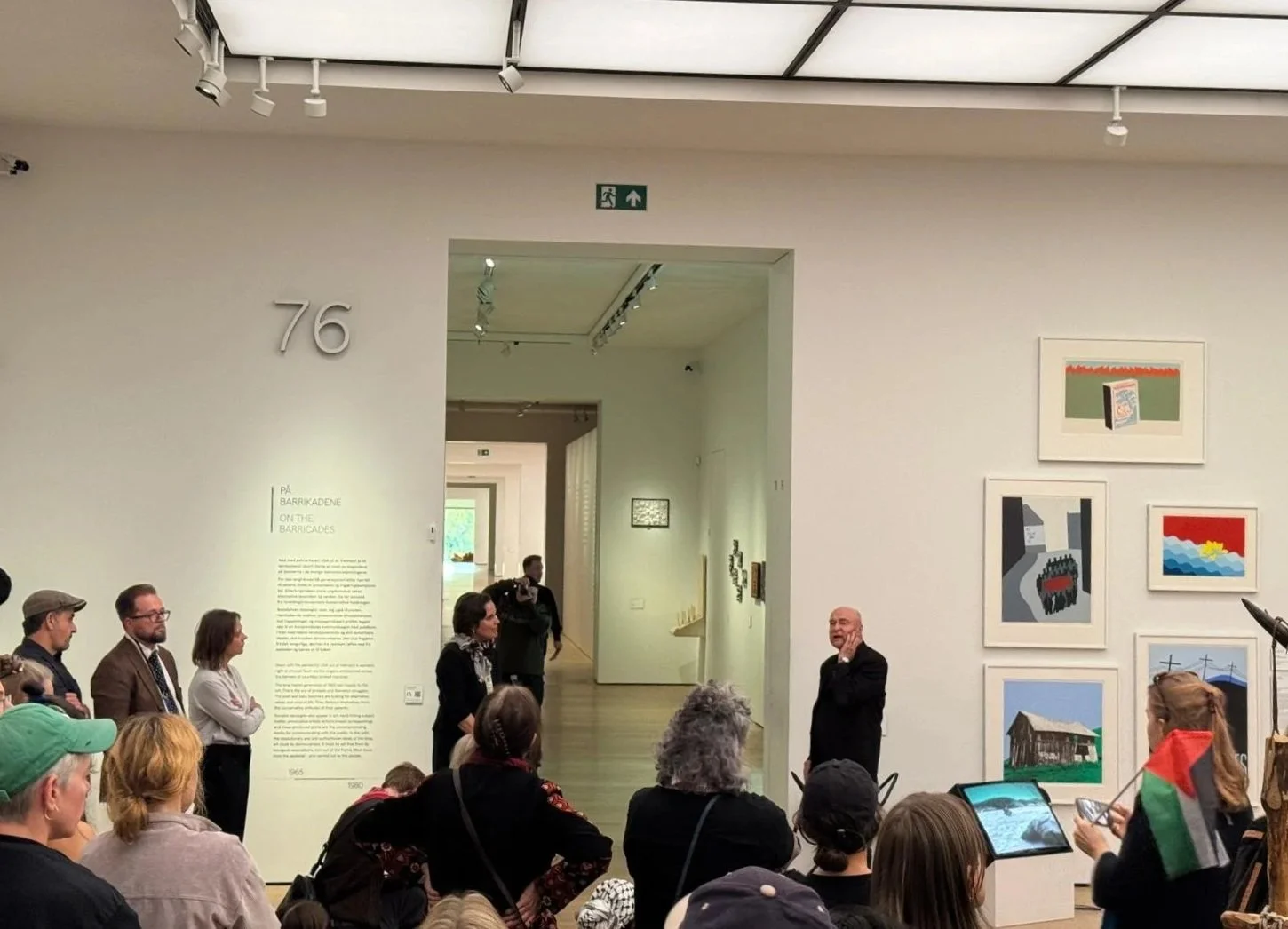
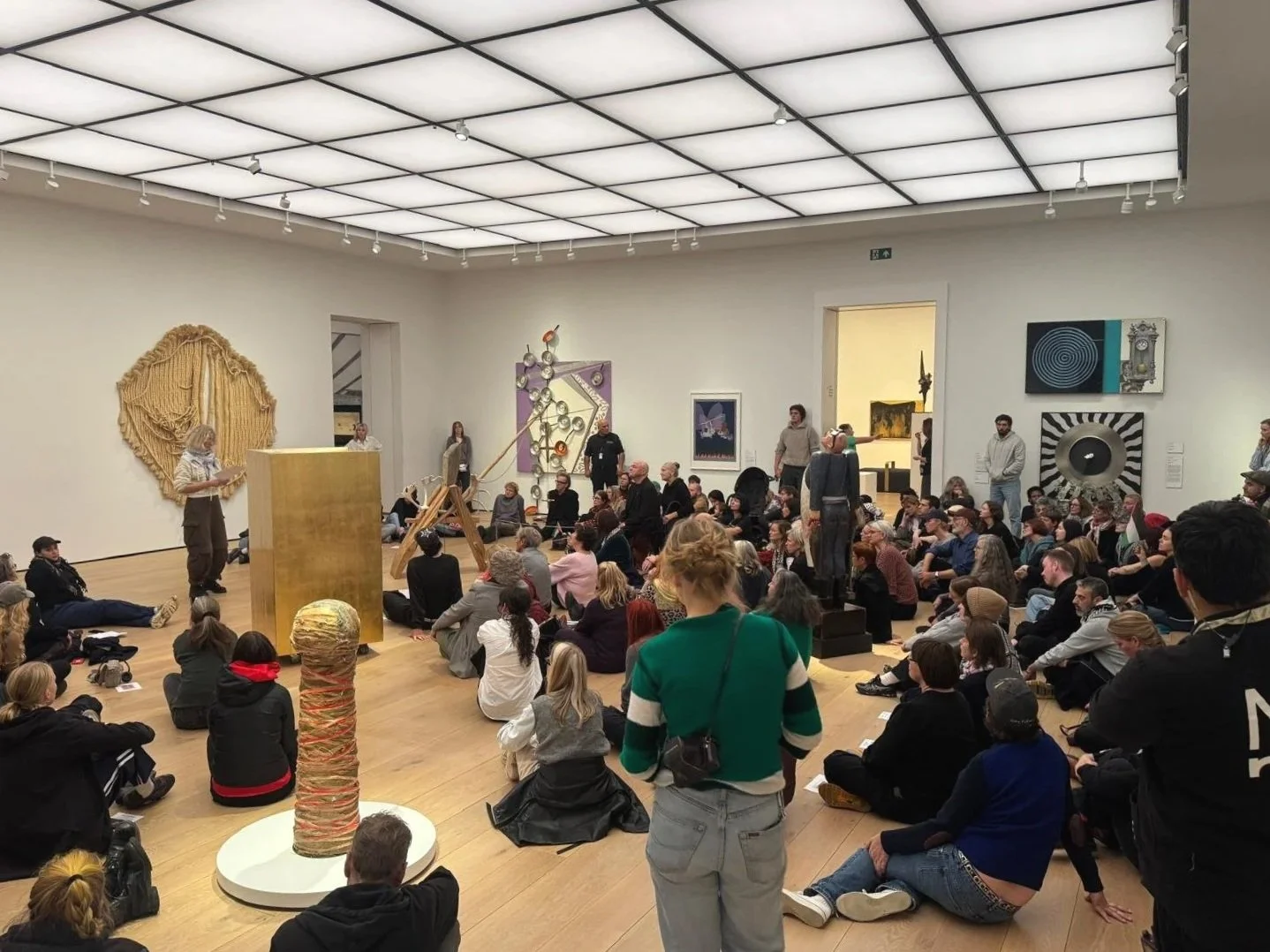
Images from the protest and sit-in at the National Museum in Oslo in Room 76. In the first image artist Victor Lind address Ingrid Røynesdal. Images by Erlend Hammer
So, when the museum had carried out the rehanging of Room 76 by replacing a work that needed conservation with a work by an Israeli artist that thematizes a Palestinian attack on the town of Ma'alot in 1974, this immediately provoked strong reactions. Not least there was fervent criticism that the wall text accompanying the work stated that Eshkol was born in Israel, a country which did not yet exist in the artist’s birth year, 1924.
The resistance culminated in a sit-in protest at the museum on 9 October 2025, where the artist Victor Lind, who is Jewish and whose work in large part involves the Norwegian branch of the Holocaust, as well as several other artists, art professionals, and activists objected to how Eshkol's work had been placed into this context. The protesters demanded an explanation from the museum: after almost a year of requests from a great number of employees at the museum (and other Norwegian art professionals) that the museum should rather mark support for Palestine, how could this Israeli work suddenly appear in the collection presentation instead? It seemed like a deliberate provocation, and wasn't this doing exactly the opposite of what the director and chair of the board themselves had said should be the museum's position as “apolitical?” The group demanded that the museum explain how this could have happened. In reality, however, almost everyone who was there already knew the answer.
In an investigative piece co-published by the journals Museum and Kunstkritikk on 21 October of 2025, we gained new insight into the internal discussions that had been going on at the National Museum in relation to the Eshkol work, specifically the wall text that originally accompanied the artwork, i.e., the one that claimed Israel as Eshkol’s birth country. What constitutes Israel's borders is obviously such an inflammatory question that no one should be surprised that this claim would provoke strong reactions. Several employees at the museum were aware of this, and the issue was discussed through an internal correspondence consisting of some 300-400 emails about the labels in Room 76 throughout the spring of 2025. In these leaked emails, several employees from the museum stand out, and one is curator Ingvild Krogvig.
The discussion appears geared toward following the institution's usual practice: “neutral,” “apolitical,” “academic.” Curator Elsebeth Kjerschow summed it up as follows: “When it comes to place of birth, don't we follow the rule that we use the current term for a geographical area, i.e. Israel?” Krogvig’s public positioning over many years makes it difficult to read her role in this discussion as politically neutral. She has voiced her skepticism of Islam on social media repeatedly and not least what she believes to be the left's “complacency” in the face of “Islamic fundamentalism.” Her right-leaning stance does not disqualify her from curatorial work, but it complicates the museum’s claim that the process itself was merely procedural. We have seen the Facebook updates on such topics for fifteen years, if not more.
What’s significant is simply that this was the piece of the puzzle missing from the conversation about Room 76. More importantly, it was essential to what the leadership of the museum refused to acknowledge: because what this situation made clear was that the same bureaucracy that had confused Karin Hindsbo could seemingly also allow for a single curator to push through their own agenda. As a result “the museum” had to commit to an idea whose consequences had not been sufficiently considered. What makes this even more pressing is that this was not the first time this particular curator had centered their own political agenda within the setting of the museum. It also happened in 2016 when Krogvig criticized the strongly leftist 1970s artist group GRAS, several members of which are represented in Room 76, in connection with an exhibition devoted to more conceptual art practices of the same era.
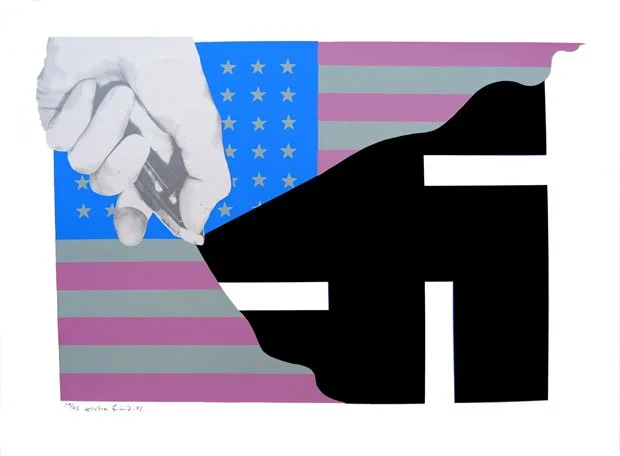
Victor Lind, USA – 71 - 1971. Image from the website of GRAS
The National Museum’s leadership’s profoundly avoidant take on acknowledging this fact was more troubling than having the work installed in the exhibition in the first place. In a debate at Kunstnernes Hus on 5 November 2025, the museum's Director of Education and Visitor Experience Rikke Komissar had the unfortunate task of trying to answer for the choice to include Eshkol's work in the museum’s presentation. She mostly repeated the claim that the museum curates according to many criteria, and that there was nothing unusual about Eshkol's presence in Room 76. The museum had simply “not been good enough at communicating the work”— as if knowing more about the complexity behind the work could change anything. No one was protesting the artwork, but rather the curatorial act, no matter how vague or subconscious, of placing the work in the collection exhibition at this moment in time. No curatorial gesture can exist outside of a specific social or political context and this one, in 2025, was impossible not to read politically. After two years of widespread requests that the museum show support for Palestine, a work was instead installed that revolved around Israeli grief. Mounting this work was thus a very clear curatorial statement, no matter how “ambiguous” the artwork as such can be interpreted to be.
It was therefore even more absurd when the Fritt Ord Foundation's director Knut Olav Åmås and Tinius Foundation’s director Kjersti Løken Stavrum defended the museum against criticism in the conservative-leaning newspaper Aftenposten. They wrote: “What we are defending is the freedom to show art without being politically controlled. The museum is there for art and the public, not for commemorations in individual cases.” What they did not understand, or simply refused to admit, was that the Eshkol work was not hung for neutral “aesthetic” reasons, but as a political provocation, as an intervention in a very particular and already extremely toxic situation within the museum. It was a work being shown under “political control” even if this control was not consciously sanctioned by the museum leadership as such.
The National Museum, of course, could never admit to this as it would put the consequences of how the museum is organized in a catastrophically bad light. Just as Hindsbo was unable to understand the decision-making processes behind whether the new museum should have two or three rooms devoted to French art, Room 76 shows that the museum's bureaucratic processes are so confusing and convoluted that, given particular circumstances, it appears to have been possible for someone within the organization to weave their way through the system with their own agenda without anyone noticing and stopping it.
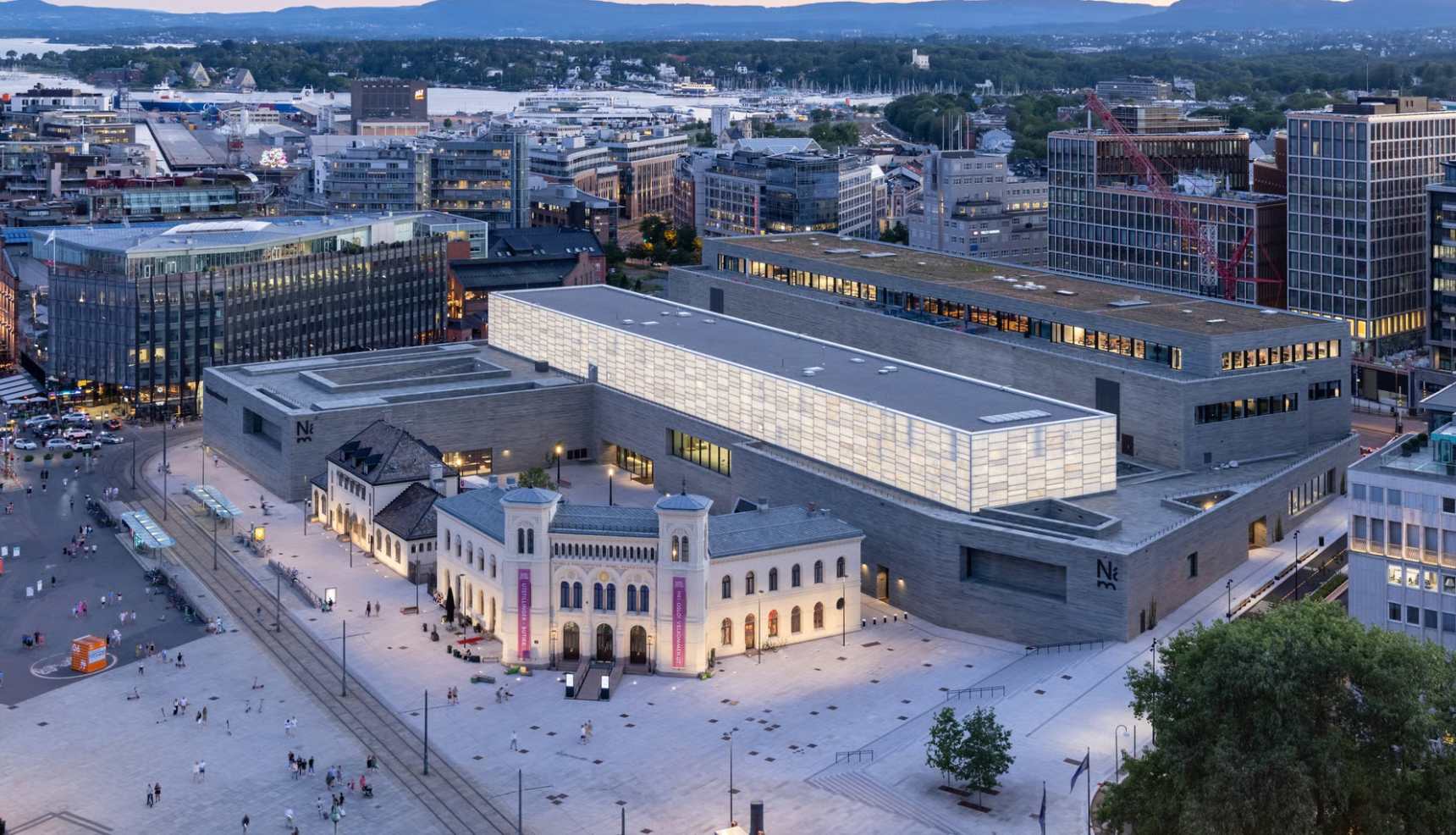
The National Museum in Oslo. Image: Iwan Baan
I don’t think the solution to this problem would be an even stronger bureaucratic streamlining of the curatorial model of "collective sender". A better solution may be, as Anne Szefer Karlsen (Professor of Curatorial Practice at the University of Bergen) stated in the debate at Kunstnernes Hus, that the museum simply needs to allow its curators to have a much clearer singular vision for the exhibitions they make. This would also turn the museum into more of an arena for a genuine, rather than illusory, exchange of ideas. The bureaucratic collectivism of pretending to be able to speak with a single voice counteracts the ideals of its purported core values: recognition, curiosity, community.
Finally, and most importantly, we know that the process of including Eshkol in Room 76 occurred during a period when the National Museum's former director of collections, Stina Högkvist, was on her way out of her position. During this months-long period there was a large vacuum in the understanding of the artworld at the museum’s top level. When the director of a museum has zero qualifications to have any form of opinion on art-related questions, this kind of extremely vulnerable situation is the result.
The saga of Room 76 appears as a bureaucratic, curatorial variant of Stanley Kubrick's Dr. Strangelove, where the system is organized so that a single individual can trigger a nuclear holocaust without leaving anyone to blame but a pulverized collective communal, abstract “subject.” “Nobody” is to blame because everyone individually is not to blame. But there is always a specific someone who initiates a process like this. In Dr. Strangelove it’s Brigadier General Jack Ripper. For Room 76 it seems obvious that it was one particular curator.
The organizational structure of a museum of this size creates a subservience to the political will of bureaucracy and public funding, of course, and this also contributes to the illusion of an abstracted collective subjectivity. The objectivity fantasy that follows from these structures remains a chimera. This came into full view in the clash that occurred in Room 76.
While neither the curation of the exhibition at LNM, nor its individual works, goes very deeply into the specifics of what happened in Room 76 over the course of 2025, it shows that a gesture as simple as an exhibition title can remind us that institutions such as the National Museum are usually founded on faulty, perhaps self-delusional, logic, and that this occasionally has real consequences. In this case, recognition, curiosity and community appear less as institutional values than as institutional décor: words that can be displayed while the structure underneath prevents them from being enacted. Recognition, curiosity, and community are illusions within an institution like the National Museum, equally as empty as the idea that it would be possible for it to structure itself into an idealized collectivist subjectivity independent of the urges and desires of its individual members.
Erlend Hammer is an independent curator and writer based in Oslo