

Fear and Loathing in Venice
Katarina Löfström
The gonzo journalist Hunter S. Thompson and his sidekick/doctor/healer/dealer, played by Johnny Depp and Benicio del Toro, are driving into Las Vegas to cover a motorcycle race, while imaginary bats swarm the car. In director Terry Gilliam’s classic film adaptation of Hunter S. Thompson’s novel with the same name, they are preparing for one of cinema’s most bombastic renderings of overindulging, overdosing, and deadline-dancing ever.
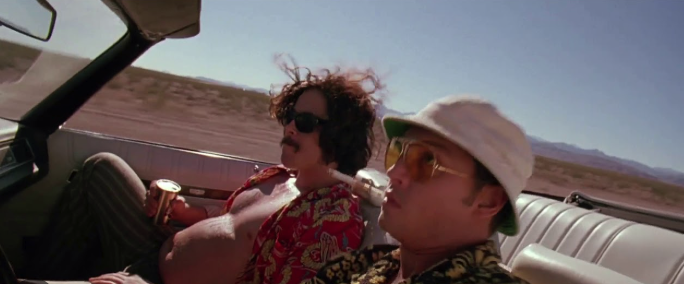
Thompson’s book from 1971 serves as a savage political satire of Nixon-era America, weaponizing drug-fueled absurdity and caricature to expose the deep rot, moral hypocrisy, and violence under the surface of the illusion of The American Dream. Their erratic takeover of the glitzy Las Vegas Strip is mocking a society that has lost its mind to greed and war.
Entering and moving through the 61st Venice Biennale in the preview days, I somehow wish I could have had whatever they were having in that car. Perhaps minus the bats.
Venice and Vegas do indeed share a taste for blunt exaggeration and spectacular forms of escapism.
To understand why this Gonzo frustration enters my mind when sifting through the Venice Biennale, one must understand the political landscape Thompson was diagnosing in 1971. Fear and Loathing was an epitaph for the death of the 1960s counterculture. Thompson wrote during the Nixon era, right when the utopian hope that peace and love could stop the war machine crashed against the reality of Vietnam. He chose Las Vegas because it was the ultimate commercial vacuum - built entirely on greed and insulated from the violence the state committed abroad.
There are many parallels: Just like the countercultural wave that rolled back, the Biennale this year represents the institutional capture of radical thought. Thompson was raging at a ruling class that could gamble fortunes on the stock market and in Las Vegas, while young people, mostly of color, were being killed in the jungles of Vietnam. The Venice Biennale holds that same moral contradiction. Institutions and galleries celebrate the lucrative participation of their artists, host prosecco parties, and cater to ultra-wealthy collectors, at the same time as global conflicts rage outside, genocidal states are art-washed, pavilions are boycotted, and democratic structures in several countries are under threat.
In the opening days, the exhibitions are filled with art professionals and wealthy dealers and players, nodding at wall texts about Marxist revolution and indigenous sovereignty, completely ignoring the fact that they are the very problem the art is diagnosing and trying to heal.
While scanning my entrance code, I smile thinking of the second part of Fear & Loathing in Las Vegas, where the protagonist walks straight into a Las Vegas law enforcement drug convention, completely strung, surrounding himself with narcs and official authority. He muses over the total ignorance of those police officers lecturing each other on marijuana and hard drugs, while completely missing the frantic journalist vibrating on prescription stimulants right in front of them.
The similarities to the situation around me in the Arsenale and the Giardini are equally amusing and excruciating. I feel like an imposter, observing people looking at people looking at art, watching what the wealthier in both cultural and actual capital endorse, post on social media, and ultimately, buy.
In Arsenale, the hallucinated bats of the sky are abruptly juxtaposed by a different shape in the sky. Where Thompson saw a swarming cloud of paranoia in the shape of bats, the entrance to this exhibition forces me to look heavenward at something entirely different; an imaginary flying white kite.
The sense of loss and death is a factor that permeates the whole exhibition, in the form of mourning the death of curator Koyo Kouoh and of the German artist Henrike Naumann, who both tragically passed away in the year before the opening. Death is present in the poem that Arsenale opens with, by the Palestinian poet and activist Refaat Alareer, written just weeks before he was killed in an airstrike.
If I must Die
Refaat Alareer
If I must die,
you must live
to tell my story
to sell my things
to buy a piece of cloth
and some strings,
(make it white with a long tail)
so that a child, somewhere in Gaza
while looking heaven in the eye
awaiting his dad who left in a blaze -
and bid no one farewell
not even to his flesh
not even to himself -
sees the kite, my kite you made, flying up above,
and thinks for a moment an angel is there
bringing back love.
If I must die
let it bring hope,
let it be a tale.
Much has already been said about the geo-political manifestations, the strikes, the demonstrations for and against the participation of certain countries. A fair amount of attention has been given the bared boobs, balaclavas, and water scooters of Femen, Pussy Riot and the Austrian Pavilion, and will not be discussed or given further attention in these ramblings. The jury dramatically resigned days before the opening in protest of the Biennale's policies; artists and pavilions have withdrawn from consideration for the so-called public prize, which was invented in the absence of the abdicating jury. These ins and outs can be read about in more depth in another article on SITE Zones.
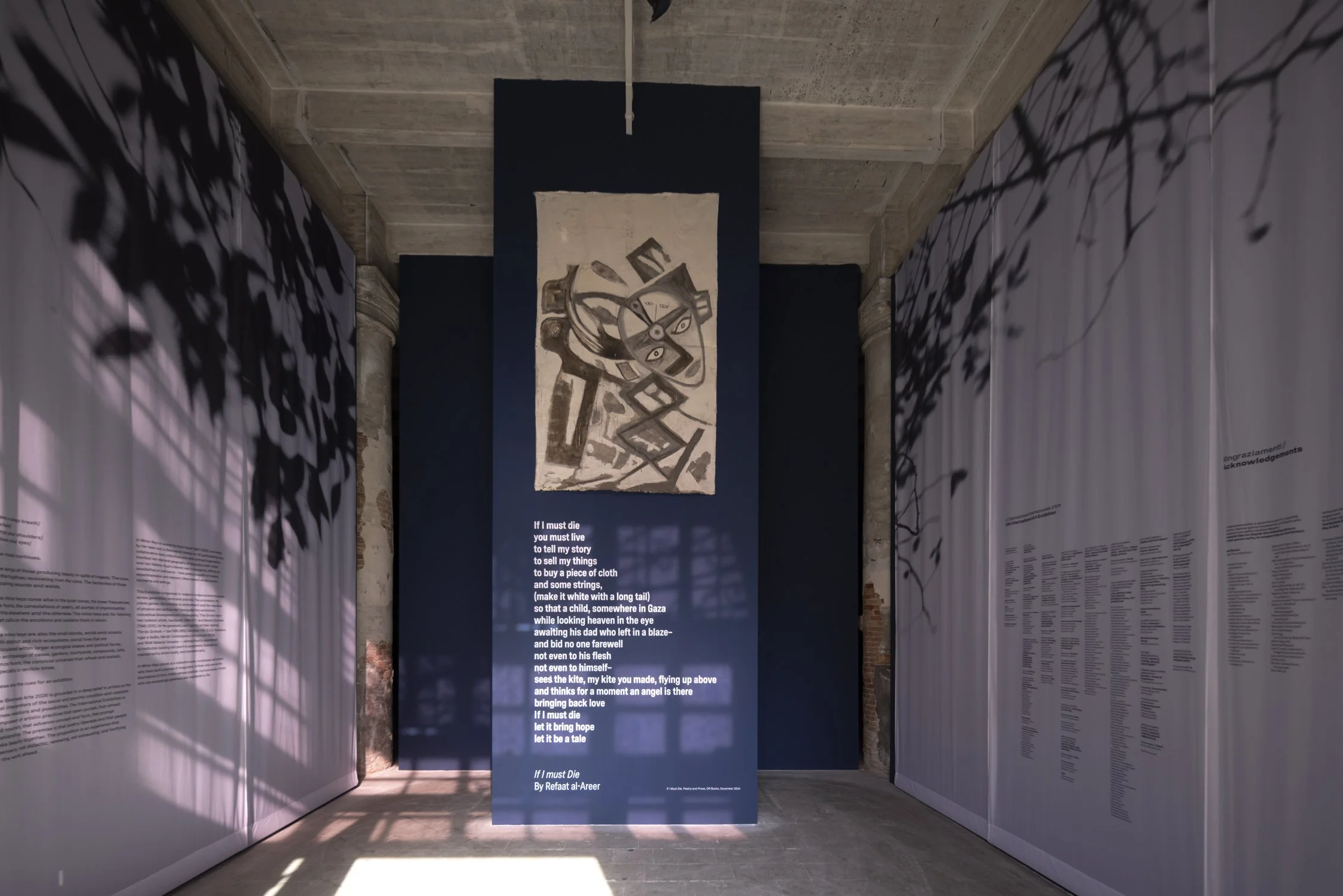
Standing in front of that heartbreaking poem covering the entire opening wall of (arguably) one of the most important art exhibitions in the world, the contrast between the title of the main exhibition – “Minor Keys” and what I’m actually seeing entering the exhibition is disorienting.
Koyo Kouoh's concept In Minor Keys, is said to be a study in "lower frequencies"—the whisper, the hum, the quiet resistance of the marginalized. Boy, do I yearn to see an exhibition like that.
Alas, walking past Alareer's poem and into the Arsenale, dodging art world players and influencers hunting for striking backdrops, the dissonance is striking. The imaginary white kite of Gaza, a symbol of basic survival, is immediately co-opted, being transformed into social media content.
Stepping into the exhibition, the "minor keys" are turned up into a loud, dissonant “major key.” No doubt does many of the works hold high artistic standard well within the parameters of the curatorial concept, but they are crammed together almost to the point of getting mixed up with each other. Wolff Architects has created smart exhibition modules made of cardboard and textiles, advised by Koyo Kouoh's ideas of polyphonic compositions shaped by motifs such as Shrines, Processions, Schools, and Oases.
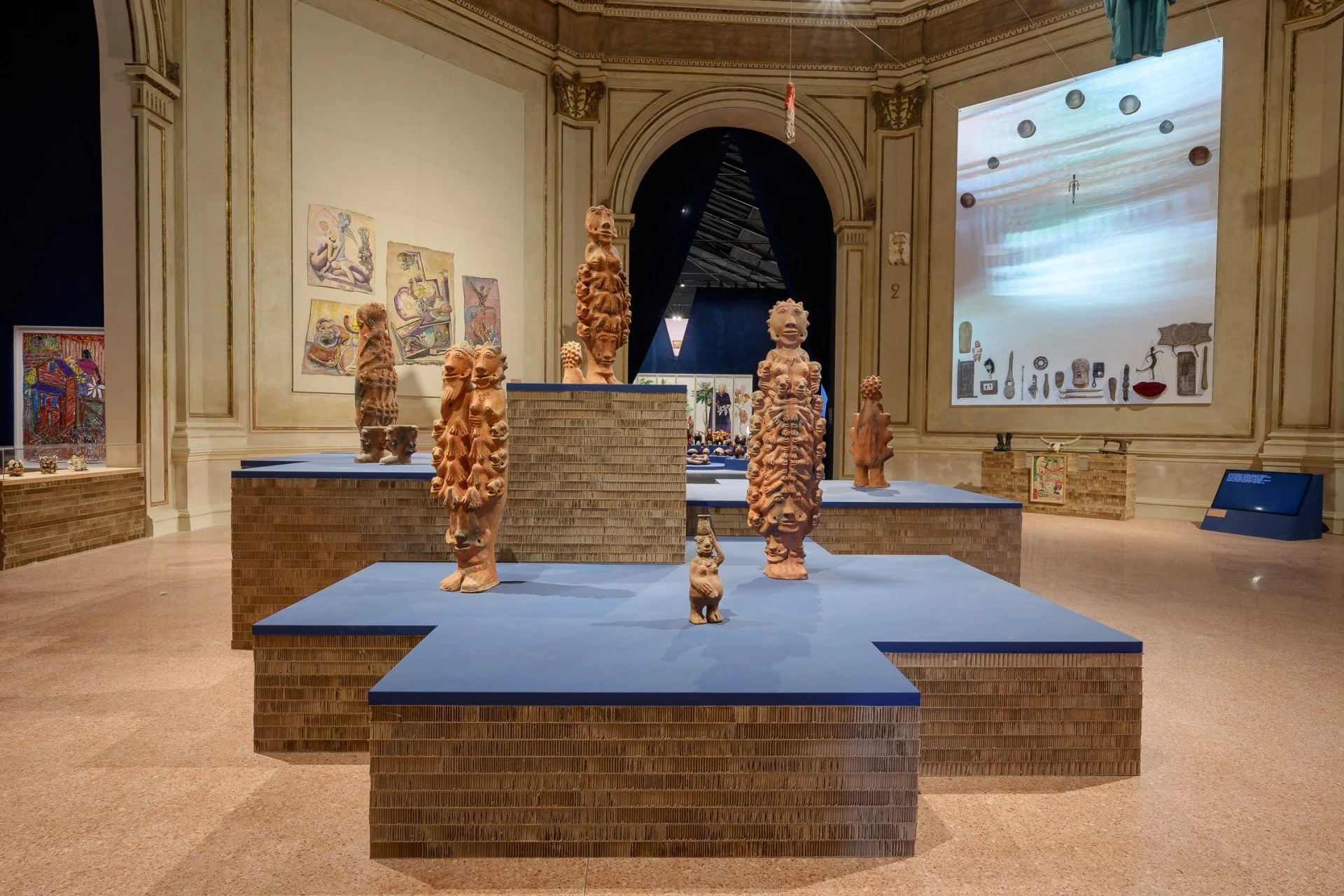
Installation in the International pavilion, Giardini - a series of untitled sculptures by Awa Camara Seyni on top of pedestals by Wolff Architectures. Photo: Andrea Avezzù, courtesy La Biennale di Venezia.
The walls, platforms, and room dividers are beautiful and smartly sound absorbing, but tend to take middle stage when they should be the backdrop for and enhancing the art. It somehow works in the Arsenale but walking through the main exhibition in the Giardini the saturated colors and textile room dividers, make the rooms look eerily like a very exclusive home-decor showroom instead of that advertised sanctuary of minor keys.
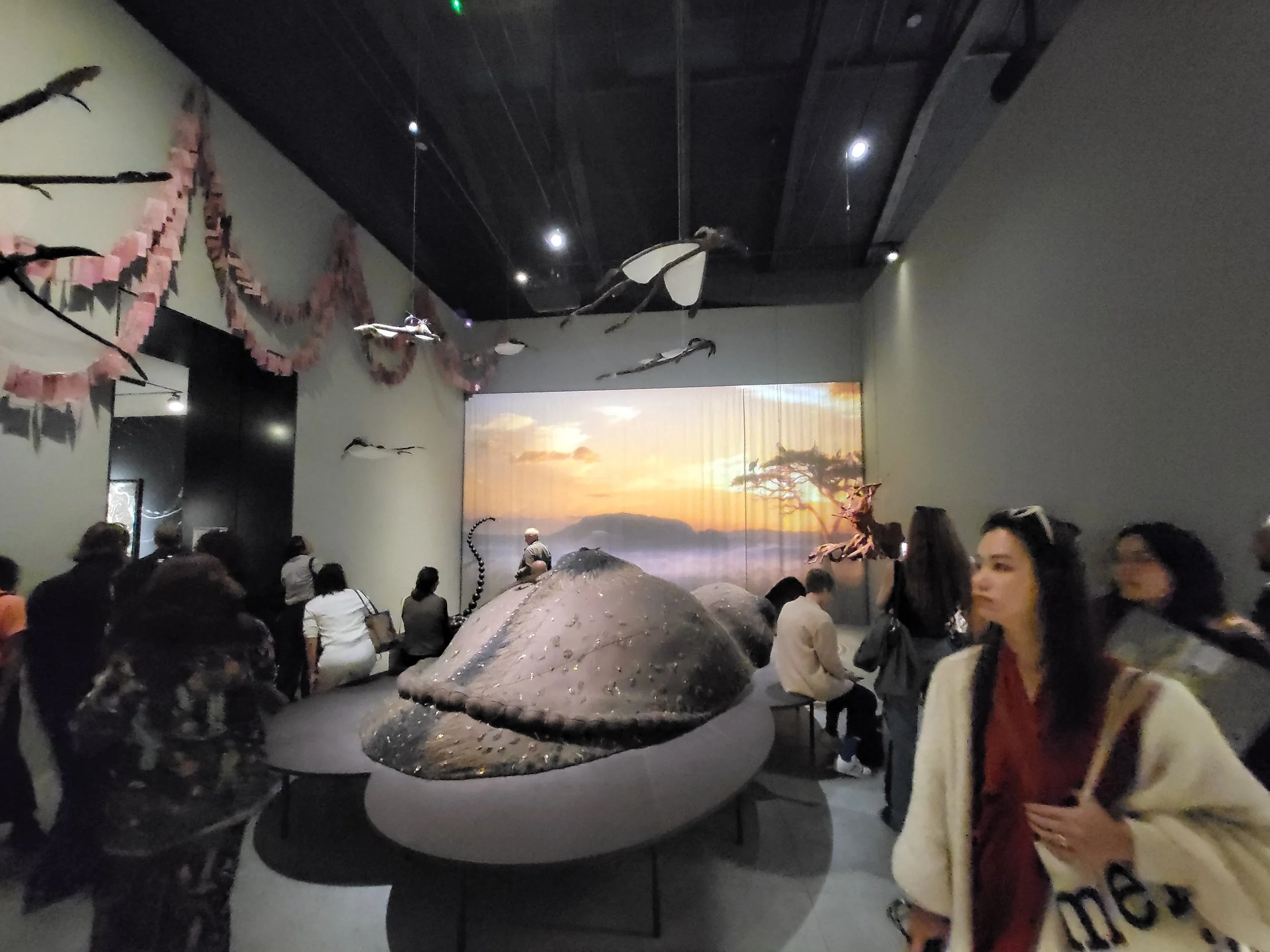
Installation image from In Minor Keys
While trying to fend off the onslaught of bats, collectors, and critics, and actually see the show at hand, my meandering thoughts go to Brian Eno. In a conversation with musician James Blake, Eno disses his younger colleague for using the so called “asshole chord,” a dissonant chord structure that offers an all-too-predictable, cheap, and disappointing harmonic resolution to a composition. Eno argues that throwing unexpected dissonances into an otherwise "pretty" or major musical progression is like adding sugar to everything you cook, not fully relying on the attentive and independent musical palette of the listener.
The team of hardworking curators trying to interpret and realize Koyo Kouoh's vision might have gone a bit overboard with their cooking on this one. Too many works, too saturated, too in-your-face, too much sugar, ends up leaving me with the sense that this show somehow lacks the self-esteem and assertiveness that it has the artistic practices and original idea to flaunt. It tries too hard.
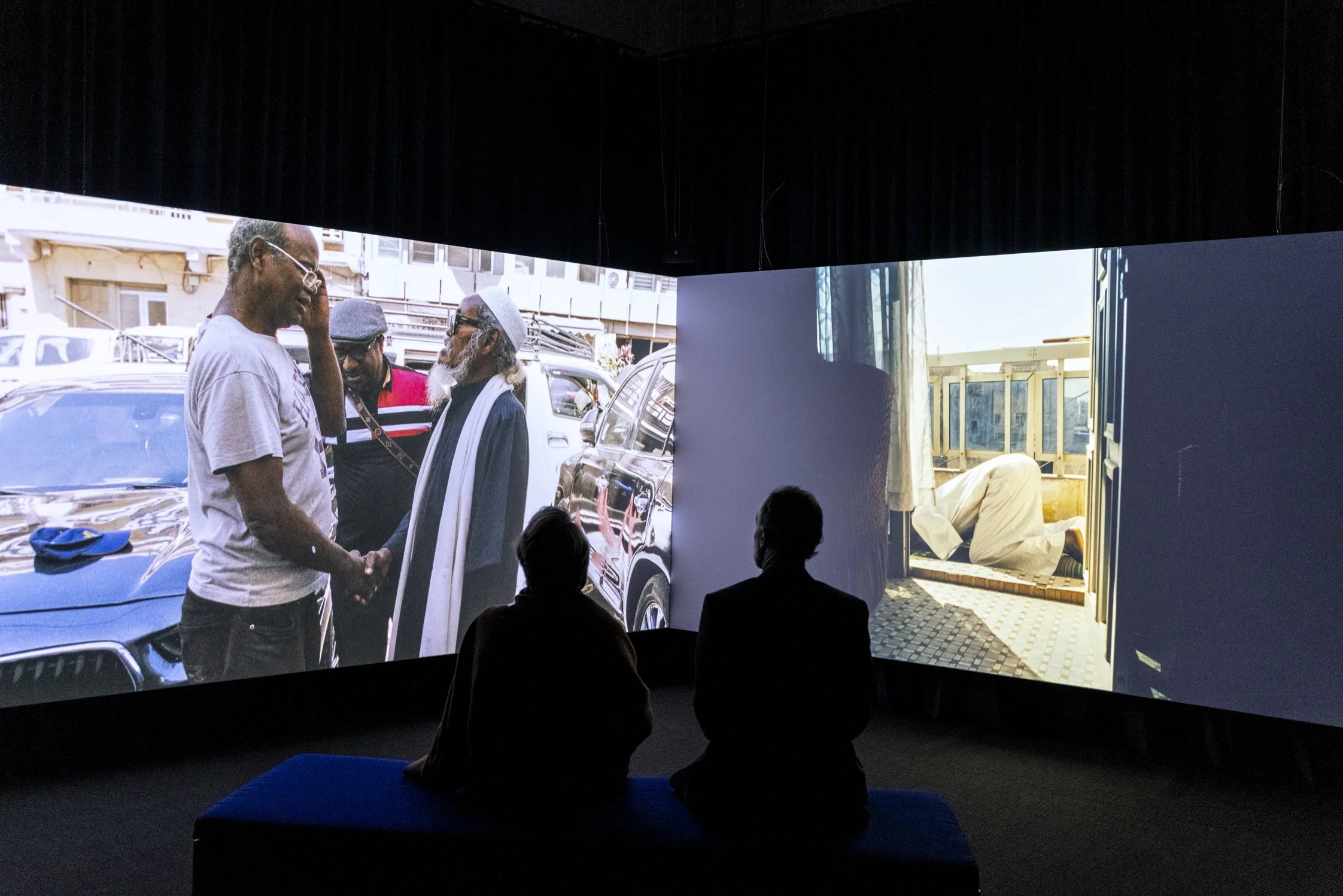
Installation shot Tuấn Andrew Nguyễn, Ñi Demoon Ñoo Delusi (Those Who Left Are Those Who Return), 2026. Photo: Marco Zorzanello, courtesy La Biennale di Venezia.
Still, I find some really nice punctuations and minor key moments in Arsenale, in the form of rooms for film- and video works. I stayed a full hour in Andrew Tuấn Nguyễn’s film installation that explores stories of the counter-history of colonialism. His work Ñi demoon ñoo dellusi tells the story of renegade “Bouba Chinois,” a mythical bandit and working-class Robin Hood figure descendant of a Vietnamese mother and a Senegalese father. Growing up seeing the racism towards the mother, Bouba Chinois rebelled against the Senegalese society in his own, slightly Gonzo-ish ways. It is a haunting, well told story of expulsion, longing, and belonging.
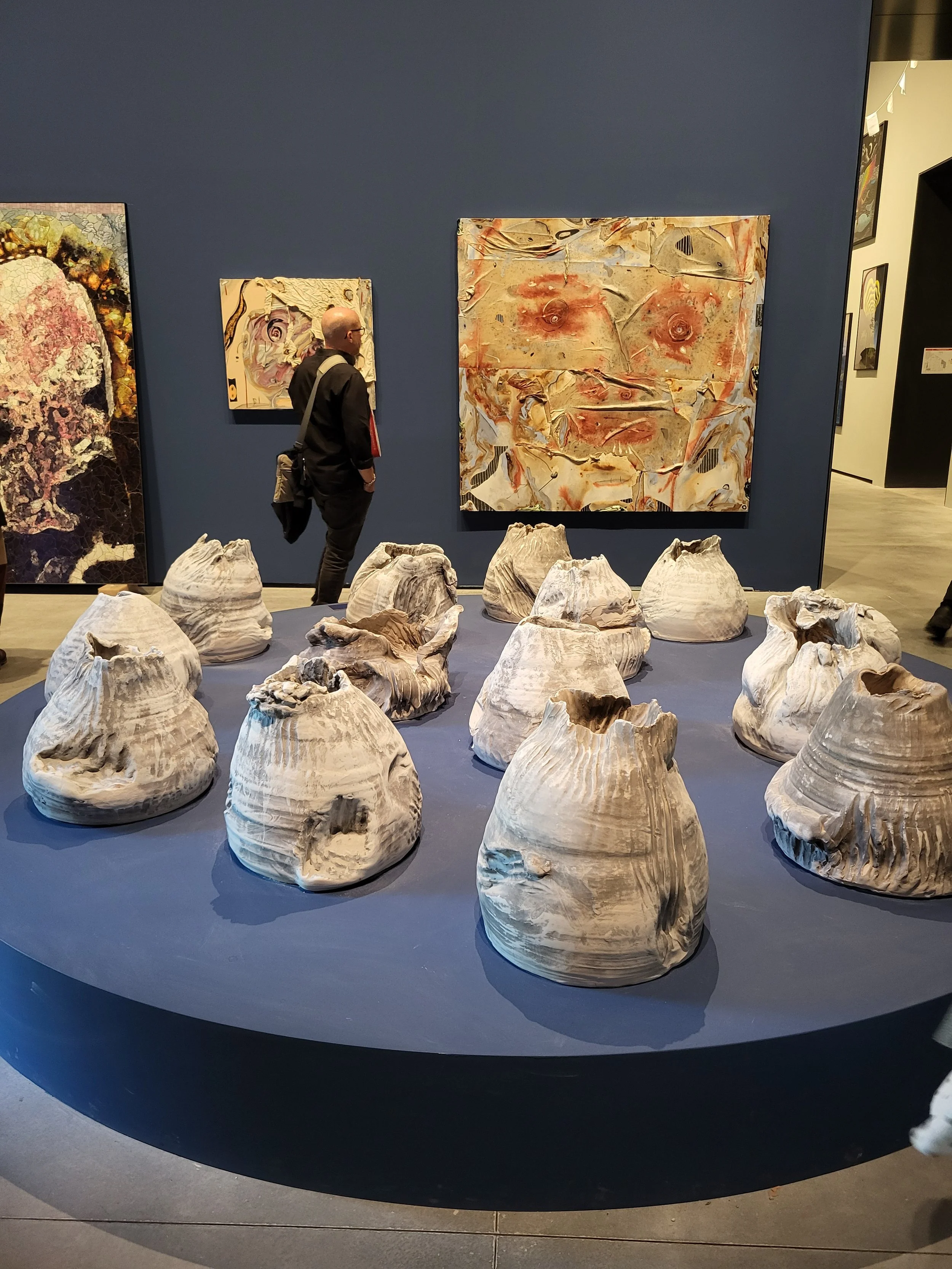
Installation image from In Minor Keys
However, as a whole, the Biennale has successfully packaged the aesthetics of trauma into luxury goods. The national pavilions function like the Las Vegas Strip - architectural and curatorial interventions to keep visitors compliant, soothed, and sometimes titillated (yes, I mean you Austria). The massive textile installations, ceramics, and draped ancestral artifacts of the main exhibitions, do not challenge power; instead comply to it. Raw global conflict and historical extraction are packaged into smooth sellables. It’s an all too effective market loop.
As an artist stuck in this curated hall of mirrors, the urge to find a vintage bottle of ether (or at least an espresso) returns. It is hard to handle the vertigo of watching revolutionary grief serve as a backdrop for a prosecco mixer. Having said that, those glasses of bubbles might have saved many an artist and curator from total meltdown trying to wrap our heads around the shows. Is it just me? Is it the art? Is it the curating? Is what I see before me a major shift from showing works of actual artistic risk and innovation, into a market friendly commodity display?
The underlying paradox of the curatorial intent stays intact. The curation talks about the power of the quiet murmur while at the same time turning up the volume to an operation that requires millions in state and corporate sponsorship, which in turn means that artists represented by wealthy gallerists or rich countries take center stage. The market welcomes a whisper if that whisper is well funded and then sells.
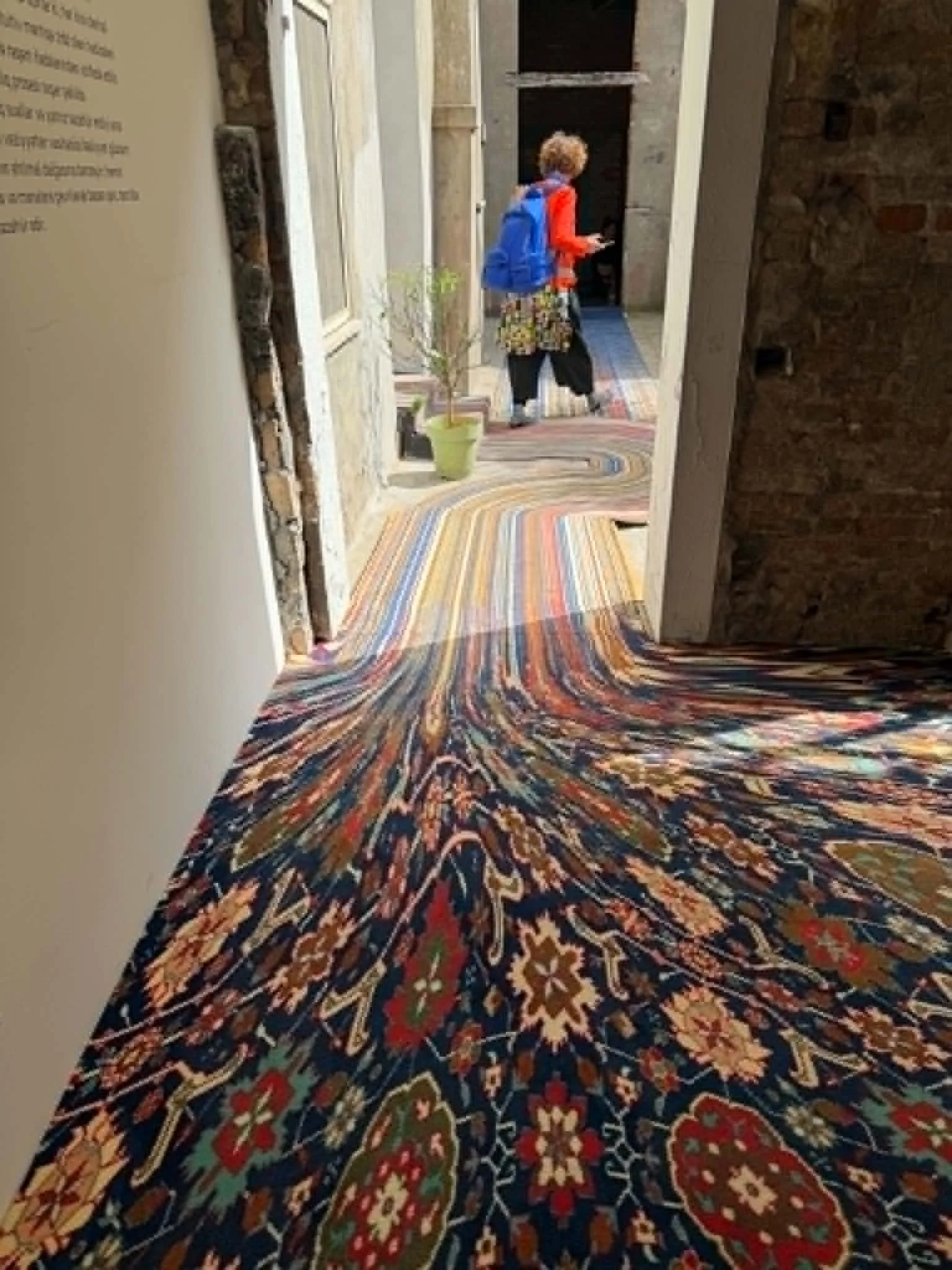
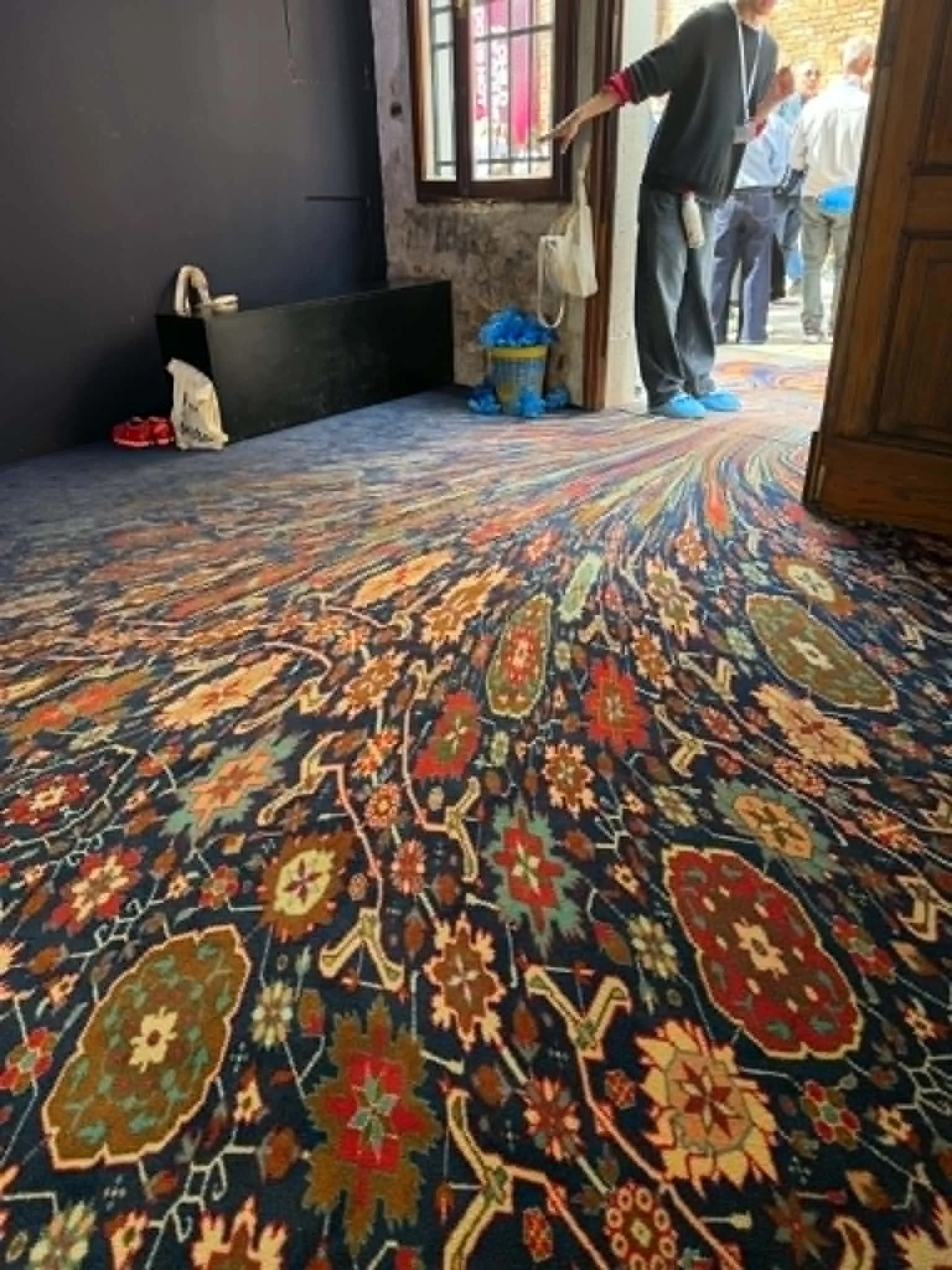
Yet, even during a bad trip, some things come through clearly. In the Azerbaijan Pavilion, the textiles of Faig Ahmed actually break away entirely from the bourgeois normcore.
His carpets mutate into optical, dizzying patterns that crawl up the walls and flow through the room disrupting the very architecture, suggesting there are other ways of moving and thinking from point A to point B. It is a direct retinal challenge, and a visual trip Hunter S. Thompson would have appreciated, as the Oriental carpet beneath my bare feet is starting to melt and morph.
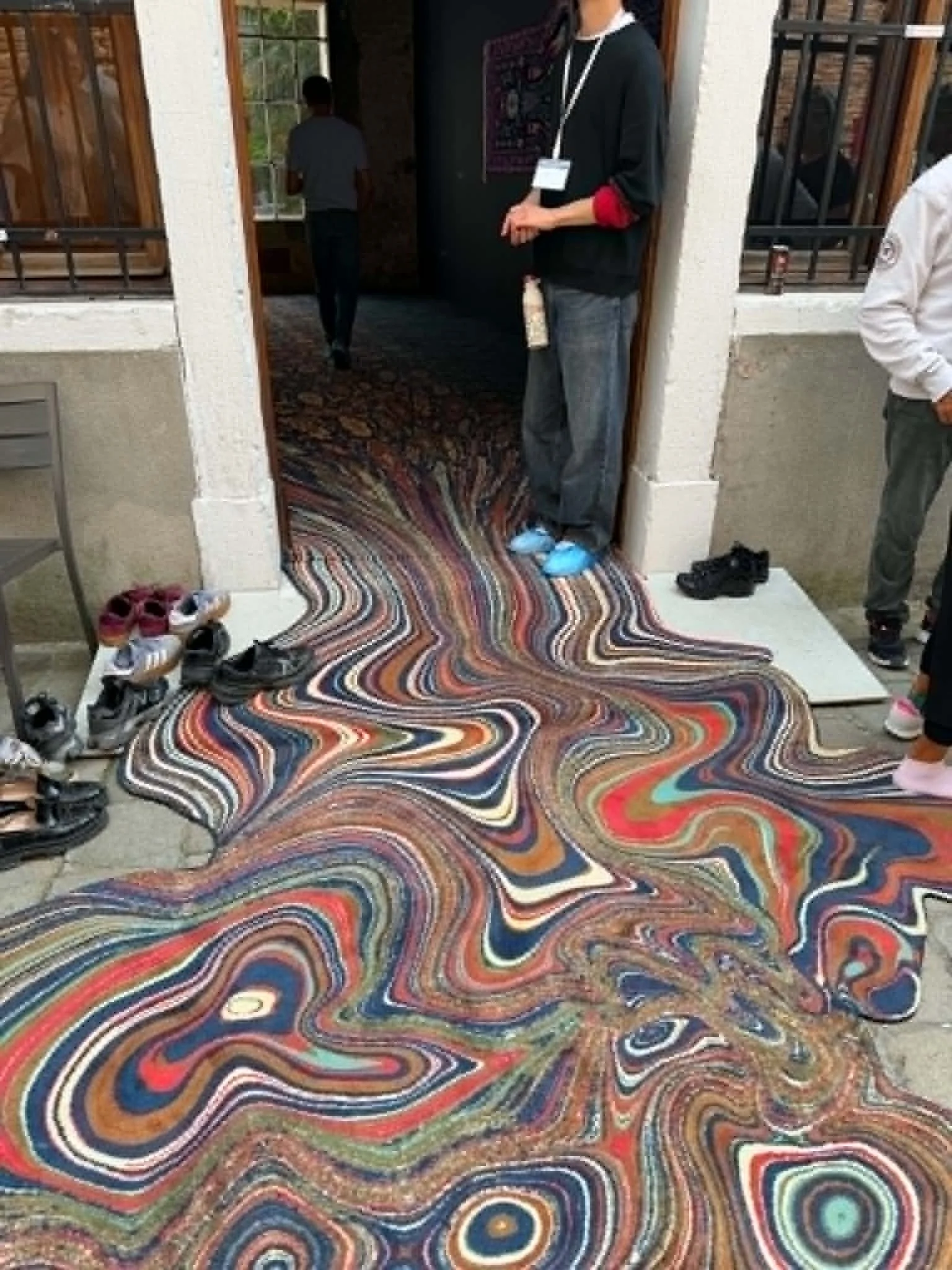
Nearby, the Peruvian Pavilion drops the polite academic tone entirely to feature Sara Flores, a shaman and painter from the Shipibo-Conibo people of the Amazon. Her massive kené geometric paintings on raw cotton function as a structural map of an ayahuasca voyage, mapping out ego-death and a raw reconfiguration of the cosmos. For a brief and exhilarating moment, you are looking at the actual mechanics of an altered reality. Most of the preview crowd walks right past it, missing the fact that the blueprint for their own undoing is right there on the wall.
I slouched toward the exit, looking for a way out of the chatter of the main exhibitions, pavilions, and side shows. Climbing upward for air, I ended up on the roof of the Korean Pavilion, to unexpectedly experience Liberation Space: Fortress/Nest. Up there, the noise of the biennale finally drops away through the structural and physical interventions of artists Goen Choi and Hyeree Ro. A quiet, choir-piece emanating from small, amorphous ceramic sculptures drifts out over the lagoon. No big ado - just a fragile, haunting frequency humming in the air. Downstairs, the bats are still at it. But up on the roof, for a minute, the minor key is finally found, and I slowly start to build my imaginary kite.
Katarina Löfström is an artist based in Stockholm.
Double-click to edit...