

Matias Faldbakken’s Vi er fem and Stakkar
Stefan Kjerkegaard
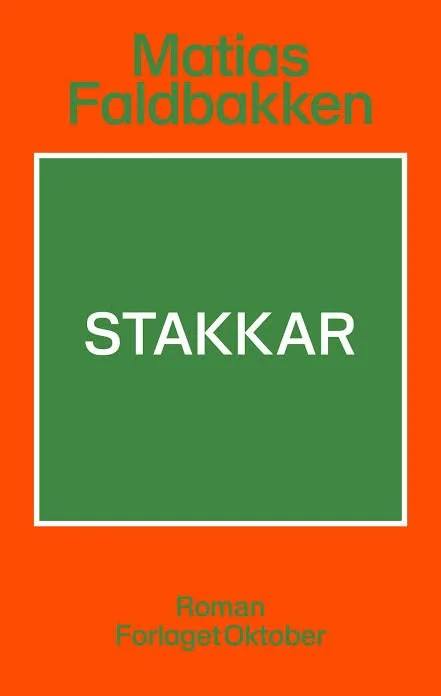
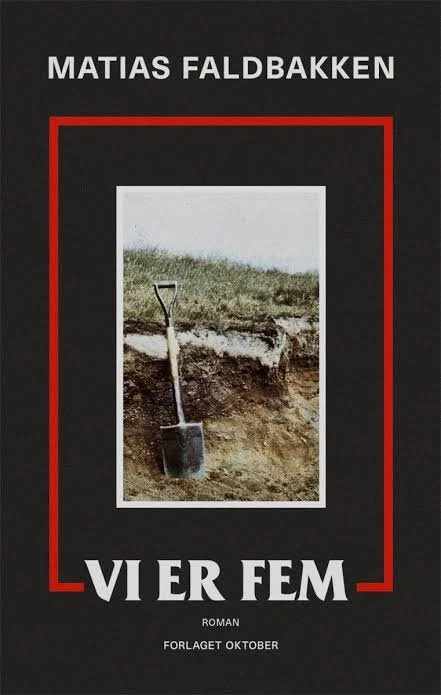
At first glance the Norwegian writer and artist Matias Faldbakken’s recent novels Vi er fem and Stakkar (We Are Five and Poor Thing) appear modest in scale: they are set in rural environments, attentive to ordinary domestic routines, and often marked by a dry, understated humor. Yet beneath this surface emerges something distinctly unsettling. The novels depict worlds in which the human position no longer functions as an unquestioned center, and in which materials, bodies, and environments begin to exert forms of agency that unsettle familiar narrative expectations.
What interests me in this essay is how these novels stage, almost despite their modest settings and comic tone, a profound disturbance of anthropocentric order. Substances and bodies normally treated as passive, backgrounded, or merely instrumental begin to act. Agency is no longer securely grounded in human intention or control but appears dispersed across materials, infrastructures, environments, and relations of care. In this sense, Faldbakken’s novels resonate with a broader critical diagnosis articulated by Amitav Ghosh, who has argued that the climate crisis is also a crisis of imagination; specifically, of the narrative forms through which humans have traditionally made sense of the world.[1]
Rather than approaching the Anthropocene as an explicit theme, Faldbakken’s novels stage it as a condition that shapes the very logic of storytelling. They do not simply add climate change, extinction, or environmental catastrophe to an already established narrative repertoire. Instead, they operate within what Mary Louise Pratt in her book Planetary Longings has described as an Anthropocene chronotope: a configuration of time and space in which human activity has become a geological force, yet one whose consequences exceed human foresight and control.[2] Within this chronotope, temporal scales multiply and slide into one another, as the deep time of geological and material processes presses into the rhythms of everyday life. Spatial boundaries likewise grow porous, as domestic spaces can no longer be insulated from wider ecological and technological systems. Causality, finally, becomes opaque, as actions rebound belatedly and from unexpected directions.
To describe the Anthropocene as a narrative condition, then, is to emphasize that it alters the basic coordinates through which stories organize experience. It changes what can meaningfully count as an event, where agency can be located, and how sequences of action and consequence can be connected at all. As Marco Caracciolo has argued, the challenge posed by the Anthropocene lies not merely in telling new kinds of stories, but in confronting the anthropocentric assumptions embedded in inherited narrative forms, particularly their reliance on human-scale temporality, clear intentionality, and linear causality.[3] Narrative itself comes under pressure, forced to reckon with a world that no longer behaves according to the rules it was designed to capture.
Faldbakken’s fiction fits strikingly well into this configuration. In both Vi er fem and Stakkar, humans find themselves caught in webs of agency they do not control and barely comprehend. The strange beings at the center of the novels – a lump of animated clay and a feral girl – are not really metaphors. They are rather pressures on the narrative system, in other words forces that disrupt the familiar, and reminders that the world is full of lively materials and bodies whose trajectories cannot be fully governed by human intention.
Let me begin with Vi er fem, the novel that perhaps best crystallizes this uncanny ecological imagination. At first glance it is a simple, often comic story: In a small Norwegian village, a father named Tormod mixes clay with various additives, including fertilizer and a mysterious “kneading compound,” and by accident creates a living clay-creature. The idea is whimsical, almost absurd, and Faldbakken plays on this absurdity. But very quickly the novel moves into a deeper register.
The clay-creature emerges not from a laboratory, nor from cosmic interference, but from the everyday textures of rural life: the workshop, the kitchen, the soil behind the house, the WiFi router on a shelf. Everything that animates the creature is already present in the domestic and technological environment. It is as if the novel is asking what would happen if matter simply started responding to all the energies, substances, and gestures we surround ourselves with – heat, metals, signals, oils, residues, waste, and not least of all, human hair that has been cut. The creature becomes the condensation of a whole micro‑ecology: a system of materials and practices that was always there, but whose vitality perhaps was hidden from view.
What also is striking is how quickly the humans try to domesticate the creature. The children teach it to chop vegetables. The parents use it like a combination of pet, helper, and toy. It becomes a kind of household tool, until it isn’t. The moment it is placed on the family’s WiFi router to “warm up”, as Tormod’s son thinks, it absorbs signals and begins to act aberrantly.
“The kneaded clay had developed certain quirks after the episode in the plastic box, on top of the wireless router. It was no longer so easy to get it to hold, chop, brace, or tighten. The lump twisted itself and seemed obstinate. Tormod tried new rounds of kneading to make the lump stabilize, but it always pulled in other directions and was no longer as compliant. This was irritating. Tormod had grown accustomed to the clay as a helping hand, but now it seemed more willful, stubborn – it no longer obeyed.”[4]
What follows is not a moral tale about bad parenting or technological hubris; rather, it is rather the Anthropocene’s feedback loops rendered in narrative form. A seemingly harmless domestic decision rebounds unpredictably. The clay-creature begins to disturb its environment and eventually escapes.
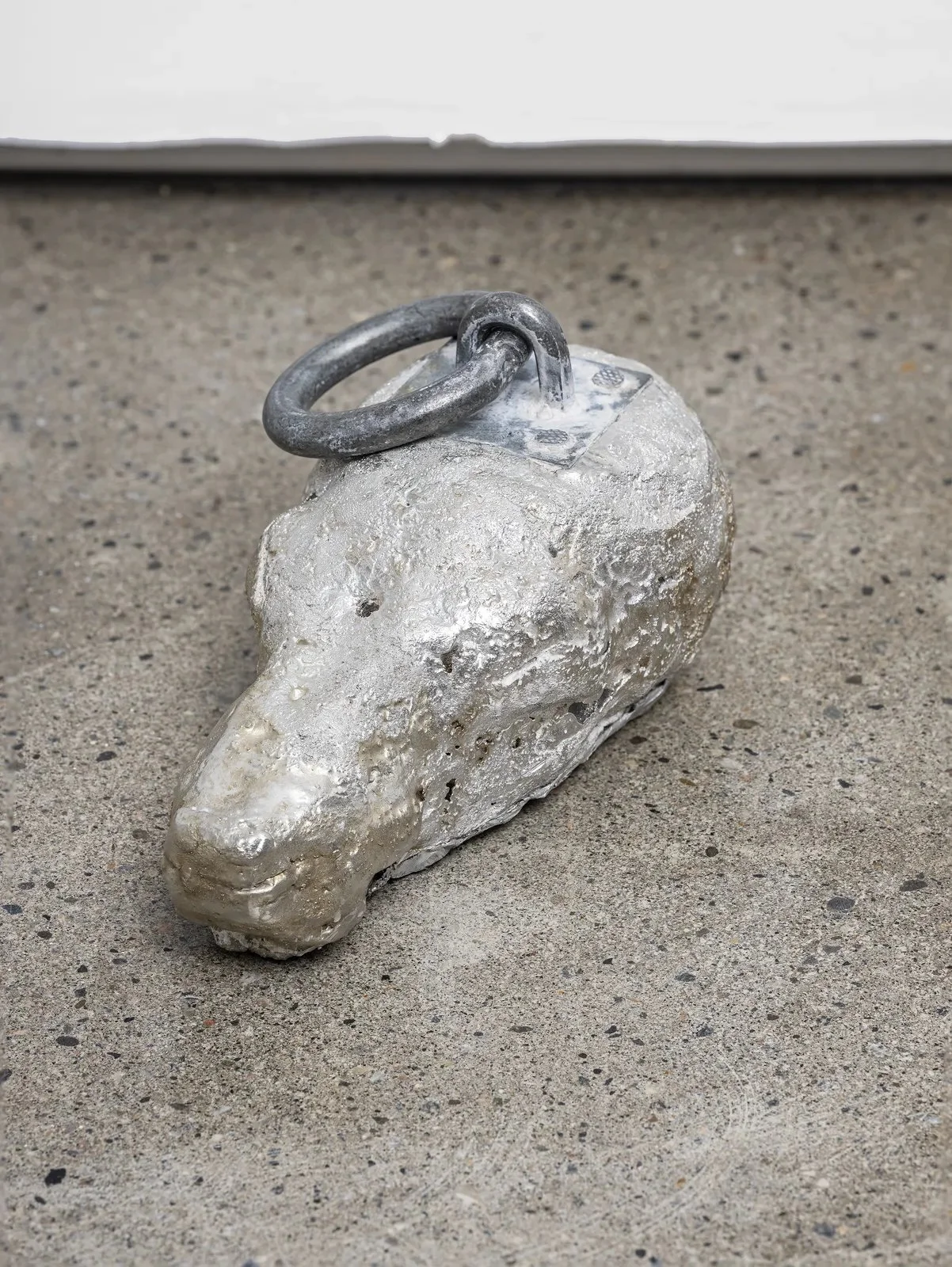
Matias Faldbakken, Weight in the Shape of a Sleeping dog 5 kg, 2026. Courtesy: Standard Gallery
The reason this works so powerfully is that the creature is not simply a monster. It is a form of weird matter. It is not symbolic of something else; it is matter that has become agentive. This redistribution of agency destabilizes human centrality and aligns with earlier readings that emphasize the novel’s non-anthropocentric perspective.[5]
Faldbakken presents this agency with a peculiar tonal mixture: irony but also sincerity; playfulness, and earnest dread. This oscillation gives the story a living pulse. It refuses to settle into satire or simple horror. Instead, it becomes a story of how humans try to live with something they cannot fully understand or master – something that is intimately bound up with their own actions. And furthermore, intimately bound up with the household as an institution. Faldbakken’s novels probe the family itself as a strangely elastic and paradoxical institution – both a refuge and a pressure chamber. The family becomes the place where care and control blur, where love produces unintended consequences, and where the very attempt to create stability ends up generating new forms of instability.
This is where the New Weird enters the picture.[6] The New Weird is often described as a genre in which the monstrous is not supernatural but ecological: a disturbance that originates within the material world rather than from beyond it. Its monsters are not metaphysical intrusions but eruptions of agency from within familiar substances, organisms, and systems. As Jim Greene formulates this, New Weird fiction “embraces the strange and the fantastical in order to subvert prevailing perceptions of reality.” (n.p.)
In Vi er fem, the clay-creature fits this perfectly. It is made of soil, minerals, kitchen scraps, and human residues. It is, in a sense, the earth’s response to being manipulated, shaped, heated, and fed. It embodies all the leakage points between human and nonhuman systems. And it forces the humans to confront the limits of their own explanatory frameworks. The clay‑creature also arrives as an uncanny stand‑in for the family dog whose mysterious disappearance has already unsettled the household, cf. the title We are five, it is a substitute born of grief as much as of curiosity. In this sense the creature becomes an attempt to restore a fragile harmony, even as its very presence reveals how unstable that harmony perhaps always was.
The novel is, as one can gather out of these recaps, also deeply funny. Faldbakken has a talent for writing scenes where the grotesque emerges almost unnoticed within the mundane. A clay-creature chopping onions is both comic and disturbing. A village hair salon swept clean by a creature that absorbs hair (and brings robot vacuum cleaners to mind) rather than brushing it aside is a scene of domestic absurdity that quickly becomes unsettling. Or this amazing passage, where Tormod tries to get a hold of the lump after it’s fatal WiFi exposure:
“With harsh movements, Tormod pressed the lump down into the steel bowl of the mixing machine and poured in some of the galvanized water from a canister; that, he thought, would get the clay going again. But just as the steel bowl began to spin, and the kneading hooks dug into the clay, something strange happened. The lump let out a long, metallic howl. It was a confined, tormented wail, as if a defect were being set to sound. Tormod had never heard anything like it. Or rather – yes. If he thought about it, the scream sounded exactly like Axl Rose’s shrill, constricted twelve‑second screech, right in the middle of Slash’s fierce second guitar solo, after the tempo change, in the outro (around 7:24) of November Rain, for those who remember.” [7]
The inhabitants of the village react with laughter and disbelief, until suddenly they no longer can. Moreover, the readers are left unsure how to orient themselves toward the creature. In an otherwise fairly realistic narrative universe, basic questions arise and remain unresolved: how does the lump of clay move about on its own? How, more precisely, does it assist with household tasks? The novel offers no clear answers. Instead, the reader is asked to accept the clay’s strange agency at face value, as if further explanation were beside the point. From the outset, the universe of the novel is subtly, but decisively, absurd – some might even say fairy‑tale‑like – in the sense that its internal logic does not require justification. Things simply happen, and they happen because this is how the world of the story works. In this respect, Vi er fem recalls the logic of folktales, where animacy and transformation are taken for granted rather than explained, a logic that, notably, also applies to Stakkar. Both the clay-creature and Utskilde are remarkably difficult, if not impossible, to visualize with any precision. One can describe them, but they resist stable mental imagery. They are not characters that readily translate into cinematic pictures or psychological types. Rather, they exist primarily as literary constructions, products of language that can only fully inhabit the space of fiction. In this sense, they can be read in light of Faldbakken’s own reflections on artistic practice in “Upopulær” [unpopular]. There he praises art as a site for experimentation, a place where one can “try out what is impossible to try out in other genres,” and where value lies precisely in exploring forms and possibilities that have not yet found an established place. The clay-creature and Utskilde may therefore be understood not merely as narrative inventions but as experiments in the capacities of literature itself. Faldbakken seems interested in discovering what a novel can sustain, how far fiction can stretch beyond the realm of the readily imaginable while remaining compelling and emotionally persuasive. These figures are neither realistic nor conventionally fantastic; they occupy an indeterminate zone that can be articulated in language more easily than it can be pictured. Their strangeness thus becomes a demonstration of literature’s peculiar freedom: its ability to bring into being entities that do not have to submit to visual plausibility. What emerges is a form of narrative invention that resembles a thought experiment, testing the limits of representation and reminding us that fiction can create realities that are thinkable and readable without ever becoming fully visible. This commitment to exploring what literature can do, rather than merely what it can represent, also helps explain the peculiar tonal register of the novels. Because Faldbakken does not seek to naturalize the strange, the uncanny can coexist with the comic, and the grotesque with the everyday.[8] This formal and tonal instability, moving constantly between humor and horror, banality and threat, perhaps captures something essential about the Anthropocene: the way catastrophe and ordinariness coexist, the way the world becomes uncanny not through drama but through a tiny shift in what we thought was inert.
If Vi are fem deals with matter, Stakkar deals with flesh. Its central figure is a feral girl discovered in a forest: wounded, neglected, violent, and vulnerable at once. She is not a supernatural being. She is profoundly biological – driven by hunger, by pain, by instinct. And yet she, too, unsettles all human categories. She behaves like an animal, but not quite. She responds to care, but not in predictable ways. She inhabits the border between human and nonhuman, between child and creature, between poetry and the prosaic.
“In Utskilde there gradually emerged a strong cooperation between engine and chassis, as they say in motorsports; the way she was built lent resonance to what she said, and this gave the whole contraption a peculiar force. It could seem as though the girl spoke in archaic forms, while at the same time dropping every other word, and her sentences acquired a distinctive snap of their own. Utskilde lacked the ability to find the conventional turns of phrase, the things one says in this or that situation; instead, she said something else – something strange, and something virtuosic.”[9]
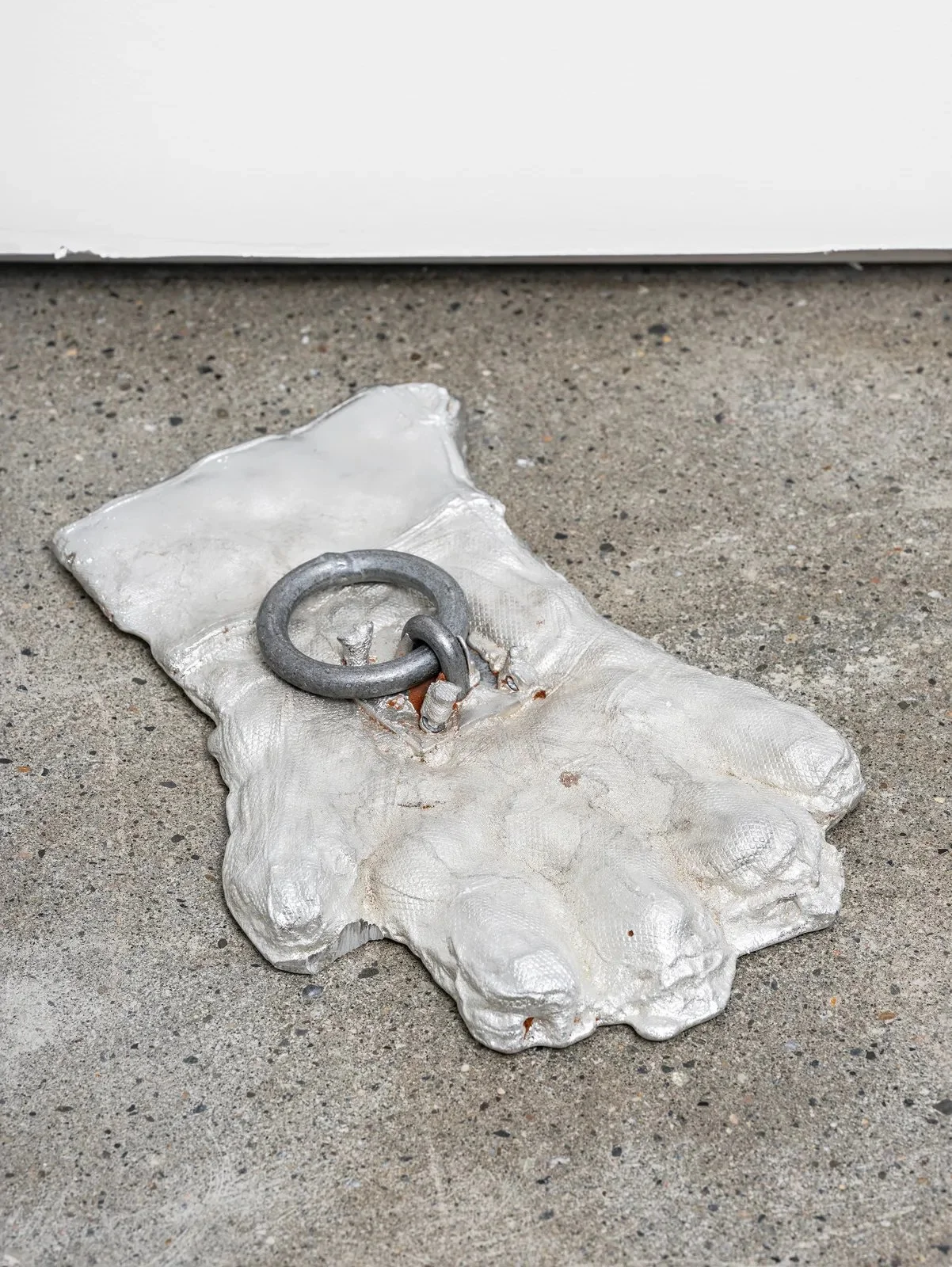
Matias Faldbakken, Weight in the Shape of a Work Glove 4 kg, 2026. Courtesy: Galleri Standard, Oslo.
The name “Utskilde” literally (in Norwegian bokmål) suggests someone who has been separated or set apart. It encapsulates Faldbakken’s broader exploration of Anthropocene subjectivity, where human bodies and voices emerge as ontologically disjoined from the systems meant to contain and explain them.
Of course, the girl also evokes the long cultural figure of the Kaspar Hauser child – the being who arrives without a past, without social inscriptions, and whose very presence exposes the community’s shaky definitions of humanity. Like Kaspar Hauser, she becomes a mirror held up to the society that receives her, revealing its fears, its failures of care, and its need to categorize what resists categorization. In this sense, the novel is not only an ecological or Anthropocene narrative, but also a study of how modern communities react when confronted with a life that cannot be easily placed, explained, or domesticated.
The girl thus radically disrupts the village’s sense of itself. While the clay-creature challenged domestic routines, the girl challenges the community’s ethics. She becomes an object of curiosity, fear, fascination, and eventually exploitation. People see in her what they want to see: innocence, monstrosity, pathology, opportunity. The girl’s presence reveals not only the fragility of social norms, but also the profound instability of the category “human” itself. In this sense, she occupies the same position as the clay: she forces a confrontation with limits of knowledge, control and empathy.
Together, Vi er fem and Stakkar show Faldbakken moving decisively into a form of ecological storytelling where the central question is not “what does this creature symbolize?” but “what does it do to our sense of the world?” If his earlier novels often tested the boundaries of the literary system, destabilizing narrative conventions and exposing ideological contradictions – I here mainly think of the Scandinavian Misantrophy trilogy – in these newer works the destabilization shifts to the ecological and ontological level. Where Faldbakken’s earlier work often targeted cultural taboos and literary norms, these novels redirect that destabilizing energy toward something more fundamental: anthropocentrism itself, and the fiction of human exceptionalism that sustains it.
This shift does not erase Faldbakken’s earlier concerns, it rather transforms them. His commitment to boundary-testing remains, but now the boundaries under pressure are those between organism and object, tool and companion, care and danger, domesticity and wildness. His skepticism towards stable meaning now becomes skepticism toward stable ontology. And his interest in tone, especially the interplay of irony and sincerity, becomes a way of inhabiting the uneasy affective space of the Anthropocene, in which we oscillate between denial and recognition, distraction and dread.
But what, then, do these novels teach us? I think their lesson is less moral than perceptual. They ask us to attend to forces we usually overlook; that is not only the liveliness of materials or the quiet agency of infrastructure, but also the vulnerability of bodies, the volatility of systems, and even the subtle horror embedded in family structures themselves. They remind us that the world is full of feedback loops, and that our attempts to control them are often both understandable and hopelessly insufficient. And they suggest that a new kind of ethical sensibility may be required; one grounded not in mastery but in attention, in a willingness to accompany fragile beings and volatile materials without fully comprehending them.
In the end, one might say that Faldbakken's weird ecologies offer neither apocalypse nor comfort, but rather something more challenging – that is an invitation to recalibrate our sense of what a story can do in the Anthropocene. His narratives do not simply describe ecological crisis, they perform it. They rearrange the coordinates of agency. They blur the boundaries of the human. They unsettle the ground beneath familiar genres. And they do so with a tone that is as humorous as it is haunting.
Utskilde’s final “defense speech”, conceivably a climax in the narrative, which the narrator calls a “ruined poem”, does not function as an argument but as a fractured testimony, shaped by a childhood that had no witnesses and therefore no stable language. Here we hear Utskilde’s voice for the first time, although we must assume that the speech is transcribed and therefore presented in a second order degree:
“I write and I say that we have experience of another order. That around the accident, around the accident, in the unhappy, unhappy child, there lies a land. That this land is called the dark continent.
I write and I say that the continent is wider than life is long. That neither I nor you can cross the dark continent. That we do not reach the accident, Osker.
Osker, do you hear me, Osker. That we do not get in.”[10]
Its broken syntax, repetitions, and semantic slippages enact the impossibility of translating embodied trauma into juridical or narrative coherence. Rather than explaining her actions, the speech insists on the existence of an experience that cannot be entered, crossed, or fully known, even by the speaker herself. In this sense, the defense becomes an ontological claim: not a plea for acquittal, but a refusal of the explanatory frameworks that demand clarity where only ruins of meaning remain.
If literature in the Anthropocene must find new shapes, new monsters, and new modes of attention, then Faldbakken’s work is one compelling example of what that might look like. His creatures are not warnings or metaphors; they are mirrors, dark, distorted, and strangely alive, held up to a world where humans no longer stand at the center, and perhaps never did.
Stefan Kjerkegaard is a researcher and author based at Aarhus University, Denmark, with interests in contemporary literature, literary studies, and culture.
[1] Amitav Ghosh. The Great Derangement: Climate Change and the Unthinkable. University of Chicago Press 2016.
[2] Mary Louise Pratt. Planetary Longings. Duke University Press, 2022.
[3] Marco Caracciolo. “Storying the Anthropocene: Nonhuman Agency and Ecostorytelling.”
Narrative, vol. 29, no. 2, 2021, 181–199.
[4]All translations are my own from Matias Faldbakkens Vi er fem (Oslo: Forlaget Oktober, 2019) and Stakkar. (Oslo: Forlaget Oktober 2022). Here the Norwegian version:
”Knetleiren hadde visse nykker etter episoden i plastboksen, oppå den trådløse ruteren. Det var ikke lenger så lett å få den til å holde, hakke, støtte eller skru. Klumpen vred seg og virket tverr. Tormod gjorde forsøk på nye eltinger for å få klumpen til å stabilisere seg, men den dro alltid i andre retninger og var ikke like medgjørlig. Dette var irriterende. Tormod hadde vent seg til leiren som ei hjelpende hånd, men nå virket den mer egenrådig, sta – den lystret ikke.” (Vi er fem, 130).
[5] Line Langaas Berg. En leirklumps livssyklus: Skapermytens muligheter som dystopisk håp i Matias Faldbakkens Vi er fem. (2019). Masteroppgave, Universitetet i Oslo, 2021.
[6] Jim Greene. New Weird (literary movement). In EBSCO Research Starters: Literature & Writing. https://www.ebsco.com/research-starters/literature-and-writing/new-weird-literary-movement, 2023.
Clute, J., Langford, D., Nicholls, P., & Sleight, G. New Weird. I The Encyclopedia of Science Fiction. https://sf-encyclopedia.com/entry/new_weird, 2021.
Stefan Kjerkegaard. “Når verden bliver mærkelig: New weird og underlig fiktion i ny nordisk litteratur.” Site Zones, 10 Nov. 2025. https://www.sitezones.net/articles/newweird
[7] ”Med harde bevegelser trykket Tormod klumpen ned i stålkolben på eltemaskinen og helte på av det galvaniserte vannet fra en dunk, slik skulle han få fart på leiren igjen. Men idet stålkolben begynte å spinne, og eltekrokene grov seg inn i leiren, da skjedde noe underlig. Klumpen ga fra seg et langtrukkent, metallisk ul. Det var et innestengt, forpint hyl, som om en defekt ble tonesatt. Maken hadde Tormod aldri hørt. Eller, jo. Hvis han tenkte etter, hørtes skriket nøyaktig ut som Axl Rose sitt skingrende, trange 12 sekunder lange hvin, midt i Slash’ heftige guitarsolo nr. to, etter taktskiftet, i etterspillet (ca. 7:24) på November Rain, for den som husker det.” (Vi er fem, 129)
[8] Matias Faldbakken. ”Upopulær”, UKS – Forum for samtidskunst 3/4, 2001, 9-16.
[9] “I Utskilde var det etter hvert et sterkt samarbeid mellom motor og chassis, som man sier i racersporten; måten hun var bygget på, ga klang til det hun sa, og dette ga hele doningen en særegen kraft. Det kunne virke som jenta snakket i arkaiske former, samtidig som hun sløyfet annethvert ord, og setningene fikk en helt egen snert. Utskilde manglet evnen til å finne de alminnelige talemåtene, det man sier i de og de situasjoner, da sa hun noe annet, noe rart, og noe virtuost.” (Stakkar, 134)
[10] ”Jeg skriver og sier at vi har erfaring av en annen orden. At rundt ulykken rundt ulykken i den ulykkelige ulykkelige ungen ligger et land. At landområdet heter det mørke kontinentet.
Jeg skriver og sier at kontinentet er bredere enn livet er langt. At ikke jeg og ikke du kan krysse det mørke kontinentet. At vi når ikke frem til ulykken, Osker.
Osker, hører du, Osker. At vi når ikke inn.” (Stakkar, 183-184)
Double-click to edit...