

Who Are You Looking At?
Ingeborg Guemberena Shutrick
Entering the Giardini during the opening days of the 61st Venice Biennale meant stepping into a human soup as the queues kept growing. The choice seemed to be between shit feminism and porn feminism. In Seaworld Venice, Florentina Holzinger fills the Austrian Pavilion with wastewater and machines. Naked performers move through this environment as the work investigates cycles of transformation. Things to Come by Maja Malou Lyse in the Danish Pavilion also gives the body a central role and examines its relation to technology and nature from a feminist position. Lyse does this in a very different way, constructing a science fiction scenario around pornography, male fertility and reproductive technology. In the reception of both exhibitions, however, nudity has threatened to become the subject through which everything else is understood.
An exemplary depiction of this perception is found in a comment by curator Dan Cameron, who lets his followers on Instagram know that the “Austrian Pavilion at the biennial is ostensibly about water, sewage, and human waste, but it’s fair to say that the hours-long lines of people waiting outside to have a look were not so much motivated by issues of water as they were titillated by the presence of live, naked female bodies.” The funny thing is that Cameron presents this as an observation about the audience, but his comment reproduces the patriarchal gaze it claims to identify. By assuming that the queues were driven by sexual excitement, he reduces the performers to solemnly naked female bodies and makes their presumed sexual availability the explanation for the exhibition’s reception.

Maja Malou Lyse, DIS, Things to Come, 2026, installation view the Danish Pavilion 61th Venice Biennale. Photo: Zoe Chait.
Strangely enough, the Danish pavilion, which displays nudity on screens with a straightforward pornographic content, does not meet the similar critique. To compare the two pavilions on the superficial premise of their use of “naked female bodies” as a pretext for talking about other issues is indeed inherently patriarchal. However, by recognizing how nudity is today still seen as taboo after a long history of feminist art using the body, it is relevant to dismantle both Holzinger and Malou Lyse’s use of nudity to understand what they contribute with to this discourse and struggle.
Malou Lyse, inspired by science fiction, both its retro-futurist aesthetic and its creation of alternative realities, has imagined a future based on research which has found that watching immersive pornography increases male fertility. Science fiction is not a strict prediction of the future but a reflection of our current time, and Malou Lyse in many ways provides an accurate depiction of the contemporary moment; however, it seems less like a visionary reflection and more of a trite reproduction of our absurd reality.


Maja Malou Lyse, DIS, Things to Come, 2026, installation view the Danish Pavilion 61th Venice Biennale. Photo: Zoe Chait.
In one of the two rooms in the Danish pavilion, the artist shows containers used for transportation of sperm along a wall. On some of the containers a small screen is attached, displaying videos of young men competing in “sperm races.” This refers to a recent phenomenon where a 17 year old tech entrepreneur in LA started to make sperm speed into a competitive sport, “aimed at raising awareness of men’s declining fertility.” Whether this is a crisis, let alone one to mourn, is another question.
Maja Malou Lyse, DIS, Things to Come, 2026, film still, Danish Pavilion 61th Venice Biennale.
This depiction of sperm races traces a wider phallocentric culture allowing men, especially young men, to talk more freely about their ejaculation. There is no shortage of slang for male masturbation, or of jokes and rituals built around it, in comparison to the few relating to female and vaginal experiences. Expectations during heteronormative sex are correspondingly catered towards male orgasm, like women being expected to have men cum inside them, it being men’s “ultimate climax’”(breeding fetishism, suggesting undertones of domination and anti-choice). By putting sperm as the primary focus in her exhibition, in a manner that appeals to the patriarchal eye, Malou Lyse starts to echo the sexist structure where men's pleasure is the norm.
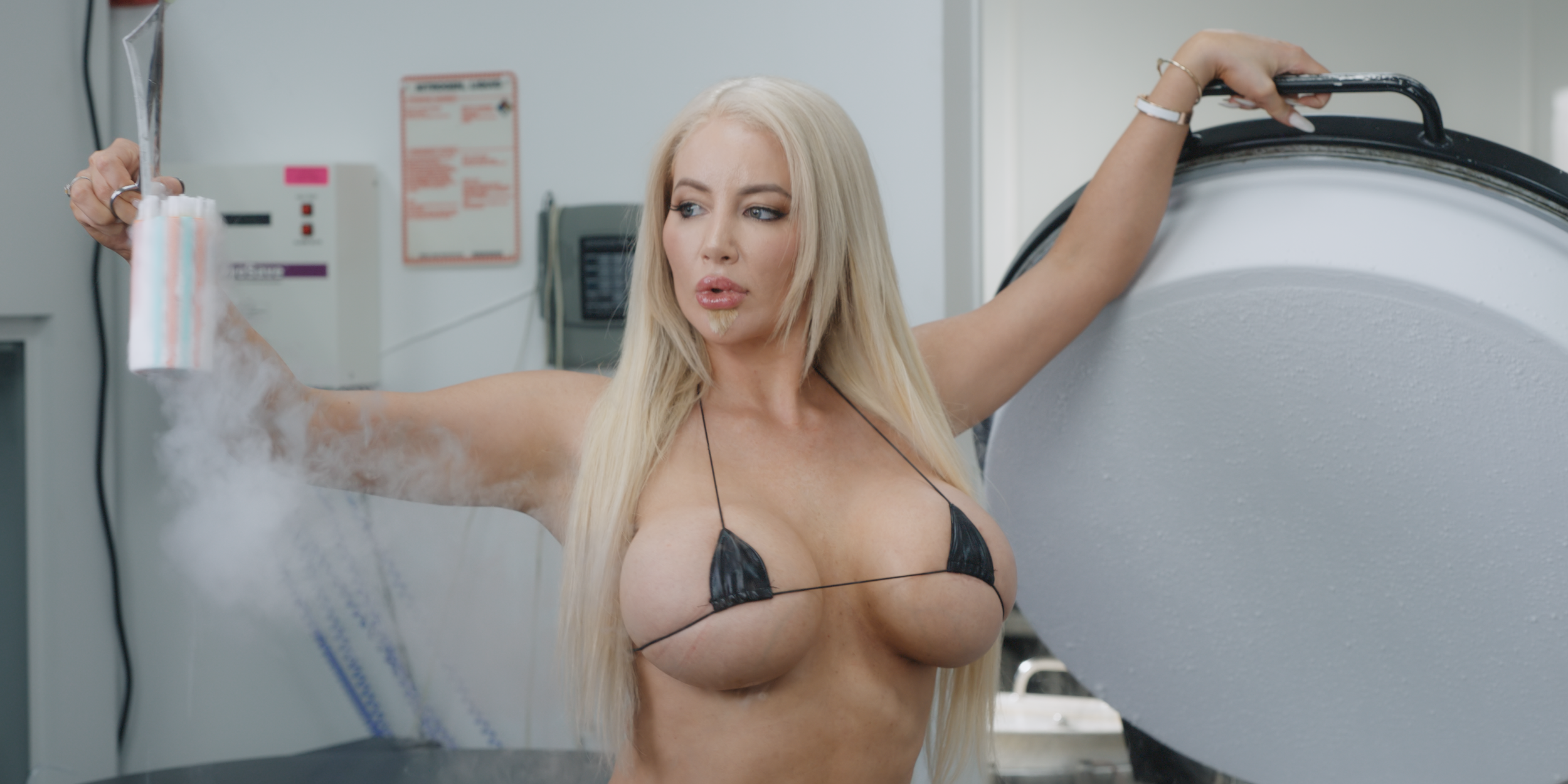
The second room contains a large screen that curves and covers all sides of the room, showing a video in which porn actresses work as scientists in a sperm bank. The actresses perform different movements and positions that evoke pornographic tropes as they hold the sperm samples. Dressed in lab coats and bikinis, the actresses have highly modified bodies that conform to female beauty ideals. Spending three seconds searching on a porn site, videos titled “Sperm Clinic Nurse is Determined to Get Sample” and “Supervisor Jerks You Off Sperm Bank Role Play” turn up, seemingly not far off in content.
The video work features a clip of the artist herself pulling two strings attached to an actor’s breasts, making them bounce up and down. What seems to be meant as a slightly comic and provocative gesture, alluding to a power structure where the artist is “pulling the strings,” falls short and evokes a sense of ridicule, simply treating the actor’s body as an object.
It seems as if Malou Lyse wants to use the contexts of the misogynistic porn industry and the male dominated tech industry and contrast them, creating a hyperbole that exemplifies the ridiculousness of these cultures; however, the artist also seems to draw from these aesthetics wholeheartedly, resulting in a reproduction of pre-existing sexist material. On the other hand, Lyse does open up for an urgent discussion on the alienation from our own bodies and the bodies of others emerging from our current technological advances, social media, AI etc. The externalization of carnal desire, projecting onto far away fantasies and not grounded in ourselves, our own skin.
Florentina Holzinger, SEAWORLD VENICE 2026, installation/performance photography by Marlanna Wytyczak.
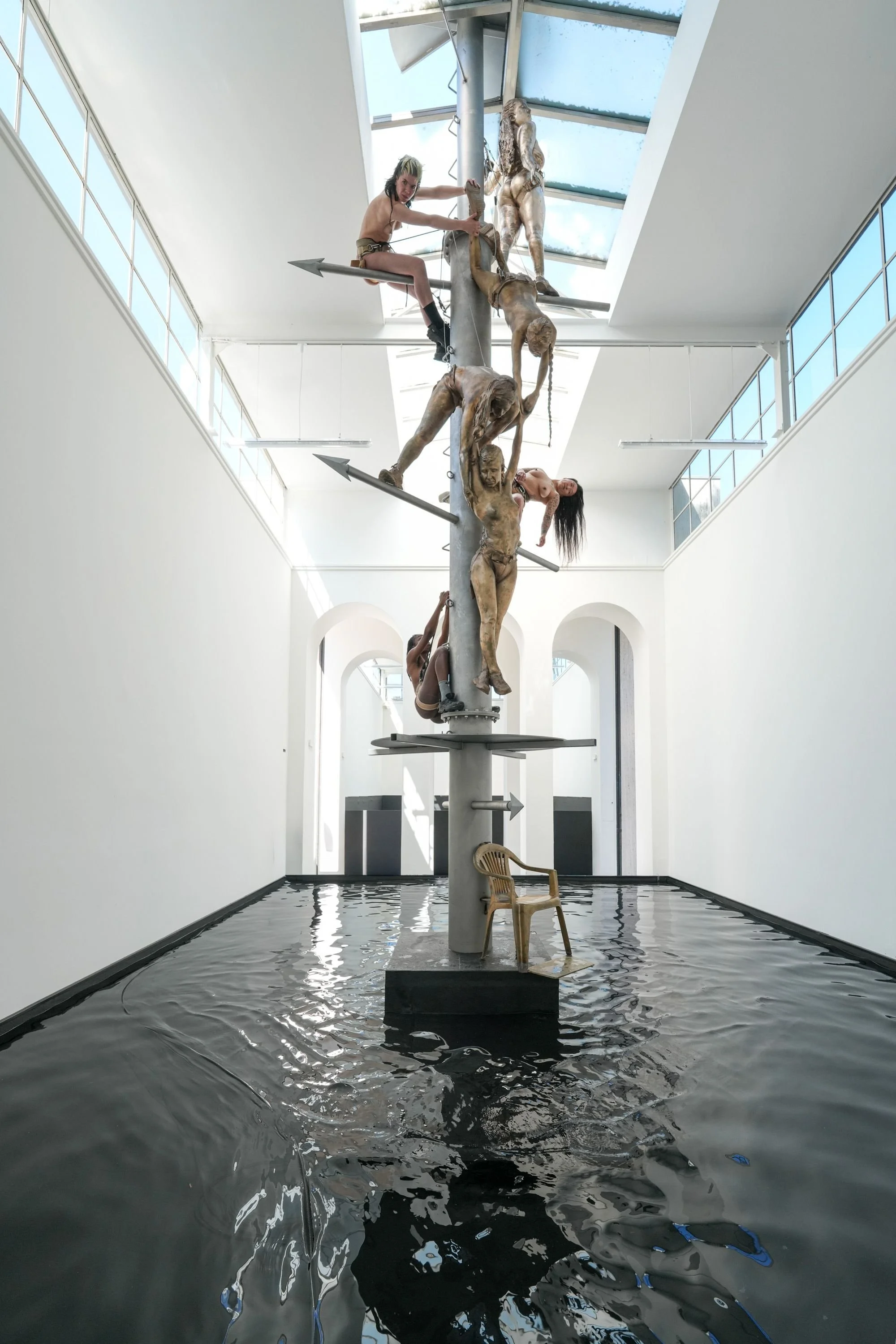
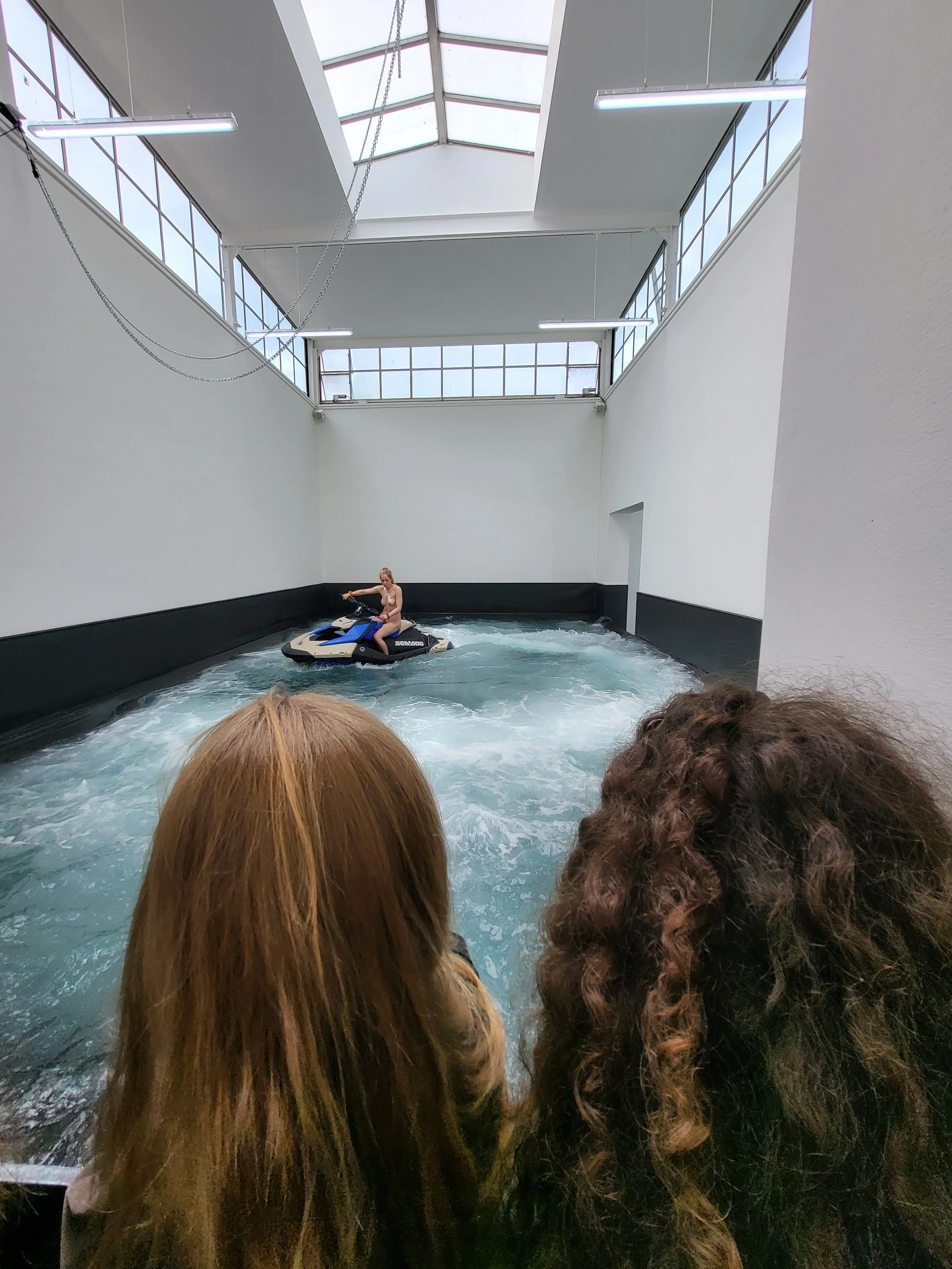
Holzinger, however, gives a response to this discussion, an attitude where she and her performers take back control of the body through showing it outside a sexual context, simply there to facilitate movement. When I enter the waterfilled pavilion, an elderly performer sits and knits calmly by the bottom of a large metal pole. Above two performers are hanging in harnesses attached to the pole. At times they climb further up or down, or they remain in the same position, static as the pole turns them around. When walking out to the backyard of the pavilion one is met by a large tank linked to two portable toilets. All this time that I have been in the exhibition the same performer has been inside the water tank, looking through the glass at the crowds. The team of performers are of all ages, all types of physiques, all female presenting or nonbinary.
Holzinger’s bodies go through extreme conditions making them vulnerable and mortal. The performers' pain and intensity becomes physically tangible. However, her performers still appear assured in spite of these conditions. This takes me to the humorous performance in the pavilion where two persons try to cover leaking holes in a tank room. Holzinger points out that even though we are facing pressure, the world being an overflowing shitshow, we have to continue to stand firmly and fight for the better.
Florentina Holzinger, SEAWORLD VENICE 2026, installation/performance. Camera: Power Ekroth.
The artist treats nudity as the norm. As one walks through the exhibition, the shame and sexualization imposed on the body every day by the media and on the street begin, little by little, to fall away. The feeling lingers in how the body carries itself after leaving the performances. Seaworld puts a bounce in every step through the rest of the Giardini.
A large bell hangs from a crane outside of the Austrian pavilion. After the inauguration speeches Holzinger climbed a rope up to the bell and suspended herself upside down inside it. The rope gets swung back and forth and the artist, only wearing a harness with metal pieces to create sound, becomes a flesh and blood human clapper.
That the artist herself does various of the performances and hence also is nude, brings forth a practice of her values, a philosophy that she mentally and physically embodies. It is concrete and in contrast to the Danish pavilion not made by brought in actors, acting behind a screen. In the Danish pavilion we see the lightly dressed and nude bodies through the lens of the male gaze in various shots, like the point of view of a man in VR glasses depicting an actress touching his thighs. However, in the Austrian pavilion one of the sites features a performer who bends into seemingly impossible positions and fixes the viewers with a wide-eyed stare. Holzinger’s performers meet our gaze and say, “who are you standing there?”
Trying to go back to a kind of “natural nudity” is not the aim but the defiance of the body (especially the “female body”) as a site heavily regulated by institutions, a primary target of power. Malou Lyse brings forth the absurdity of porn, hypermasculine gaming cultures, and incel communities, but also reproduces a portrayal of “female’ bodies” as primarily sexual entities. Holzinger’s attitude feels rebellious in a time of alienated bodies. A simple method yet bizarrely controversial to the masses, causing disruption which allows for audiences to start rethinking and relating to their own bodies in a new way, even for just a couple of seconds.
Ingeborg Guemberena Shutrick is a Philosophy and Political Theory student at Bard College
Florentina Holzinger, SEAWORLD VENICE 2026, installation/performance photography by Power Ekroth.