

How will your Biennale be remembered?
Power Ekroth
Massimiliano Gioni
High Waters: An Oral History of the Venice Biennial
JRP Editions & Les Presses du Réel
Interviews with Achille Bonito Oliva, Jean Clair, Harald Szeemann, interviewed by Jens Hoffmann, Francesco Bonami, Rosa Martínez, María de Corral, Robert Storr, Daniel Birnbaum, Bice Curiger, Okwui Enwezor, Christine Macel, Ralph Rugoff, Cecilia Alemani, Adriano Pedrosa and the team that realized Koyo Kouoh’s Biennale in 2026, Gabe Beckhurst Feijoo, Siddhartha Mitter, Marie Hélène Pereira, Rasha Salti and Rory Tsapayi. Massimiliano Gioni, who curated the 55th Venice Biennale in 2013, is himself interviewed by Robert Storr, curator of the 52nd Venice Biennale in 2007.
I hope the show is remembered for the great works that were made specifically for it. Out of all the Bienniales I have visited, I always mainly remember the artworks and the artists, and that’s what matters.
Christine Macel, curator of the 57th Venice Biennale in 2017, Viva Arte Viva
On the whole, people have short memories.
Jean Clair, curator of the 46th Venice Biennale in 1995, Identity and Alterity: Figures of the Body, 1895–1995
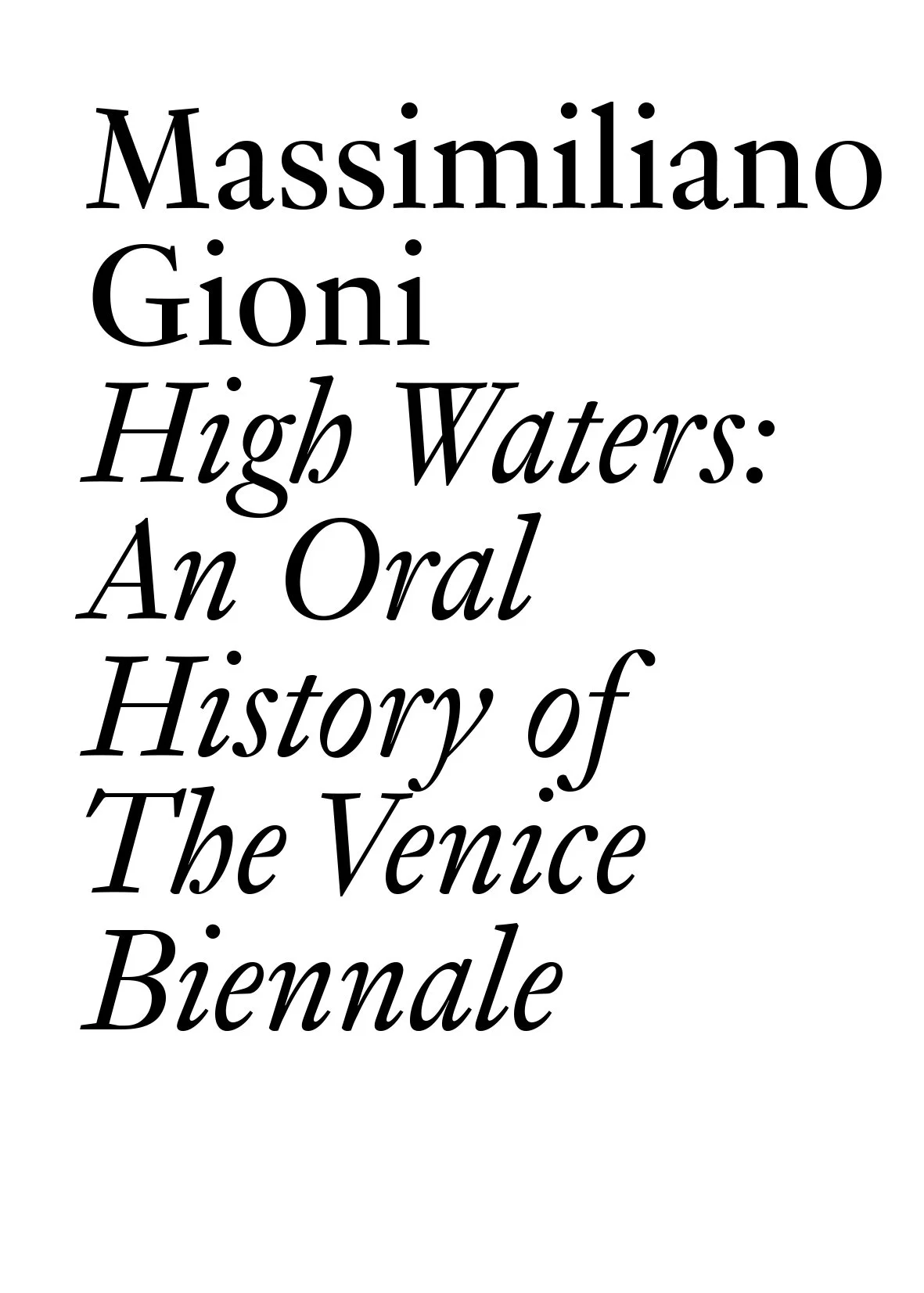
The art world thrives on anecdotes, myths and gossip, so the expectations for a book like this are unusually high. The back cover of High Waters promises “a fascinating overview on how to curate a Biennale” as well as “a precious insight into the evolution of contemporary art and the conversations around it over the last three decades, its stakes, its steadily increasing globalisation, its changing focus,” and most people inside and outside the art world with an interest in exhibition making will want a copy.
This might be a rare opportunity to expose the scaffolding holding up each edition, to get behind the scenes and understand not only the ambitions and vision of each curator, but the conditions through which became an exhibition.
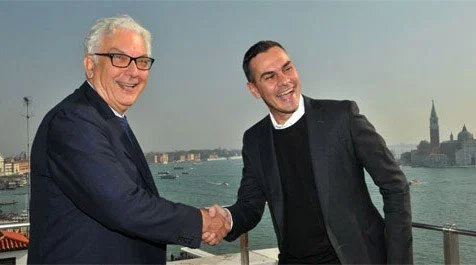
Paolo Baratta, previous director of Venice Biennale and Massimiliano Gioni in 2012 when appointed curator for the 55th edition of the Venice Biennale. Photo Courtesy Venice Biennale
“How will your Biennale be remembered?” The question recurs throughout High Waters, Massimiliano Gioni’s collection of interviews with the curators responsible for the monstrosity of an exhibition that forms the core of every Venice Biennale from 1993 until today. These exhibitions normally contain works by somewhere between one hundred and three hundred artists, which can mean organizing thousands of artworks into something meaningful and, preferably, interesting.
Tell me a curator who has not fantasized about curating the Venice Biennale, or at least a pavilion. We also know that the expectations attached to the job are impossible. The Biennale should surpass the attendance figures of the previous edition. It should give critics something strange enough to be irritated by and enough to become excited about. It should present at least some of the usual suspects in an unexpected configuration while offering a platform to unknown and emerging artists. Somehow, all of this then has to be assembled into an exhibition and made to hold together beneath an umbrella of theory.
Many people remain surprisingly unaware of the obstacles involved in curating any large-scale exhibition. Doing it in Venice adds another layer of absurdity. Transport is available to the highest bidder. Even the largest international transport companies may find themselves waiting for a Venetian boat driver to finish his first espresso and cornetto before discovering whether he is available for the next delivery. Sometimes this requires a little bit more resources than you imagined. Hundreds of artists need attention and the respect they deserve – simultaneously. An institution like this has its own procedures and hierarchies. Works arrive late. Time disappears. Decisions that seemed straightforward six months earlier suddenly have to be remade inside the exhibition itself. These are not peripheral problems around an exhibition. They are part of what makes the exhibition what it becomes.
After going through the conversations, however, the feeling is rather like looking into a colander whose holes were too large. Some juicy pieces remain. A great deal has slipped through. It is worth beginning with what remains.
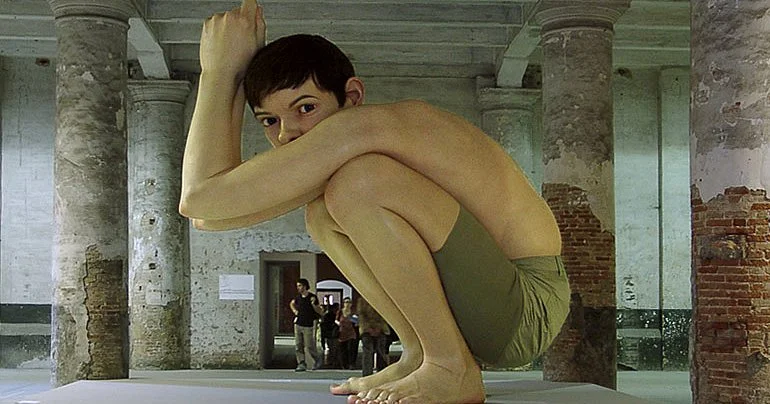
The opening installation by Ron Mueck at the Venice Biennale Plateau of Humankind 2001, curated by Harald Szeemann. Photo courtesy Venice Biennale.
We do get glimpses of curatorial motivation and of the determination required to keep working under difficult circumstances. Harald Szeemann, in dialogue with Jens Hoffmann, insists on the idealism of trying “to change the world.” Describing Venice, a Biennale he had at one point stopped attending, he observes that “if you want to have international resonance, importing the Venetian model is your best bet.”
That observation has particular resonance today, when the relevance of national pavilions and national representation colors so much of the response to the 2026 Biennale realized by the team assembled by Koyo Kouoh. As Gioni points out in his conversation with Jean Clair, curator of the 46th Biennale in 1995, “Every year brings the same debate about whether or not the pavilion model is obsolete or not, but every year new countries want one.”
We also learn how several curators received the news that they had been appointed. What we learn much less about is everything leading up to that moment. How are the contenders identified? Who enters the room before the final name appears? Who proposes whom? What combination of institution, network, reputation, and chance makes one person curator of the Venice Biennale rather than another?
Francesco Bonami offers one of the funniest accounts. The president of the Biennale, Franco Bernabè, called him while he was in Florence and asked him to come to Venice. The board met the next day while Bonami waited for news. By six in the evening, he had become convinced that the job had gone to somebody else. His phone, it turned out, had no signal. He finally learned of his appointment when his mother called to say that a friend had heard the news on the radio.
It is a great anecdote. It also opens up a cluster of other questions. If Bonami was convinced that someone else might have got the job, there were presumably other contenders. Bonami may not know who they were, but someone does. The story makes the appointment sound wonderfully contingent while leaving the machinery producing that contingency almost completely untouched.
Sugar in the espresso
Gioni’s closeness to his interviewees is part of the attraction of the book. His introductions are mini biographies charged with admiration. People are feverishly active, possessed of volcanic creativity, living legends, “like a Kofi Annan of contemporary art,” or voraciously curious. Gioni knows these people and their world intimately, and this gives him an access and familiarity that a more distant historian might never achieve.
It also adds one spoon too many of sugar to the espresso.
Some curators are more open than others about the reception of “their” Biennale. Bonami is one of them. Gioni describes him as his own mentor and refers to the “Bonami school,” a circle of assistants and associates who went on to significant curatorial careers. Several eventually became Venice Biennale curators themselves, among them Gioni, Cecilia Alemani and Daniel Birnbaum.
Bonami’s 2003 Biennale received “pitiless reviews” and “went down in history as one of the most chaotic and complex in the history of the event.” Bonami remembers the president of the Biennale, Franco Bernabè, telling him that “if the attendance results were in keeping with the disastrous critical response, my career would be over.” Bonami continues: “It was the last real show I curated; after that, everything I did was in the shadow of what to me was a marvelous disaster.”
Several other curators in the book later vindicate his exhibition by describing it as a significant point of reference.
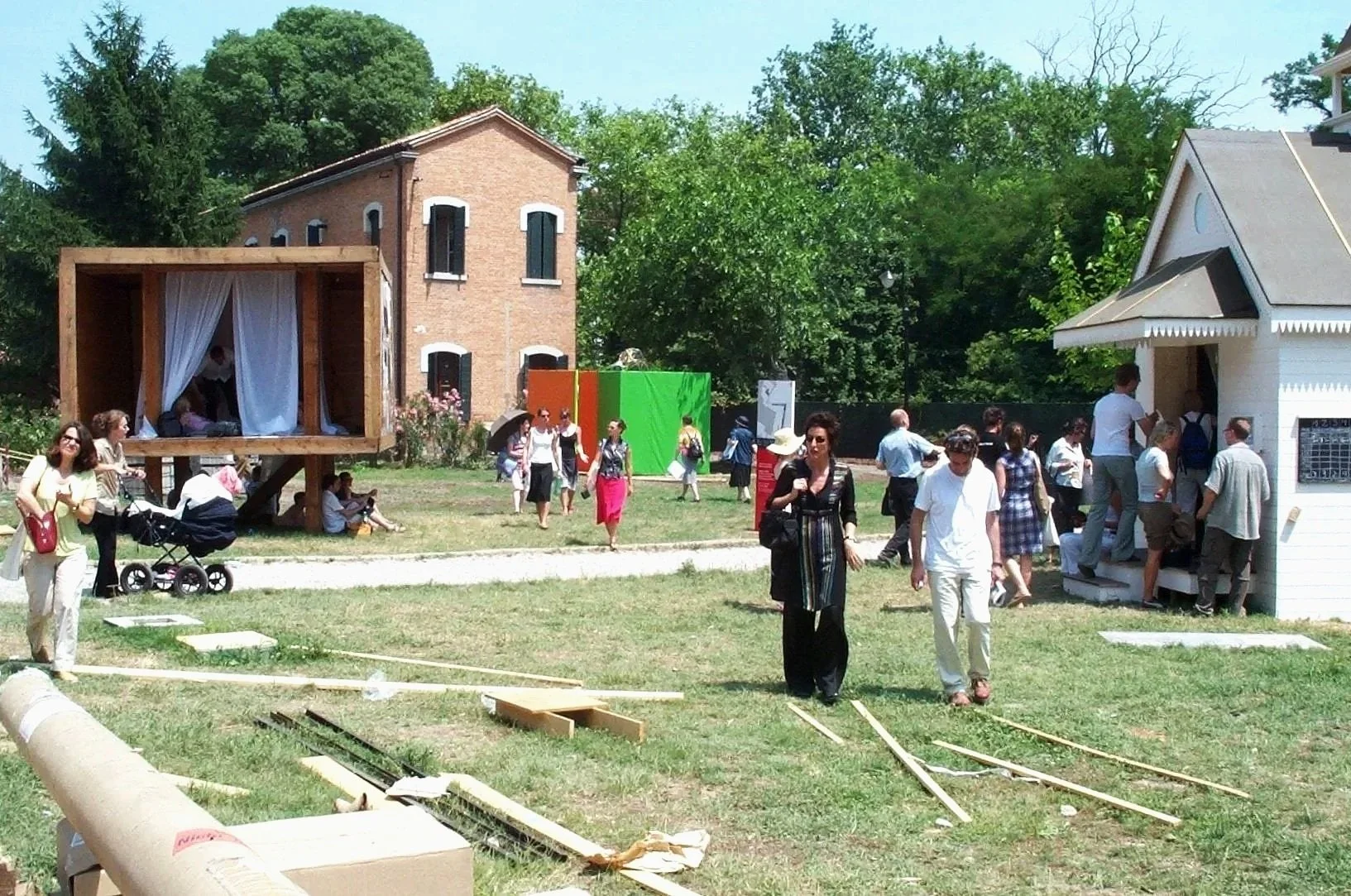
At the very end of Utopia Station, the Utopia Garden, section curated by Molly Nesbit, Hans-Ulrich Obrist, Rirkrit Tiravanija for the Dreams & Conflicts: The Dictatorship of the Viewer 2003, head curator Francesco Bonami, 50th Venice Biennale. Photo: Power Ekroth
These curators know one another, many have worked together. Some have mentored others, they have assisted one another and succeeded one another – and some, like Gioni and Alemani are a married couple. They have watched the same exhibitions, discussed them, disagreed about them and built careers partly through distinctions from what came before. Yet the prevailing tone of the book remains one of admiration.
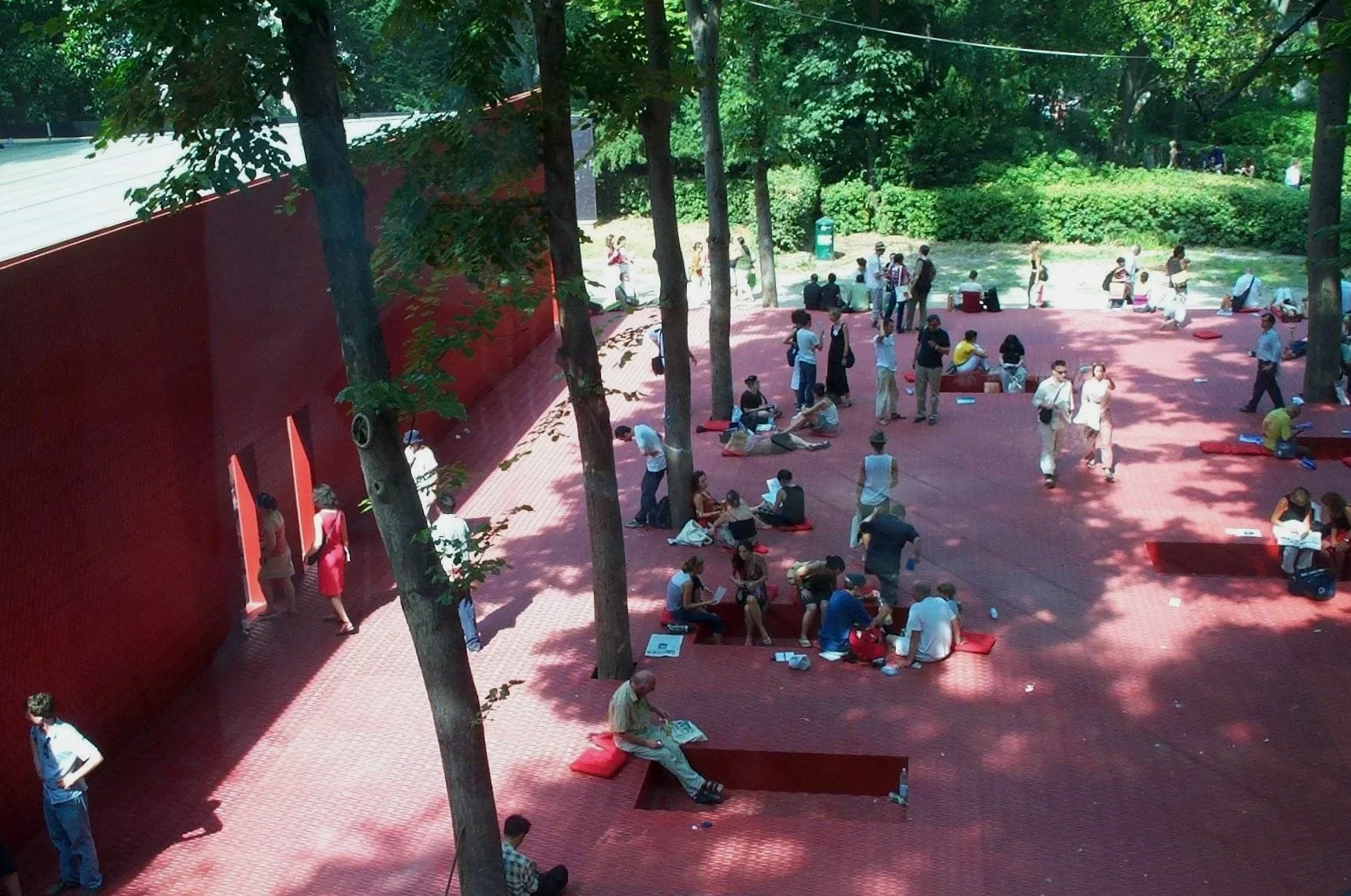
The Italian Pavilion 2003, curated by Massimiliano Gioni. Photo: Power Ekroth
Admiration is not in itself the problem. Nor is intimacy. Intimacy is one of the book’s qualities. The more interesting question concerns what happens to an oral history when the person conducting it belongs so completely to the history being narrated. The same proximity that grants Gioni extraordinary access also creates a striking discretion around more serious criticism, conflict and allegations of misconduct.
Bonami’s 2003 Biennale, Dreams and Conflicts: The Dictatorship of the Viewer, was the fiftieth edition and perhaps the edition that paid the most explicit tribute to the legendary echo running through the pages of this book: Aperto.
Aperto is the ghost of almost every Biennale that followed Achille Bonito Oliva’s 1993 edition. The 1993 Aperto developed from an earlier section for young artists created by Bonito Oliva and Harald Szeemann in 1980. Much has been written about Aperto as a dividing line in the history of the Biennale. It opened the attention of critics and audiences to a broader spectrum of contemporary art and helped establish a particular kind of curator as a central protagonist.
Bonito Oliva describes the shift himself:
Up until then that section had been a sort of documentation, a census rather than a real show. Whereas I applied the same ideas to it that were central to my whole exhibition: working without walls or borders, across different media, nations and disciplines.
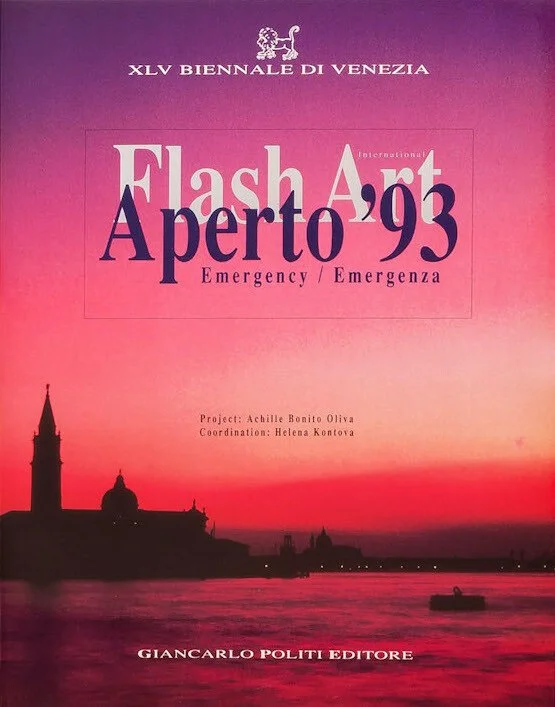
As iconic as Aperto became, and as obvious an inspiration as it was for curators who followed, the interviews leave considerable curatorial analysis on the table. What exactly was its allure? Why has almost every Biennale since had some relationship to it, through imitation, resistance or reinvention?
Aperto 93 was co curated by Helena Kontova, who in turn invited a large group of then very young and relatively unknown curators who would later become highly influential, among them Bonami, Nicolas Bourriaud, Jeffrey Deitch, Bob Nickas and Matthew Slotover. Looking at the artist list today, it almost resembles point zero for what we have come to call the usual suspects of the international biennial circuit.
This leads to one of the most obvious subjects left largely untouched in the interviews: how do these curators position themselves in relation to other Venice Biennales?
They arrive with a relationship to the institution already in place. They have seen earlier editions. They carry memories, judgments, irritations, and enthusiasms. They have watched ideas succeed and others exhaust themselves. The relationship to the immediately preceding exhibition must be particularly charged. Every curator arrives with a need to change something, to leave a mark and to introduce a different constellation of artists, tools, ideas, and ways of thinking.
Anyone who has attended a few Biennale openings will recognize the ritual. During the opening days every new edition is discussed against the backdrop of its predecessor, which somehow always, always, begins to shine in a more flattering light than the exhibition currently at hand. Bonami’s 2003 exhibition, collectively mauled by the press, suddenly became “better” when Rosa Martínez and María de Corral opened their Biennale in 2005. Martínez and de Corral were then “better” than Robert Storr in 2007, and so it goes.
There are glimpses in High Waters of exactly this kind of historical thinking, which makes their rarity more noticeable. Christine Macel, when asked about inspirations for Viva Arte Viva, recalls Jean Clair’s 1995 edition and a section devoted to a history of taste in which one work was selected for every year between 1895 and 1995. What struck her was “the extreme relativity of taste” and the shock of seeing “how certain names and works are simply wiped out by history.” She hoped her own Biennale would offer “a different perspective on time and history,” less concerned with the consumption of new names.
Here is precisely the kind of connection one wants more of: one exhibition remembered from within another, one curator thinking through a predecessor, not as a lineage of mutual admiration but as part of the intellectual material from which another exhibition is made.
Politics and national representation
Art can be described as a mirror of what we call reality, and politics is a stubbornly real part of that reality. Curators can engage with it in radically different ways.
The current president of the Venice Biennale, Pietangelo Buttafuoco, has received considerable criticism for his decision not to intervene in the Russian or Israeli pavilions in 2026. His position is that he does not have the authority to remove a national pavilion and that the “need for censorship and exclusion, which can only satisfy the ego and narcissism of those who, shut away in the comfort of their own homes, think they can resolve everything with a stroke of the pen, that is, a signature, and then move on.”
A response by Bonito Oliva in High Waters becomes particularly interesting in light of these debates:
Speaking of national pavilions, I did a brash thing that maybe I wasn’t even allowed to do, but which somehow I was able to pull off. I took away the Serbian pavilion from the government of Slobodan Milosevíc, which was responsible for the war in Bosnia. I said in public that I would take it away – which I couldn’t really do, since the pavilions are independently managed by their respective countries – and my idea was accepted: the Serbian pavilion was used for a thematic show.
The follow-up questions concern the influence of the main curator over the national pavilions. The much harder question raised by Bonito Oliva’s intervention remains largely untouched: whether war crimes or genocidal acts can constitute grounds for disqualifying a state from representation at the Biennale.
What the story does make clear is that curatorial authority is not merely symbolic. Bonito Oliva could not formally remove the pavilion, yet he intervened and changed the conditions of participation. His authority mattered. Responsibility and power were exercised through a space where the formal rules appeared to say that he had none.
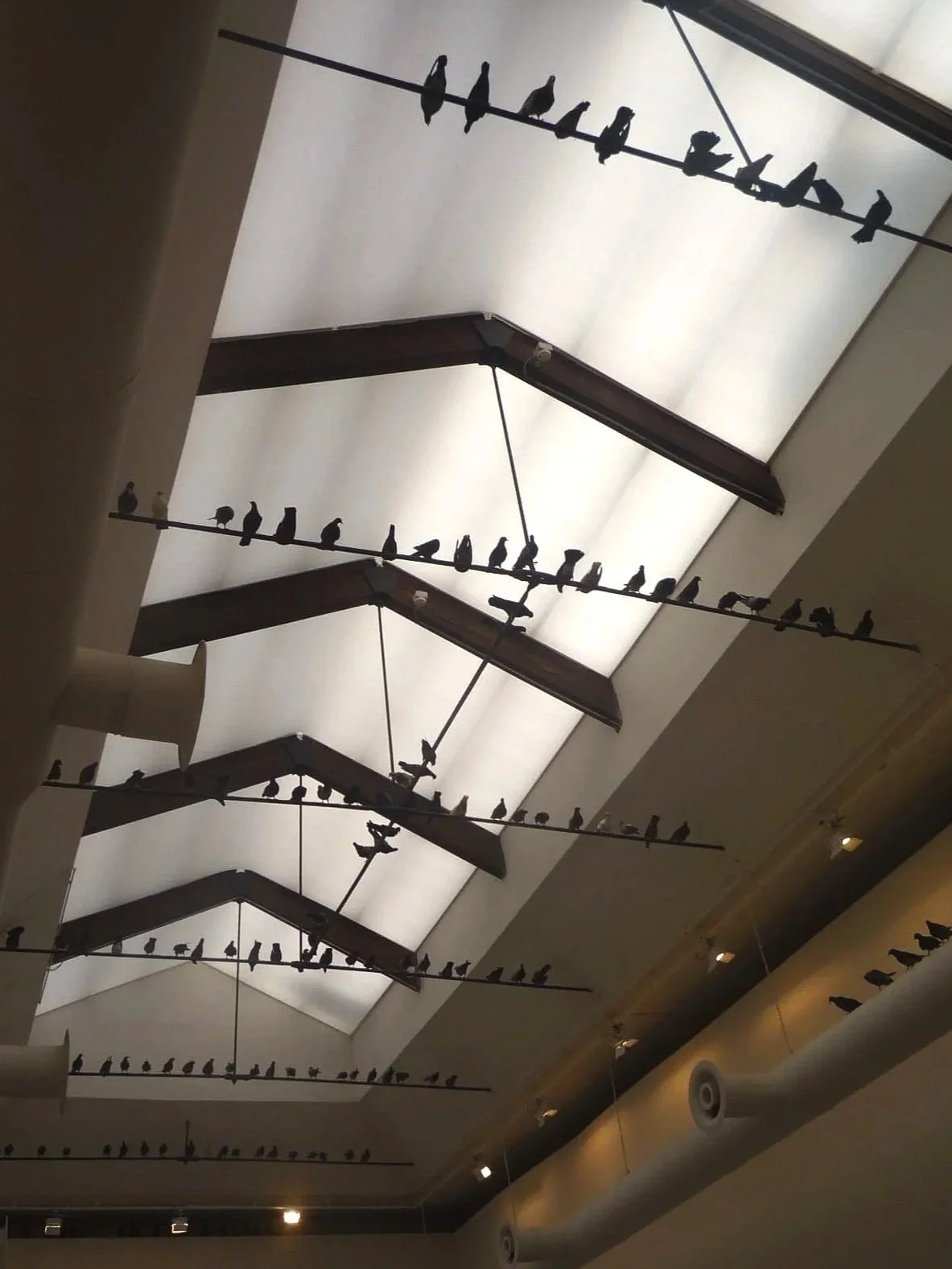
Maurizio Cattelan’s doves in the International Pavilion 2011, curated by Bice Curiger and Giovanni Carmine. Photo: Power Ekroth
Bice Curiger, who with Giovanni Carmine curated the 54th edition, ILLUMInations, in 2011, offers a more romantic and perhaps naïve understanding of the pavilions:
Actually, in many cases, the history of the national pavilions at the Venice Biennale is also a story of utopian aspirations, the desire to take part in an international dialogue. Where can we overcome restrictive ideologies and clichés, if not in art? Isn’t the Biennale in some ways a temporary, ideal community, a nation of art?
Bonito Oliva gives another example of his determined involvement with the pavilions:
[…] I was directly involved in the decision to give the American pavilion to Joseph Kosuth, and to make sure that the German one could present a Korean artist named Nam June Paik.
Elsewhere he describes his work as a critic as “a constant hand-to-hand confrontation with art and culture and the world.”
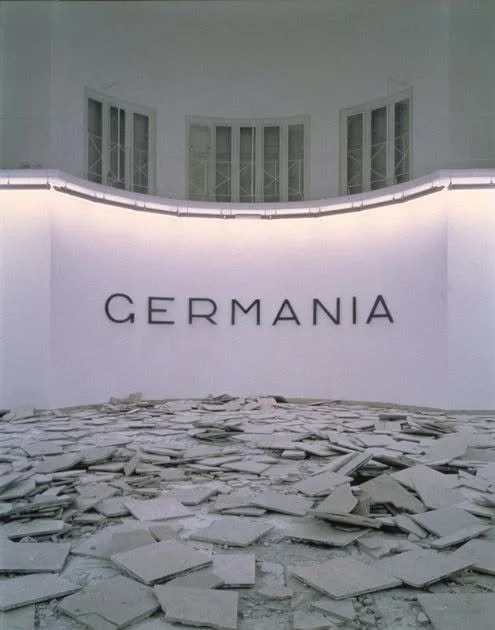
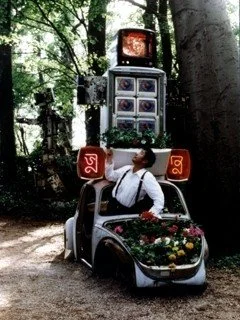
Hans Haacke and Nam June Paik, German Pavilion 1993. Photo: unknown
Bonami had another model. He imagined his Biennale as a “hot-air balloon that rose up over the world to offer a moving observatory, allowing a constantly changing perspective.” He invited a large group of other curators to make their own sections, among them Gilane Tawadros, Igor Zabel, Hou Hanru, Carlos Basualdo, Catherine David, Gabriel Orozco, Hans Ulrich Obrist, Molly Nesbit, Rirkrit Tiravanija and Daniel Birnbaum.
He also created a Palestinian pavilion after visiting Israel, while other sections of Dreams and Conflicts focused on politically charged regions including Eastern Europe, South America, the Arab countries, and Africa. One section of the Arsenale was titled Clandestine.
Okwui Enwezor, curator of the 56th edition in 2015, gives one of the book’s longest and most forceful answers when discussing his idea of the Giardini as a “garden of disorder”:
If one were to really think about the silence of history that overhangs the pavilions, and how loud it rings when you enter the Giardini, that for me is very astonishing, and a strong metaphor to explore. In the Giardini, among the ramshackle architectural follies, exist the rise and death of empires, the collapse of the colonial state, the misappropriation of ideologies. That’s why Marx was such an essential figure in the drama of the exhibition I organized. Let’s take the Belgian Pavilion as an example. It was the first national pavilion to be built in 1907. But not many people make reference to the fact that at the beginning of the century King Leopold held Congo as his personal property. He never set foot in it, but nonetheless, through his murderous agents he transformed a territory much larger than the entire Euopean continent into a vast and reprehensible labor camp. Congo was really the first global atrocity of the 20th century, the first genocide, in which nearly nine million Congolese died. If you take this very specific example, and layer it onto the history of Nazism and Fascism, the Bolshevik Revolution, decolonization, the end of empire, the Cold War, the fall of the Berlin Wall and the collapse of the Soviet Union, then the Giardini, with its virtuous circle of national pavilions, immediately projects a terrible picture of global disorder. So, how can we avoid thinking that the history of nations is also this history of extreme and excessive violence? This history gave shape to the conglomeration of pavilions and it begs a series of questions. For example, what does it really mean to be in the British Pavilion? […] The Giardini is an atomized space of incredible geopolitical turmoil. It is a despoiled space.
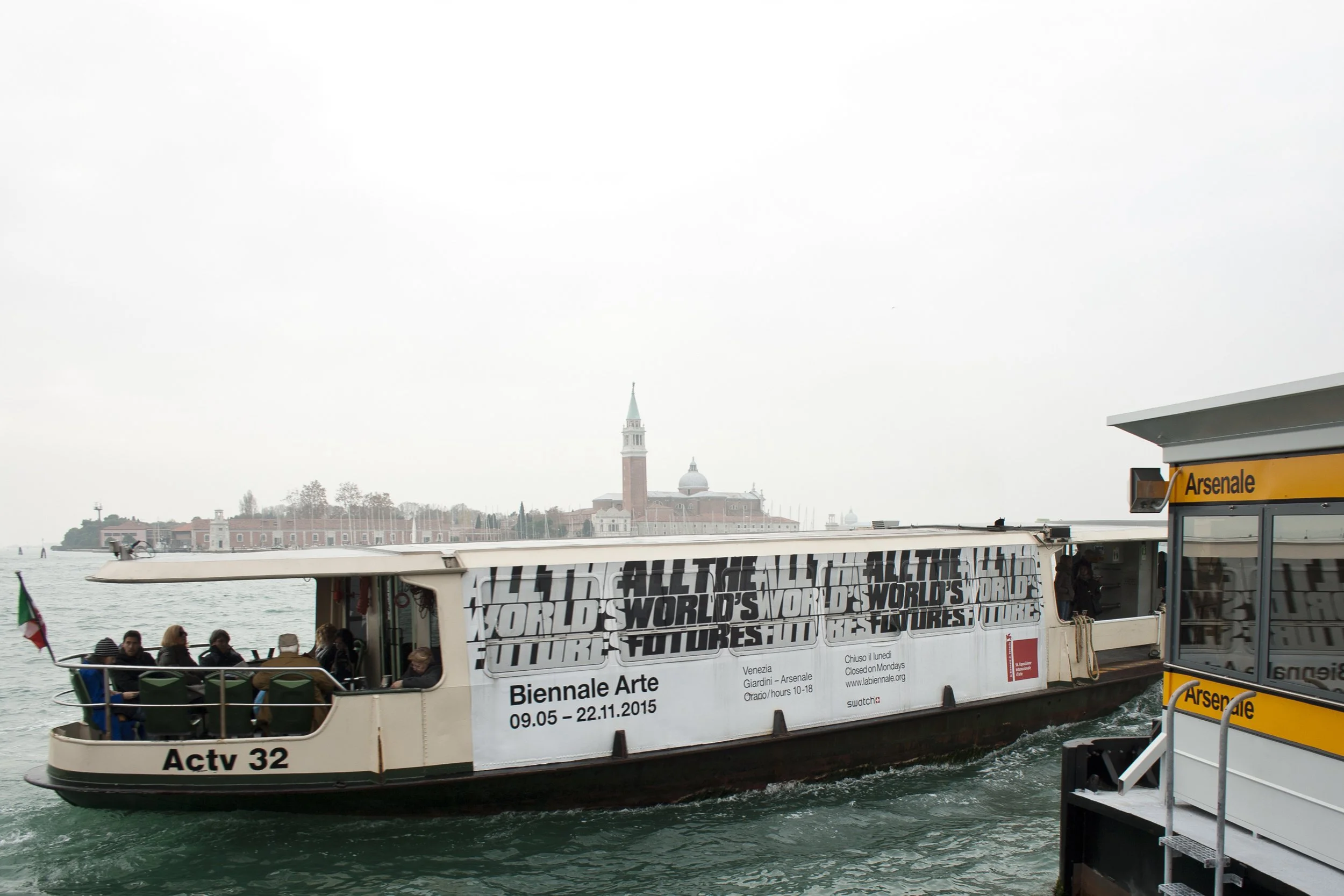
From Venice, 2015. Photo: unknown
Enwezor also names the 1974 Biennale, entirely dedicated to Chile one year after Pinochet came to power, as a “touchstone.”
Other curators were less interested in politics. Christine Macel’s Viva Arte Viva is described by Gioni as producing “an introverted version of art and the world that seemed to step away from the socio-political approach […] in favor of a more personal, idiosyncratic one.”
The contrast is fascinating. What remains underexplored is what those choices actually did to the exhibitions
Time, money and gender
The perks of being the curator di tutti are considerable. You are given a chance to write yourself into history, to become a kingmaker of sorts, and apparently you get a bicycle during installation and a motorboat with a driver during the opening days. You also get around 2 million Euro to play with, excluding donations and sponsorship.
The downsides, mentioned by almost everyone in the book, are remarkably consistent: only 2 million Euro, and never enough time.
The most extreme example discussed is the Martínez and de Corral edition of 2005. They had only eight or nine months between appointment and opening. Germano Celant apparently had six months for his 1997 edition. He is absent from the book because he passed away of Covid 19 in 2020.
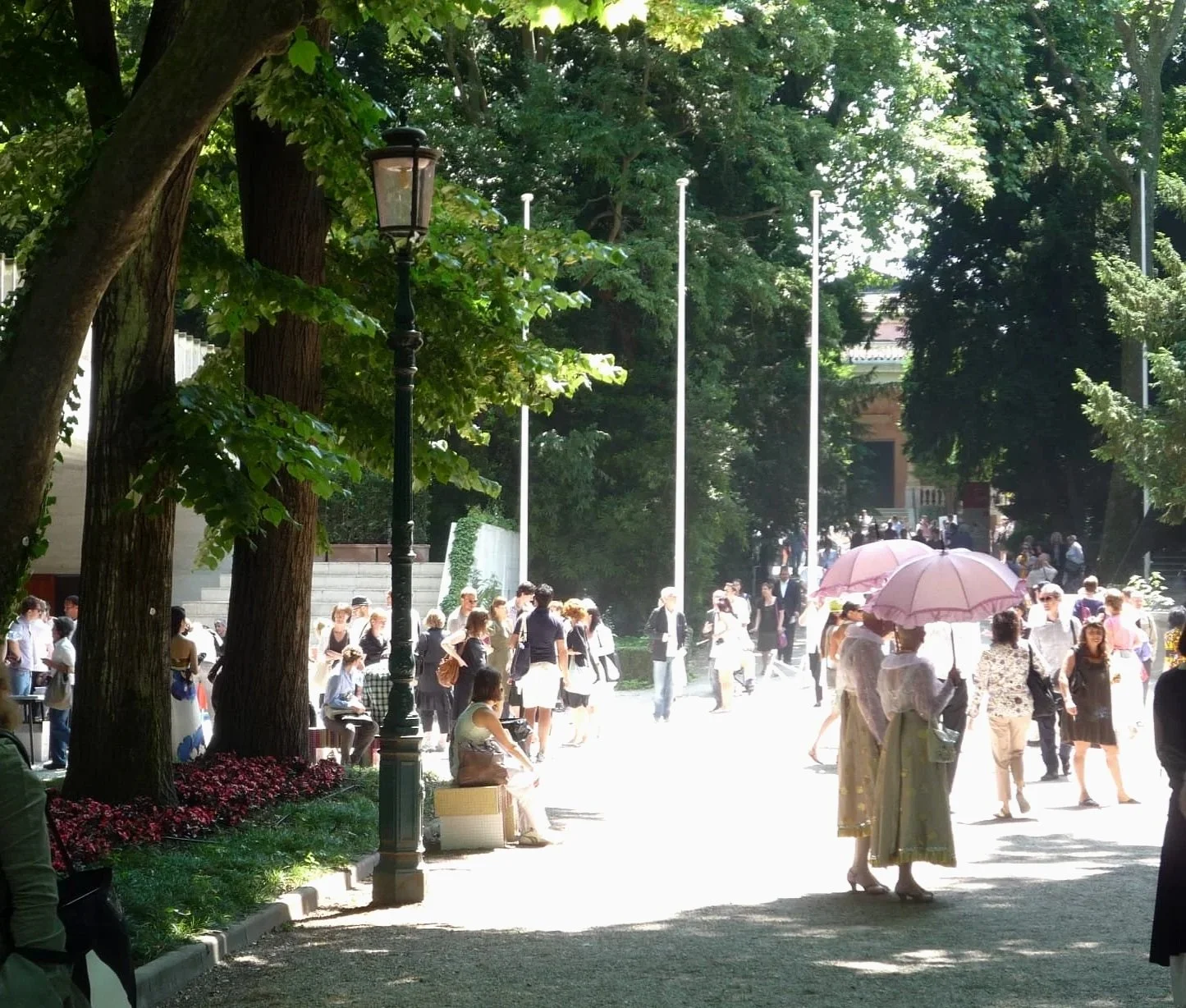
Giardini, opening days 2011. Photo: Power Ekroth
Time was also one of the main topics during the opening days in 2005. How had they managed to get everything installed? How had they even managed to publish the catalogue on time? Compared with the 2003 edition, when many labels arrived only after the press days and several installations were still not working, the Martínez and de Corral Biennale appeared meticulously installed. The overall critical judgment was nevertheless not particularly positive.
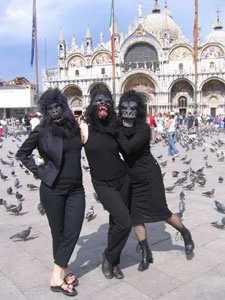
The Guerilla Girls in Venice. Photo: unknown
Martínez believes that their Biennale, with her curating the Arsenale and de Corral the main pavilion, will be remembered as the first feminist Biennale. It was unprecedentedly curated by two women and included artists such as the Guerrilla Girls within an explicitly feminist framing. The actual gender ratio in their international exhibitions was however 38 percent women to 62 percent men, interestingly enough.
At the first Biennale in 1895, women made up only 2 percent of the artists. A century later they still represented only 9 percent. It was not until Cecilia Alemani’s The Milk of Dreams in 2022 that the proportions swung dramatically in the opposite direction, with around 90 percent women and gender nonconforming artists.
This matters because representation still counts. It also shows why asking curators how they hope their exhibitions will be remembered cannot be the end of the inquiry. Memory can be tested against what was actually there.
Then there is the recurring problem of money. The Venice Biennale begins from a highly underfinanced position, and every curator has to make the numbers work by bringing in sponsors and relying on galleries to finance production, shipping and other costs. Galleries, in turn, have an obvious interest in the visibility and market value produced by Biennale participation. Several curators in the book are open about the lack of money.
The more useful questions would concern what happened next. Which galleries stepped in? Which works became possible because a gallery paid? Which became impossible because nobody did? Could an artist without substantial commercial representation produce on the same scale? Did outside financing affect whom a curator could realistically invite? Were compromises made? The budget itself tells us very little but the conditions it creates tell us a great deal.
The art
Beyond money and logistics, the book’s most revealing void is visual: there is not a single illustration.
Picture rights cost money and selecting representative images from shows with hundreds of works is difficult. But to offer no visuals at all reinforces the very problem the book purports to dissect: the reduction of art into curatorial rhetoric.
Exhibitions are sort of spatial arguments. A painting’s charge changes when placed next to a loud video loop; physical rhythm, architectural friction, and scale shape how meaning is produced. Most troubling is how marginal the actual art becomes in the conversations. Artists frequently appear as long lists of names with little context. Without images, the reader is asked to remember installations seen seventeen years ago or to reconstruct enormous exhibitions through names alone.
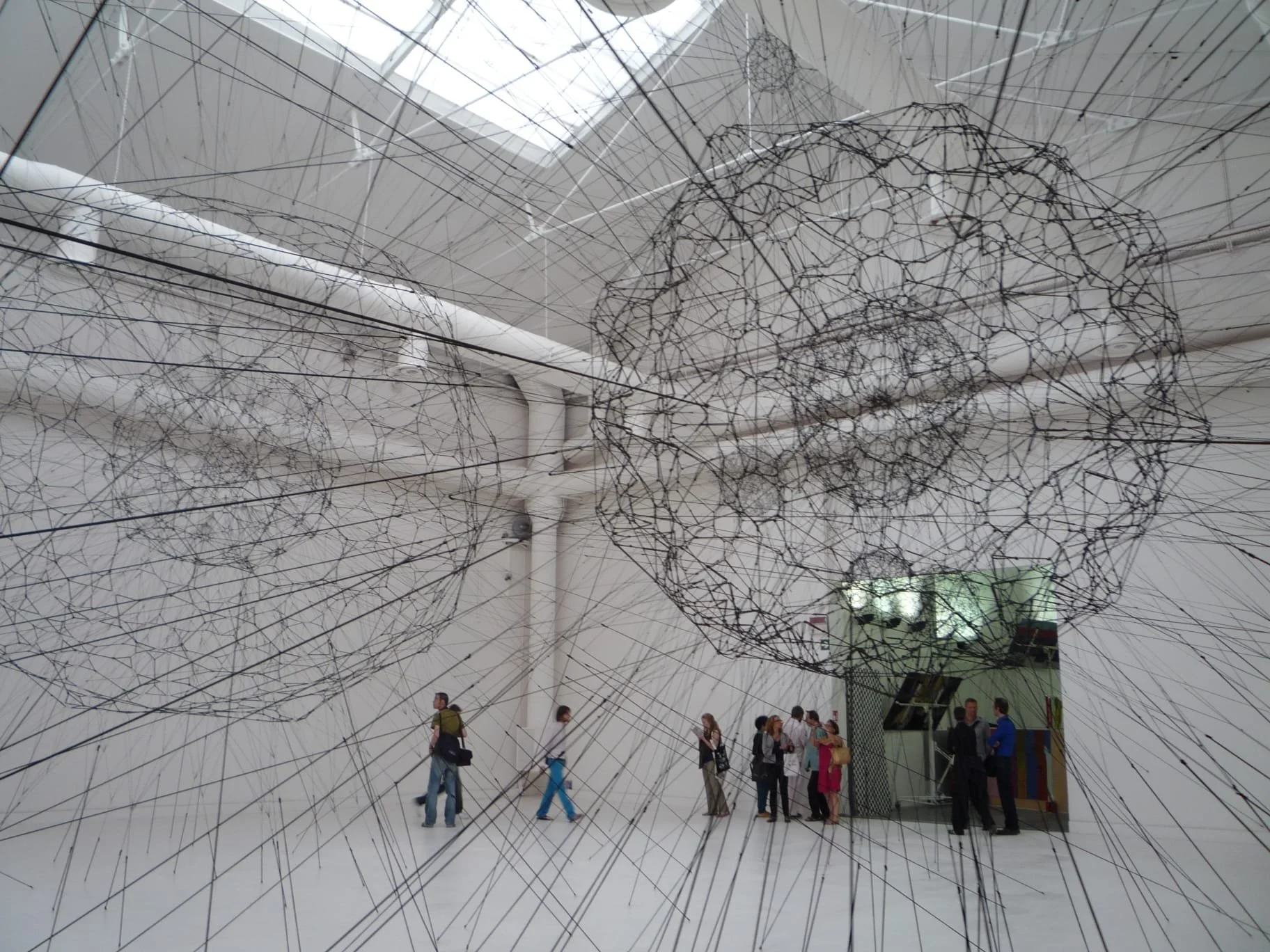
Tomás Saraceno, installation in the International Pavilion in Fare Mondi / Making Worlds, the 53rd Venice Biennale curated by Daniel Birnbaum 2009. Photo: Power Ekroth
An exhibition almost never survives its original plan intact. Works arrive damaged, sightlines fail, time evaporates, and accidental juxtapositions create meanings the curator never intended. How did these material realities alter specific works? Which installation transformed once physically built in the Arsenale? What did the lack of money do to particular works? What did the shortage of time make impossible? Which artist became more important to the exhibition than expected? Which decision would the curator change now? Did any of them discover that the exhibition had become something different from the one described in the catalogue, which by then had already gone to print?
Those are not anecdotes sitting outside the curatorial argument. They are part of the argument. The absence of images is perhaps less a design decision than a symptom of the book itself: a book about curating the Venice Biennale in which art and artists constitute the reason the exhibition exists yet somehow remain outside most of its stories.
Abuse of power comes as no surprise
The curator of the Venice Biennale is given extraordinary power. The appointment can change a career, and the subsequent choices can change many others. A curator determines visibility, proximity, context, and access to resources. Artists are selected and excluded, galleries invest, and many different institutions cooperate. Histories are rewritten and careers accelerate.
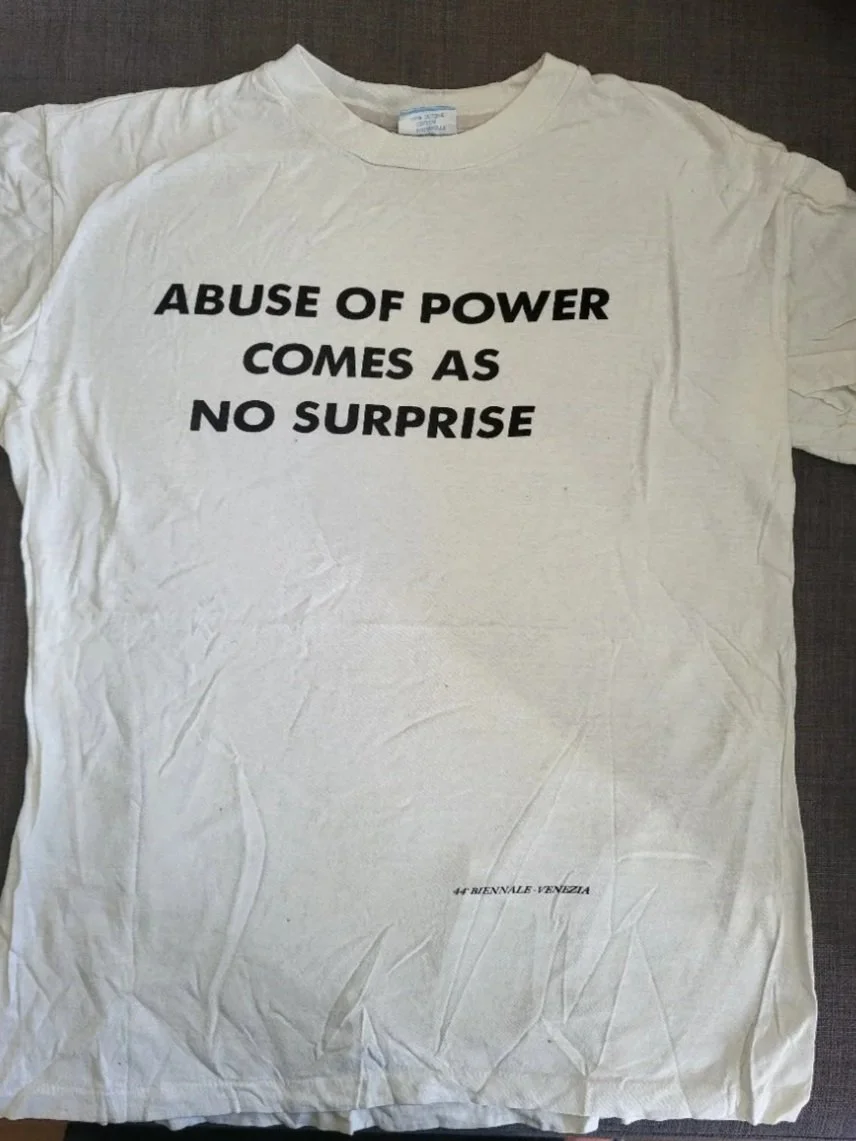
A T-shirt from Jenny Holtzer’s US pavilion for the 44th edition of the Venice Biennale 1990. Photo: Power Ekroth
Where power exists, its misuse should hardly come as a surprise. This is also precisely where High Waters becomes too quiet.
The curators are allowed to muse about how they hope their Biennale will be remembered, yet criticism is rarely pursued far enough to find out what it might have got right. The lasting impression after this intimate sit down with many of the most influential nodes of the contemporary art world is one of frictionlessness.
Gioni is not a journalist. He continues to work as a curator and as director of the New Museum in New York and Nicola Trussardi Foundation in Milan. He needs continued relationships with many of the people in this book, and his place inside this world is precisely what gives him access to them. That is part of the bargain. But access is most useful when it gets us somewhere that public statements, catalogues and press conferences cannot.
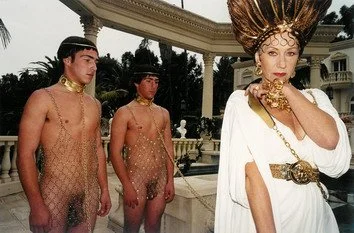
Still from Francesco Vezzoli’s film Trailer for a Remake of Gore Vidal’s Caligula, Italian pavilion, 2005
The interviews rarely enter the dreams and conflicts between curators and artists or between artists themselves. They leave aside the fights, the impossible demands, the resentments, the personal relationships and the “bunga bunga” parties after dark in the Giardini that have certainly formed part of the Biennale’s unofficial history. These stories need not be included for their scandal value, but their consequences can alter the contexts of an exhibition. A feud, an attraction, or a breakdown can become as much a condition of an exhibition as a budget line or a wall plan.
More serious questions about the exercise and misuse of curatorial power also remain outside the frame. That absence becomes especially conspicuous because Gioni is so close to the protagonists. His proximity gives him the possibility of asking questions that almost nobody else could ask, but unfortunately it leaves the reader to repeatedly be left wondering what remains protected by that same proximity.’
The interview with the curatorial team assembled by Koyo Kouoh presents another kind of difficulty. After her untimely death before the opening, the remaining team had to realize the 61st edition, In Minor Keys, without the person whose vision had brought them together. Grief alone would have made this an exceptional process. There must also have been decisions about interpretation, responsibility, continuity and how faithfully an unrealized intention could be carried forward. Gioni himself describes the result of the exhibition having “a touch of hagiography.”
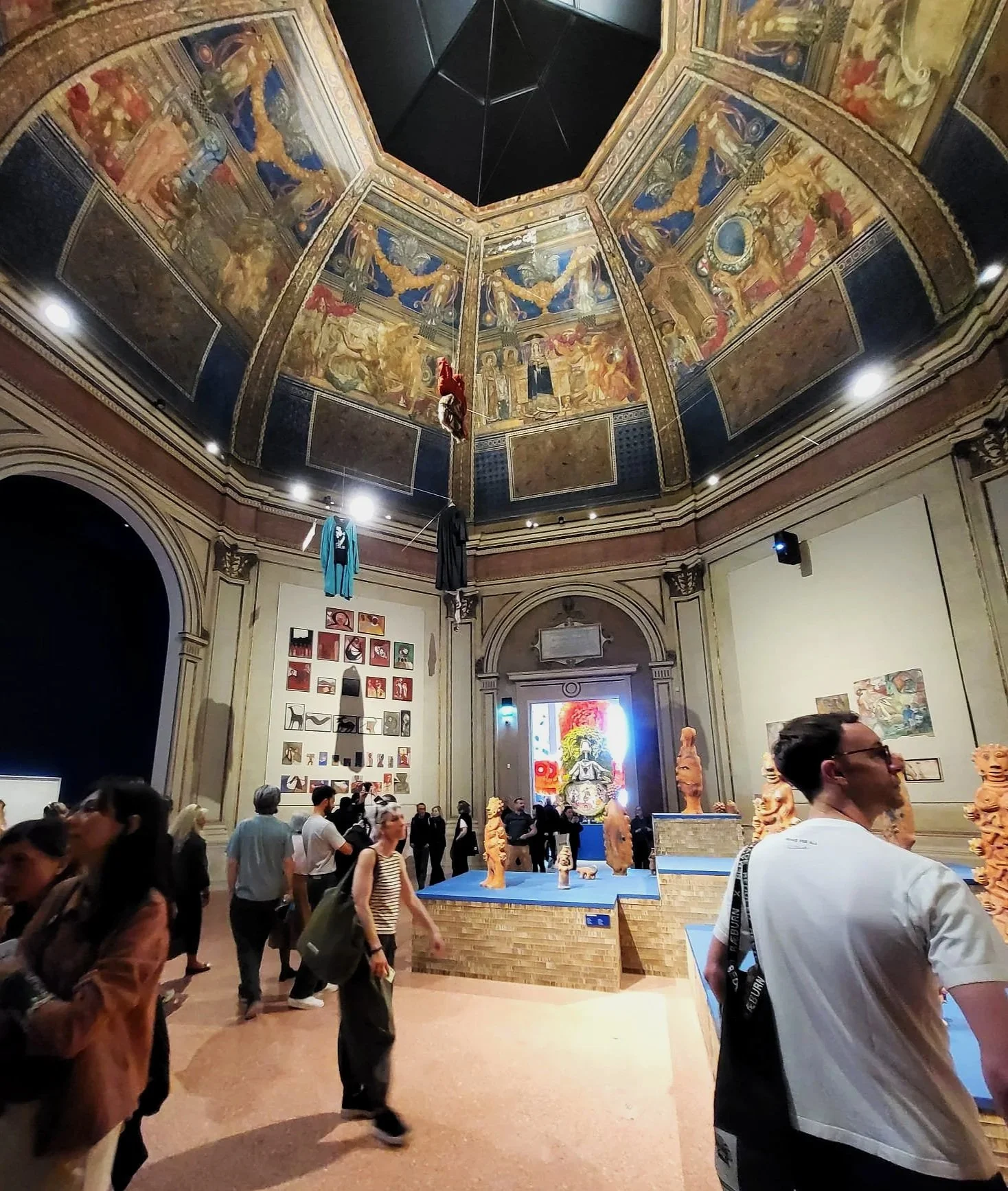
La prima rotonda, International Pavilion, 2026. Photo: Power Ekroth
But when the team is asked how the exhibition will be remembered, the answers are tame:
As an exhibition where people sit.
and:
Something beautiful.
Perhaps the more fruitful recurring question throughout High Waters would have been:
What did your critics get right?
It might have opened another history altogether.
Jean Clair is probably correct that people have short memories. Christine Macel is also right that what remains from a Biennale should finally be the artists and the works.
After the high waters, Acqua Alta, Venice eventually returns to Acqua Bassa. Perhaps this is also where the real work of the Biennale takes place: in the long periods between exhibitions, when decisions are made, conditions negotiated and the scaffolding for the final visual expression is assembled. Anyone hoping to understand how these exhibitions actually came into being may have to wait for an imaginary companion volume called Low Waters.