

Kommt Zeit, kommt Tod
Leif Magne Tangen
March 26–30, 2026. First draft handwritten in a notebook with a soft pencil.
The first thing I did when I heard of Alexander Kluge’s passing was to watch his Trauerrede on the occasion of the death of the poet Heiner Müller, January 1996. The eulogy was delivered during a Trauerfeier at the Berliner Ensemble that lasted several days, possibly weeks. Here Kluge emphasizes the importance of production (understood as thinking out loud, preferably through a medium).
What do you write with? This question is put to Alexander Kluge in Merve Verlag’s book Verdeckte Ermittlung from 2001.
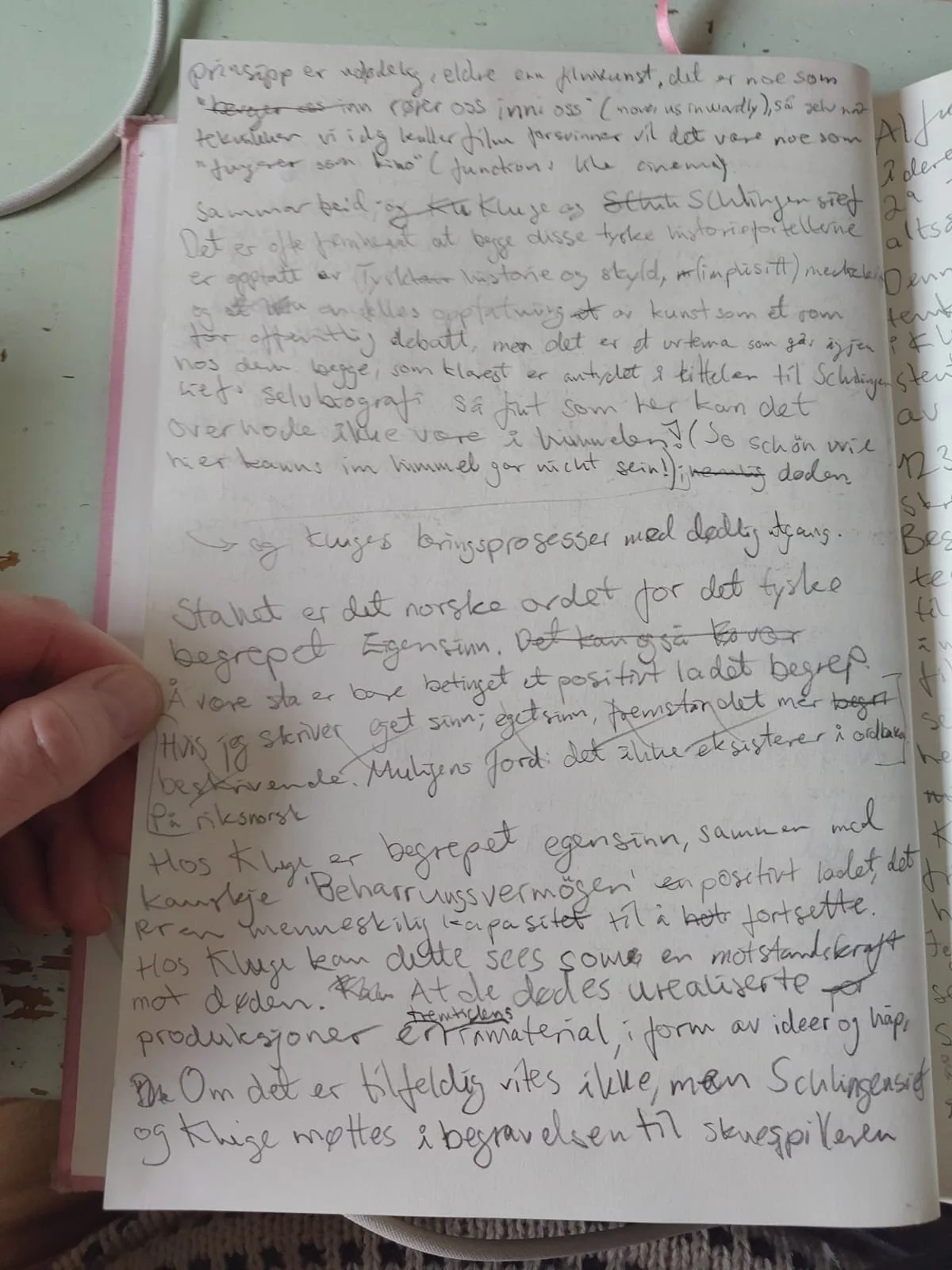
With a soft pencil. Unlike the ballpoint or fountain pen, it possesses a necessary indeterminacy, Kluge replies. One writes with the pencil in a cahier, that is, a notebook, but he crosses things out and then writes something new instead of using an eraser, which would also have been a possibility. When asked whether he could imagine writing on a computer, this is confirmed as something imaginable, but not that he himself would write anything on the computer, since the stories arise “from the tip of the pencil,” his “Bild das im Kopf,” and the first sentences never amount to anything. Kluge needed a certain run-up, or preparation time, in order to write himself into the stories (“einen gewissen Vorlauf, in dem ich mich einschreibe”). It took three days.
Rainer Werner Fassbinder, Jean-Luc Godard (JLG), and Alexander Kluge. Three now dead thinking filmmakers. An entire minute of black screen in the cinema, and the people present hear (for one minute) that they are alive (Heiner Müller on JLG via Kluge). For Kluge emphasized that if Fassbinder had lived to celebrate his 70th birthday in 2015, he would have been working on his 182nd film. They are absent, they are missed.
What Kluge nevertheless missed most of all was his fellow traveler. One thing, however, was certain: Fassbinder’s coffin was empty. He lived on? Of course not physically. Yet his work still resonates, like a ghost if you will. Because, as Kluge notes in the foreword to the book Cinema Stories (2007), cinema as a principle is immortal and far older than film art. It is something that (be)stirs us inwardly (moves us inwardly), so even when the technology we today call film disappears or falls silent, there will still be something that “functions like cinema.”
Collaboration: Kluge and Christoph Schlingensief
It has often been emphasized that both of these now dead West German storytellers were concerned with the history of their country and culture, including its guilt. There is an (implicit) shared conception of art as something that discusses, but death is the primal theme that more strongly binds them together. It recurs in both and is also illustratively present in the title of Schlingensief’s autobiography, So schön wie hier kanns im Himmel gar nicht sein! (Heaven Couldn’t Possibly Be as Beautiful as It Is Here!), as well as in Kluge’s book title Lernprozesse mit tödlichem Ausgang (Learning Processes with Deadly Outcomes).
"First and Foremost, I Am a Filmmaker"
Christoph Schlingensief in conversation with Alexander Kluge on the occation of his installation chicken balls. der hodenpark at the Museum der Moderne Salzburg, Salzburg, Austria.
First shown by dcpt’s show 10th - 11th, December 2006
In everyday usage, stahet is the Norwegian word most often used for the German concept Eigensinn. This despite the fact that both egensinn and egenrådighet exist in Norwegian. To be stubborn carries only a conditionally positive charge. In Kluge, the concept of Eigensinn, together perhaps with Beharrungsvermögen (that is, perseverance), is positively charged; it is the human capacity to continue, to endure. It can be understood as a resistance to death. The unrealized projects of the dead remain as raw material in the form of ideas and hopes, wishes, dreams.
It is perhaps no coincidence that Alexander Kluge and Christoph Schlingensief first met at the funeral of the actor Alfred Edel. Both gave a eulogy. Afterwards, in their very first conversation, their collaborations began. Twenty-nine TV programs/films/reels later, they had consistently thematized the vitality of life (Lebendigkeit). This montage, this fusion of two thinkers, this layered understanding, runs throughout Kluge’s production. It is an astonishingly consistent, stable part of his oeuvre.
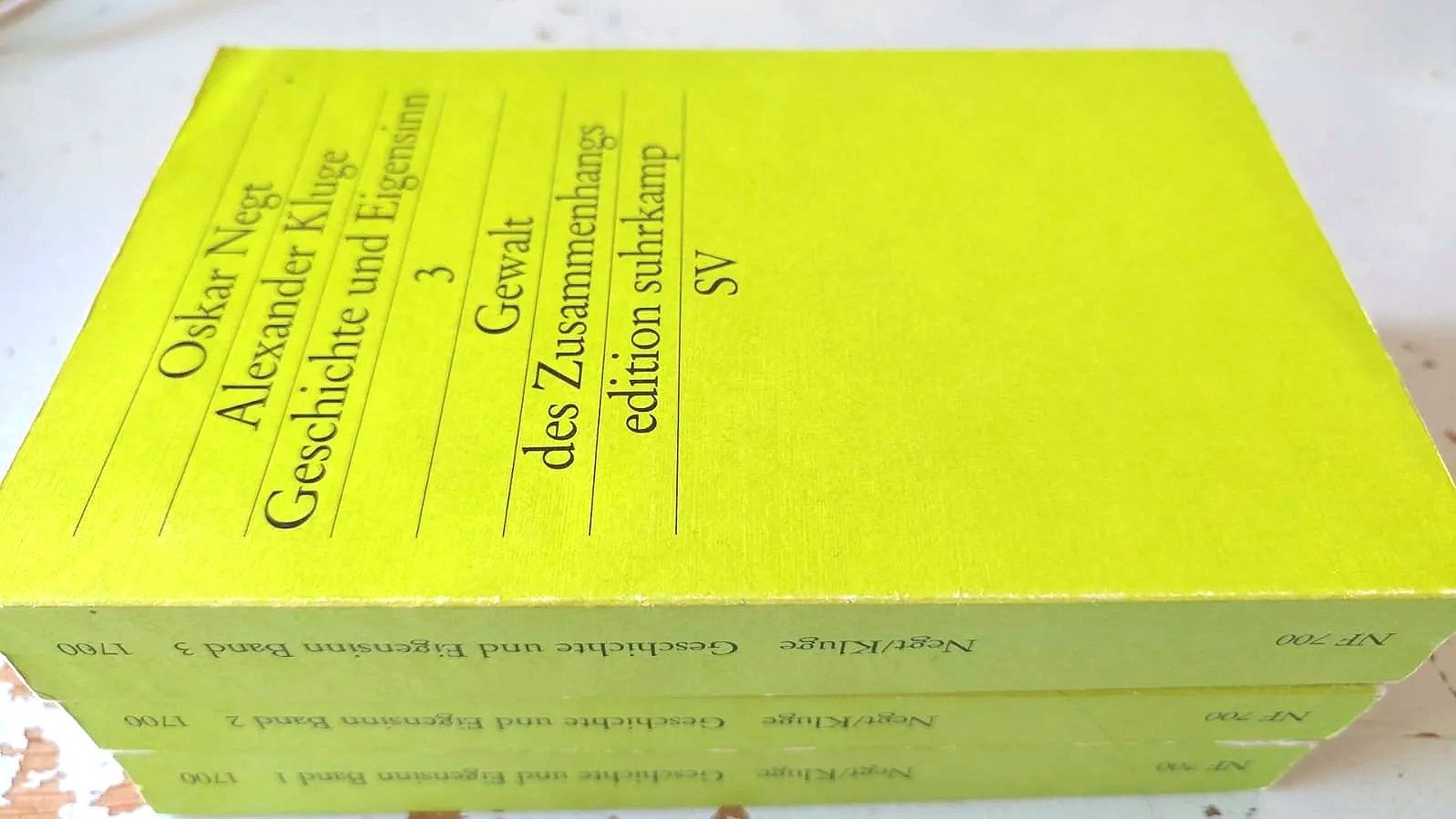
The first book by Kluge that I read (and did not understand) was the 1,239-page, three-volume Geschichte und Eigensinn (History and Obstinacy), written together with the social philosopher Oskar Negt, described by Fredric Jameson as “something of a theoretical film.” My relationship to it has much in common with, and is probably inspired by, Schlingensief’s reading of philosophy; that is, I am comfortable in the role of a theoretical dilettante, a non-expert. I dabble in philosophy and theory without having enough tools to situate what I read in a larger theoretical framework, and yet it gives me something that stays with me and comes to expression in my curatorial work.
Kluge, Halberstadt... and John Cage?
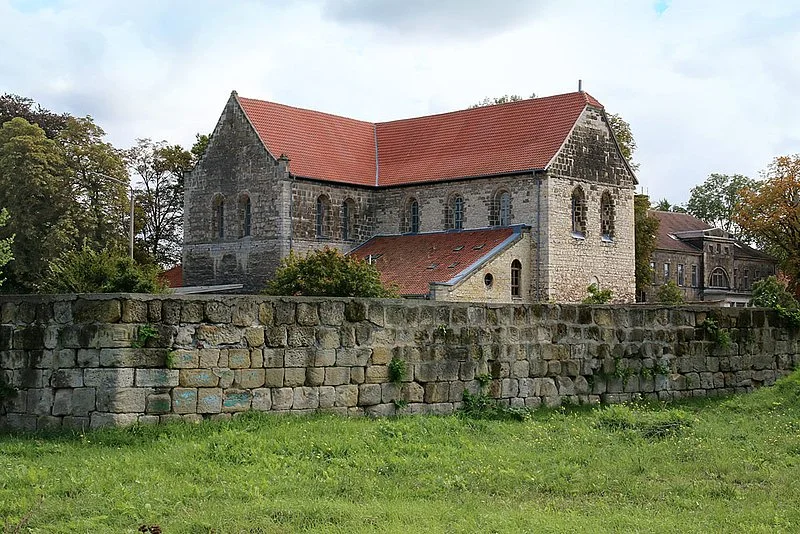
The St. Burchardi monastery in Halberstadt where John Cage’s organ project, the slowest and longest piece of music in the world will be performed for 639 years.
Alexander Kluge was born in Halberstadt in 1932 and grew up there until the U.S. bombing of the city in 1945. A footnote in his biography is that he also studied church music; it is tempting to assume that this means organ. I cannot recall that Kluge in his work ever engaged with John Cage’s piece As Slow As Possible (1985), which since 2001 and (hopefully) until the year 2640 has been performed in St. Burchardi Monastery in Halberstadt itself. A project that deals with themes such as death, (fragmented) history, and operates on extremely long time scales—should that not be of interest to Kluge? Perhaps it is too disconnected from society, becoming irrelevant in its slow abstraction.
For me, both—within a kind of Cage-Kluge container—are concerned with montage, fragments, and layered reading. In Kluge’s spirit, perhaps we can imagine, in search of a practically realistic attitude and in keeping with his markedly associative way of thinking, a short film: Cage’s Empty Thoughts. A film blending excerpts of conversations, staged sequences, reflections by others—around emptiness—as a kind of mixture of Cage’s chance operations and Kluge’s essay montages. It is also easy to imagine a link to JLG (again via Heiner Müller). There is something at work here. The Cage-Kluge container would then contain a longer conversation between two people with distinctly soft voices when speaking in public. Kluge, of course, outside the camera angle, «in off» as they say in Germany, with eager comments, almost without direct questions. What is certain is that when Kluge received the Heine Prize in Düsseldorf in 2014, excerpts from Cage’s Three Easy Pieces for Piano (1933) were performed.
Collaboration: Ben Lerner and Venice
In the book The Snows of Venice (2018), Cage nevertheless appears, in the form of a text by the poet Ben Lerner.
An organ piece lasting six centuries
Begins in the reconstructed city
Muted by a cube of glass
The chords will change in 2020
To warn the citizens of Halberstadt
Bombers are approaching
On April 8th, 1945
(excerpt from Halberstadt brennt, or the slowest music in the world, p. 123).
A few pages earlier in the same book there is an excerpt from a conversation between Lerner and Kluge in Venice’s Palazzo Corner della Regina. Two works by Paul Klee are projected for the two speakers and their audience: Stachel, der Clown (1931) and the much better-known Angelus Novus (1920). Kluge asks Lerner, possibly rhetorically, whether he recognizes the image of the angel of history. Lerner responds by referring to the artist R. H. Quaytman (“Rebecca”) and her discovery that Klee’s angel sits atop an already existing print depicting Martin Luther. “The angel of history, the symbol of Jewish messianism, is laid on top of Luther. This places Benjamin’s theses and Luther’s theses in a new relation,” says Lerner. Further: “It is a striking irony when one thinks about Benjamin’s ideas on reproduction.” The fact is that reproductions of Klee’s image do not show the surrounding paper, only the print itself, and thus not the small bit of the print by the Dresden artist Friedrich Müller from the 1830s, which itself is based on a portrait of Luther in a painting by Lucas Cranach the Elder from 1521.
Kluge says that poets are diamond cutters. But there are, as we know, also excavators of unpolished diamonds, and that he (Kluge) is a good archaeologist. He goes on to say that Lerner’s account of the angel is like an archaeological excavation. She digs through the paper and “[...] finds a connection between Luther, who was in any case an antisemite, and Paul Klee.” Lerner replies that Luther was also against angels. That Luther was an antisemite is well known and established. To my knowledge he was an iconoclast; he believed depictions of angels were a catalyst for idolatry. Kluge did not delve further into Lerner’s reply; instead, he returned to the angel and the clown. He wished for the angel in the 21st century to become an archaeologist.
Perhaps Kluge noted this because of Walter Benjamin’s epilogue to the essay on the work of art in the age of mechanical reproduction? In Cinema Stories, Kluge argues that Benjamin here hints at a film theory that would be useless for fascism and that would have value for a cinema of emancipation (a cinema for emancipation). Benjamin writes, as reproduced in the book:
Fascism attempts to organize the newly proletarianized masses without affecting the property structure which the masses strive to eliminate. Fascism sees its salvation in giving these masses not their right, but instead a chance to express themselves. ... The logical result of Fascism is the introduction of aesthetics into political life. ... All efforts to render politics aesthetic culminate in one thing: war. [the italics are Kluge’s]
Kluge connects this to the fictional 2006 PhD student at The New School, Vera Holbrooke. She problematizes this emancipation and further points out that by making the horrors of war more visible through a stronger focus on everyday life (and thereby its beauty, I assume), one might perhaps make it possible for those receptive to fascist aesthetics to see the problematic sides of fascism more clearly. Because war was part of Kluge’s project all along. In 2003 he published the book Die Lücke, die der Teufel läßt. Im Umfeld des neuen Jahrhunderts (in English The Devil’s Blind Spot: Tales from the New Century) with an image of the remains of the Twin Towers on the cover. In the foreword Kluge wonders whether we are entering a new Middle Ages. He too was misled by the hope for the future that prevailed in 1989, he admits.
History and war. The value of unresolved problems.
“He seems timeless,” Kluge writes of the brain researcher Eric Kandel. When I now, after his death, looked up and watched Kluge’s Trauerrede for Heiner Müller, the one from 1996, I was at first irritated; had I seen wrongly, was this a much younger recording of Kluge on a stage, speaking about his dead friend Heiner Müller? But no. The 64-year-old Kluge does not look that much younger than the 93-year-old Kluge who conversed with Anselm Kiefer toward the end of 2024. In his last public conversation (that is available), Alexander Kluge discussed, two months ago (January 2026), with curator Hans Ulrich Obrist under the heading AI and Philosophy: The Meteorology of Thought on AI. A man of 94 managed to think through the currently dominant technological innovation shaping the way we think. What was striking was that he began the conversation with an account of how rapidly war is escalating and expanding now in 2026, before turning to AI’s potential as, as I understand it, a kind of assistant archaeologist.
Lerner points out, when Kluge calls himself a linguistic archaeologist, that Kluge’s montages resemble poetry’s use of line breaks. It is a graphically complex and beautiful book, The Snows of Venice (The Kluge-Lerner Container); it is also a typical Kluge production for two reasons. As with any (hyper)productive artist, Kluge reuses texts, images, and thoughts from earlier productions. And although the book is designed (by Pascal Storz and Fabian Brenner), the different sections are typically Klugian in that through montage they achieve what Kluge calls a “third image.” Philipp Ekardt dwells on this in his monograph Towards Fewer Images (2018). Montage does not combine images cumulatively; rather, the juxtaposition clarifies the difference between them, and the result is a third image. This is, according to Kluge (via Ekardt), unseen (ungesehen), yet nonetheless incorporated into the visible. These third images are characterized by their silence, and therefore these third images are also still images. According to Ekardt this is not quite as esoteric as it may sound. This way of presenting images activates the viewer’s critical faculties, according to Ekardt. I think it is more common to think of Kluge’s works as never finished, as works in progress. All of his production experimented with different perspectives and temporal layers, which led the audience (a word I believe Kluge did not appreciate) to be encouraged and activated to trust their own associations. One wonders whether this is not closely connected to his ideas of an emancipatory counter-public sphere (Gegenöffentlichkeit), or perhaps of a mode of organizing labor in which subjective productive forces are emphasized, as in his endless collaborations and conversations with Oskar Negt.
The concept of “constellation” is, if anything, even more important in Kluge’s work. “Constellations” allow invisible connections, that which cannot be represented in lines (Kluge says in The Snows of Venice). To me this appears to be Kluge’s more contemporary way of describing the third images. It is here that the angel—the hope that it may become an archaeologist, that is, one who excavates diamonds—finds its Klugian place. This archaeologist is of course concerned with gathering fragments, preferably from different eras, assembling them, and creating a new constellation, a new third still image. By doing this, I think Kluge is saying that the horror of war and the pain of the past can communicate with the present and project into the future, and that we thereby move beyond what can appear to be a legally prescribed and inevitable future. Perhaps I am mistaken.
In Oskar Negt and Kluge’s Geschichte und Eigensinn (History and Obstinacy), it is written, as I recall, that the process in which life dies is not the moment at which catastrophe occurs. Life can be dead and continue for a while longer. As I understand it, this must be seen in connection with the suffocating broadcasting regulations in West Germany in the 1980s. After the CDU returned to power, within a few years so-called private public-service broadcasters were permitted, partly as an attempt to loosen the SPD-dominated grip on the state channels. These legal changes created a space for action that made it possible for Alexander Kluge—together with his partner, a Japanese advertising company owner—to establish the TV production company Development Company for Television Program (dctp). From 1988 onward, they supplied montage-based cultural programs to private TV-channels such as RTL, Sat.1, and VOX. In this light, the title of Kluge’s 1985 film, The Assault of the Present on the Rest of Time, appears especially precise. The film, markedly episodic, can be read as a bridge between his work as a cinema filmmaker and his later work in television. The establishment of dctp is also, if nothing else, a contributing reason why Kluge published relatively few books in the 1990s.
Presence and life course, an attempt at a conclusion
Back to the conversation book from 2001, and thus the beginning of the end. Here Kluge recounts that it was through Heiner Müller, and as late as 1988, that he came to understand that texts are autonomous; he is neither shepherd nor guardian of these texts. He goes so far as to describe them as partisans. As a result, his texts do not have an order, but a coherence. He no longer allows himself to be disturbed by what he himself finds incoherent.
This text is written “with a soft pencil in a cahier, that is, a notebook,” which feels unusual. And yet it is the case that the fact that I need up to several seconds to write certain longer words means that, to a greater extent than when I “think with my fingertips,” I let time, and thus thoughts, flow away. This stands in contrast to the more jumping, associative mode of writing that often leads to a discrepancy between what I am going to write and what I end up writing about. This is because pencil and paper are one thing. The computer (Kluge said in 2001) is only secondarily a writing instrument; primarily it is an easily accessible portal to another universe. Now, Kluge, in a Benjaminian tradition, was deeply concerned with the generative power of new technology. Something he demonstrated in what he created and spoke about in the last years of his life. There AI played a decisive role, precisely because it is fallible. In a Klugian perspective, this appears as a weakness in the suffocating grip that today’s technoligarchy seeks to establish over the world’s population—as he already suggests in the 2003 book, where he maps the devil’s unrecognized blind spots.
Attendance List for a Funeral (Anwesenheitsliste für eine Beerdigung) is the title of a today probably rather unknown short story from 1972. It begins like this:
Who is afraid?
Adrienne: not afraid
A. Bierstadt: afraid
S. Bierstadt: afraid
Katrin Bierstadt: afraid
Jakobine: is afraid of devaluation (Geldentwertung)
D. Albers: afraid
Annabelle Glaube: formerly afraid, now aggressive
Ernstchen Ermolly: not afraid
G. Fritzsche: not afraid
Deesdorf: afraid when he makes a mistake
F. Gütersloh: afraid
Do the relatives love anyone?
Adrienne: no one
Ermolly: no one
A. Bierstadt: no one
Jakobine: not sure
Ernstchen Ermolly: thinks he loves F.
Annabelle Glaube: no one
Katrin Bierstad: no one
Belve: no one
D. Albers: in the line of duty, all those in need
F. Albers: possibly his wife, but probably no one
F. Gütersloh: no one
Subsequently, and in an almost index-like manner, Kluge’s short story goes through the life course of the deceased and how the funeral is carried out, from what the musicians played to what those in attendance (not many) had to give up in terms of prior engagements in order to be present (A. Bierstadt: visits to the sick; D. Albers: complete a chapter of his evangelicala). It is also considered whether someone or no one is responsible for the death of the deceased. She (Mary) had apparently eaten too much red meat. It ends like this:
See you soon, said Annabelle to Adrienne as she left; Adrienne said nothing, she knew that Annabelle, the doyenne of the other side, camouflaged her hostility by an apparent senility. Most of the relatives pecked each other on the cheek as they took their leave.
The banality of the everyday is striking and demanding. And yet there is something beautiful about this almost everyday listing of these life courses. All of it written with “the necessary indeterminacy.” Perhaps it is pencil and cahier we must return to if we are not to miss the possibility of actually being able to think before we die.
Leif Magne Tangen is a curator and cultural precariat