

Alexander Kluge (1932–2026)
Martin Grennberger
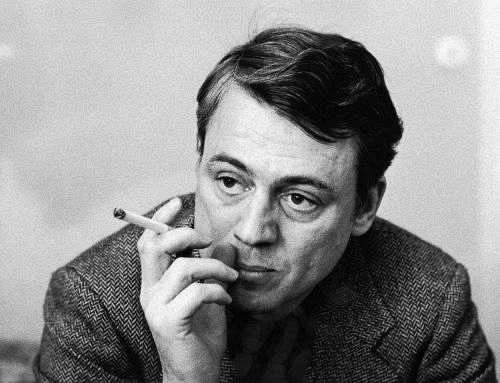
It has been said that Alexander Kluge truly discovered cinema thanks to a person who on several occasions expressed a pronounced aversion to the medium of film: Theodor Adorno. Adorno, as is well known, claimed that he enjoyed going to the cinema but strongly disliked what he saw appearing on the screen. He introduced Kluge to Fritz Lang, and the latter assisted him on Der Tiger von Eschnapur (1959). Already in his debut short film Brutalität in Stein (1961), made in collaboration with Peter Schamoni, we can discern several aspects of the modus operandi that would permeate much of Kluge’s work in film, and later—partly in a different form—when he turned to television in the 1980s: an often highly mobile, heterogeneous montage; the use of archival material; a porous use of quotation; narrative digressions; impulses colored by seemingly speculative associations; voice-over(s) in multiple registers. In Brutalität in Stein, we follow a detailed reading of neoclassical architectural structures and buildings, where the editing is accompanied by both suggestive and dramatic musical motifs. The Nazis’ urban and architectural visions are addressed; we see sketches and blueprints, while we hear the Führer and close associates proclaiming on the soundtrack and through quotations. This is repeatedly punctuated by the cheering of crowds. At the outset we read: “Every building that history has left behind bears witness to the spirit of its builders and to the spirit of its time, even if it long ago ceased to serve its original purpose.” The film concludes with several pans across scattered piles of stone. The memory of history persists in the ruins of architecture and dispersed debris. Brutalität in Stein was first shown at the Oberhausen Film Festival, which is significant in this context, as Kluge the following year would be one of 26 young filmmakers who signed the famous Oberhausen Manifesto, declaring Papas Kino ist tot (“Papa’s cinema is dead”), and that a new German cinema must emerge—one aimed at reforming German film and its conditions of production. Many have seen this as the beginning of a new era in German cinema.
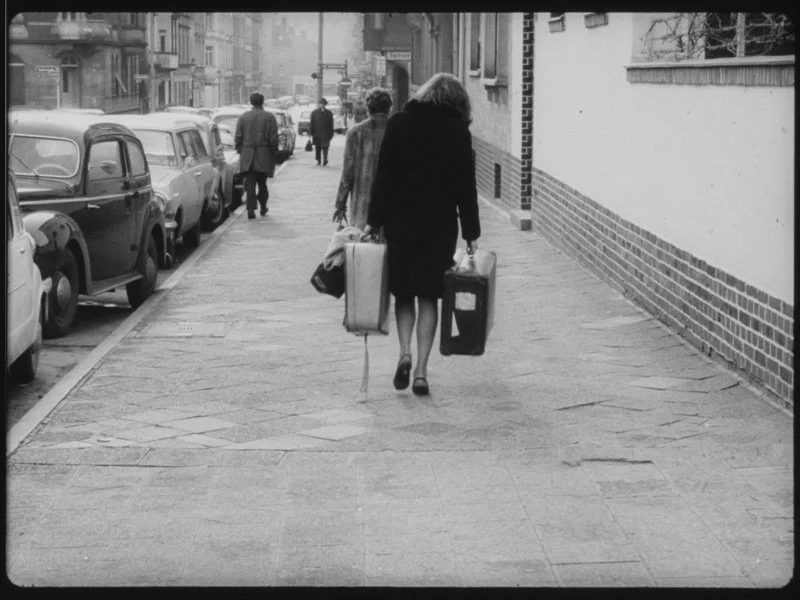
Stillbild från Alexander Kluges Abschied von Gestern, 1966
The sense of new energies and intensified cinematic ambitions is already evident in his feature debut Abschied von gestern (1966). Under the influence of the formal mobility of the French New Wave, and perhaps most notably Jean-Luc Godard’s fractured narrative structures, the film tells the story of Anita G. (after his short story of the same name), played by Kluge’s sister Alexandra—a young East German migrant who arrives in West Germany and encounters a series of difficulties adapting to her new life situation. We follow troubling work situations, a trial in which she is accused of theft, and interrogations concerning her Jewish background. It is a film that, through its impulses, shifts in tempo, positional changes, and reversals, opens up unforeseen cinematographic spaces.
Kluge has written that in film history, montage is what he calls a “morphology of relations,” and he has also pointed out and criticized what he perceives as an artificial opposition between documentary and mise-en-scène. Indeed, the relationship between documentary ambitions and mise-en-scène—here understood as staging—is often fluid in Kluge’s work. The dynamics of this relationship, or these relationships—a kind of morphological search for contact between what may appear as speculative incompatibilities within a vast branching flow of images—seems to have strongly attracted him. This cinéma impur exists in constant dialectical tension and renegotiation, for instance in the occasionally almost delirious Die Artisten in der Zirkuskuppel: ratlos (1968). On the one hand, it revolves around the circus owner Leni, whose future is uncertain as her circus has not progressed according to plan; on the other hand, we follow a panorama of archival footage, newsreels, quotations from philosophers, sociological reflections, and case studies. Kluge’s interest in the case file as a narrative substrate recurs frequently, often with a generous flexibility in relation to the concept of authenticity. I am reminded of this when revisiting the film. Clas Zilliacus has, in another context, commented on Kluge’s work with case files, but it applies equally here: “Many could be taken from life, wholly or in part. Kluge’s documentary practice is parafactual; it stands firmly with its feet both on the ground and in the air.”
“Film is the public sphere of emotions in the twentieth century,” Kluge wrote in relation to Die Macht der Gefühle (The Power of Emotions, 1983), one of his most exhaustive and polyphonic attempts to discuss the various aspects and functions of emotions in our lives as filtered through the medium of film. Against the increasing instrumentalization and domestication of emotions within the culture industry, he seeks to foreground their precision—“to tell stories about how emotions are not powerless.” At the same time, he emphasizes that The Power of Emotions is not about emotions per se, but about their organization, which is also linked to his discussions of film and the public sphere. We follow various couples and conversational situations, and it is remarkable how many variations and perspectives on the theme Kluge manages to encompass, while motifs from operatic productions create a kind of relief effect—a set of relational counterpoints in which the “power plants of emotion” (opera) and the “opera of the twentieth century” (film) are placed in dialogue with one another.
The question is surely wrongly posed, but it is not entirely easy to know what to do with the vast oeuvre that Kluge leaves behind. When it came to film, he believed in auteur cinema, at a time when many today would regard the auteur as an outdated category. He himself saw it as a continuation of early film history, in which names such as Griffith, Murnau, Dovzhenko, Dreyer—and later Rossellini, Godard, and others—were important. He has also professed his debt to 1920s cinema, the silent film era, and has claimed that without it he would not have begun making films. What endures above all is perhaps his curiosity, his impulses: “To fully understand a film is a form of conceptual imperialism that colonizes its object.” His persistent reworkings of the conventions of storytelling, his invention of new (speculative) associative trajectories, sequences of events, and new aggregates of meaning were manifold. My revisits to these films confirm this position.
Martin Grennberger is an art critic and film curator.