

On Paper Tiger Television at CCA Goldsmiths, London
Theresa Zwerschke
“The power of mass culture rests on the trust of the public. This legitimacy is a Paper Tiger.”
The image of a giant TV as an exhibition entrance feels uncannily familiar. Reminiscent of dystopic 80s movie scenes in which the protagonist is drawn into their television, getting swallowed by the reality aired on the screen. The screen presents itself as a luminous surface, seducing with a quiet, persistent pull. In this state of absorption, it becomes a threshold, swallowing the viewer into the world it constructs, enveloped by its narrative, its logic and language. What is at stake here is not what we watch, but how watching itself becomes a mode of inhabiting ideology.
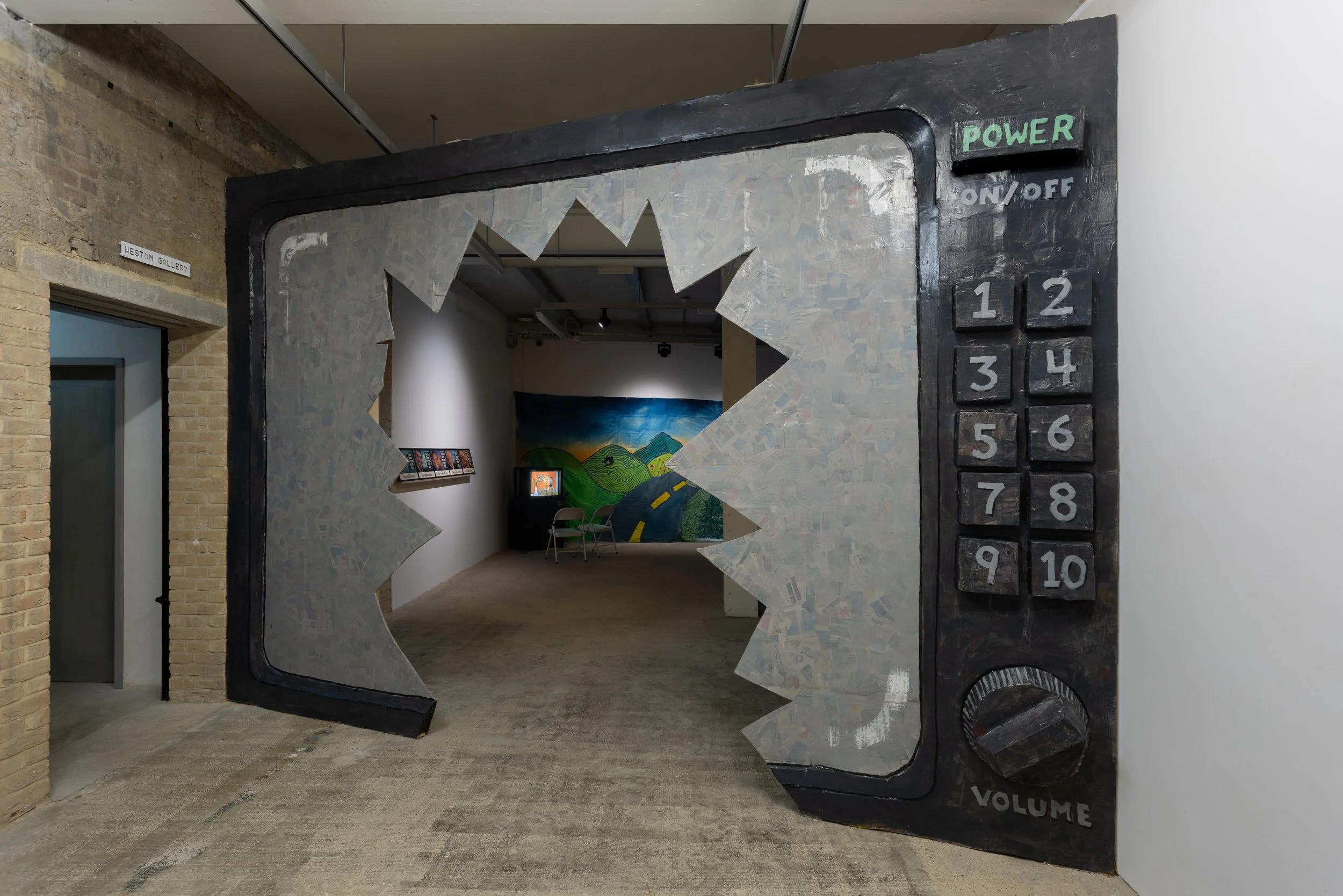
Paper Tiger Television, installation view, It’s 8:30. Do you know where your brains are? at Goldsmiths Centre for Contemporary Art. Courtesy Goldsmiths CCA.
Photo: Rob Harris.
It is against this immersive and seductive logic of mass media that the exhibition “It’s 8:30. Do You Know Where Your Brains Are?” intervenes. Entering the space, I don’t encounter a glossy TV screen but a shattered one. A giant, broken television set serves as the gate to an exhibition by the video production collective Paper Tiger Television, currently on view at CCA Goldsmiths, London. Instead of swallowing us into an ideologically distorted version of reality, which the cultural industrial complex creates, this broken screen thus opens a portal into the archive of PTTV’s investment in critical readings of popular media, interrogating the institutions that produce it, and unsettling the position of the spectator within it. In this setting, the screen no longer functions as a device of seamless transmission but as an exposed infrastructure. Its destruction interrupts the illusion of continuity and coherence that television typically sustains, revealing instead the mechanisms of control and economic conditions behind it.
Founded in 1981 by DeeDee Halleck, Paper Tiger Television was a US-based, volunteer-run collective dedicated to unpacking the operations of mass media, information industry, political and economic power relations. Over more than forty years, the collective produced nearly 400 programmes, developing a mode of broadcasting that combined radical DIY culture with critical analysis. In its early years, PTTV aired weekly on New York public-access television in a live prime-time slot, opening with the provocation: “It’s 8:30. Do you know where your brains are?” The shows were usually live on tape, low-budget productions, with makeshift sets, hand-painted backdrops and a simple low-tech switcher through which photos, graphics or video footage were cut into the take. The DIY aesthetic, partly due to the collective’s small production budget (which was usually disclosed at the end of each program), simultaneously appears as a strategy: it exposed the constructed nature of broadcast media by refusing its polish, with a defiant style becoming material practice.
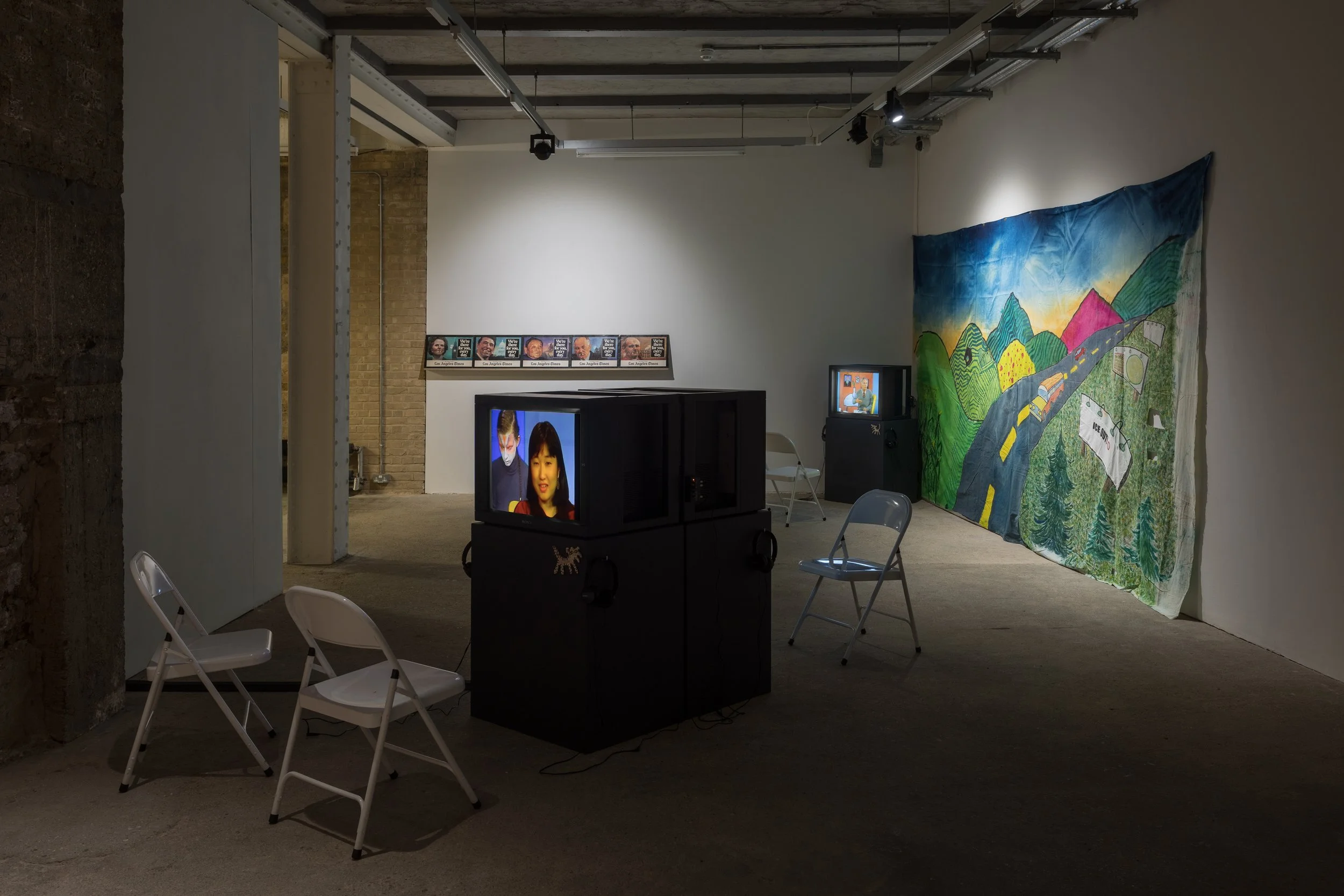
Installation view: Paper Tiger Television, It’s 8:30. Do you know where your brains are? at Goldsmiths Centre for Contemporary Art. Courtesy Goldsmiths CCA.
Photo: Rob Harris.
In its spatial set-up, the exhibition opens a space that acts as both archive and interface, in which visitors are invited to sit on one of eight television sets, each equipped with a remote, to browse and navigate a selection of forty programmes produced by Paper Tiger Television between 1981 and 2008. The act of engagement becomes an active scrutiny of layers of distortion and concealment of the capitalist ideology enmeshed in mass media. This interaction with the exhibition seems to enact a core principle of PTTV’s manifesto: „Investigation into the corporate structures of the media and critical analysis of their content is one way to demystify the information industry.“
Sitting on one of the televisions in the exhibition, I press play on The Steering Mechanism of the Ruling Class (1981). The video is part of PTTV’s first series, Herb Schiller reads the New York Times, in which the media theorist was invited by DeeDee Halleck to analyse the New York Times on public-access television, dissecting the economic and political structures embedded within its content. The show opens with a presenter listing statistics about the newspaper: its annual paper consumption, influential board members, financial flows, and patterns of stock ownership, all displayed on handmade cardboard charts. Schiller then appears in front of a hand-painted, kids’ TV-style setting, with a table, a cartoon flower in a vase and portraits on an orange wall, a setup that contrasts sharply with the gravity of his analysis. Speaking about front-page stories and the absence of a centralised control mechanism in US politics, Schiller argues that the New York Times operates as a “steering mechanism,” shaping the field of possible political outcomes. Rather than direct command, it produces consensus, guiding public perception toward the long-term interests of property ownership as a structural priority. The programme is interrupted by a video collage by Anita Thacher, in which bodies reach toward and interact with their television sets, collapsing the distance between viewer and screen into an eerie intimacy of touch.
Turning to the left, Margaret Thatcher, Ronald Reagan and other public criminals are grinning at me with threatening, sharp Vampire teeth from collaged Los Angeles Times posters next to a slogan that states „We’re there for you every day“. Staring into the smiling faces that embody the rise of neoliberalism, as one stares at the TV screen, might not only feel as haunting as their faces symbolise the spearheading of market-driven state-governance, privatisation and dismantling of the welfare system of the 80s, but also because they remind one of the acute contemporaneity of mass media’s entanglements with economic and political power today. If in the 1980s journalistic outlets like the New York Times functioned as a “steering mechanism,” that function has since been dispersed and scattered across platforms, and yet coalescing once again into the control of a small number of dominant actors. Algorithmic feeds, corporate media conglomerates, and political actors operate in tandem, producing continuous modulation of visibility, attention, and belief, that enact the paradox of apparent decentralisation masking new monopolies. With economic and ideological ties between political power and social media platforms like Donald Trump’s Truth Social, Elon Musk’s X, TV channelslike Fox Media, or the German media conglomerate Axel Springer, the list of media corporations as superstructural reflections of the economic base actively participating in the circulation, reproduction and aestheticisation of hegemonic power could be extended endlessly.

Production of Paper Tiger Television, Herb Schiller Reads New York Times #4: Hanging Out In Consumer Capitals: Foreign Correspondents, 1981.
Photo: Vicki Gholson
While the ways in which ideological forms are disseminated clearly have been altered through digital technology, certain strategies seem to persist over time. The Lie Machine: British Mineworkers Take on the Media (1985) hosts the Miners’ Campaign Tape Project and its critique of British media coverage of the miners’ strike. Following PTTV’s characteristic format, invited guest commenters guide a close reading that exposes the underlying strategy of broadcast material on the miners’ strikes. Rather than discrediting the movement as a whole, media coverage targeted individual figures, like the popular union leader Arthur Scargill. Through a series of commented excerpts, the programme reveals the tendentious re-coding of minor gestures and expressions as signs of instability or extremism: A twitching of his eye is considered evidence for his „madness“, his popular forceful speeches are reframed as menacing. The systematic practice of character assassination seems to become a prime example of what Chantal Mouffe terms disarticulation/articulation (1981), in which the discrediting of oppositional voices serves to forward the ideological project of hegemony.

Paper Tiger Television, Ynestra King Reads Seventeen: Selling the All-American Girl, 1982 [still]. Painted by Johanna Vanderbeek.
Other programmes in the exhibition address questions of representation and the ways in which social imaginaries are shaped through mass media. In Charlie Chan Go Home! (1984), Renee Tajima traces the deeply embedded racism that operates within American cinema historically back to English Imperialism. A key example is the systematic refusal to translate Asian languages, which renders characters voiceless and their speech into little more than phonetic caricature. She examines depictions of Asian women as fetishised and monolithic cultural stereotypes, shaping not only representation but the very conditions under which these characters can be heard or not heard at all. In Put Your Money Where Your Soul Is (1983), Myrna Bain engages with the black middle-class lifestyle magazine Ebony. In front of a hand-painted airplane interior, she reads a kind of manual for financial self-improvement, which offers advice such as: “Pay yourself first,” “Take no chances with your money,” and “Don’t get big-headed. Stay with the little fellows, that’s where your money is.” The programme shifts to an interview scene, in which a woman points out the gap between the magazine’s aspirational narratives and the lived realities it excludes: “I want to hear stories about welfare mothers and the problems they have, it’s not all glamour to be a black woman,” she says.
Uncovering how the cultural industry produces stereotypes, standardisations, codes and commodities to establish and reproduce the social order, conditions and relations necessary for capitalism to continue, PTTV nonetheless didn’t remain in the disillusioned analysis of mass culture, which leaves the people only as passive consumers. Neither falling into merely a cynical detached critique, nor into a romanticisation of oppositional culture, PTTV’s programs seem to approach popular culture as a conflicted field between the people and hegemony, in which the construction of culture becomes a constant negotiation of collective social understandings and the politics of signification (Hall,1980).
The program Unpacking Ted Koppel’s Revolution in a Box: Revolution? What a Crock! (1990) addresses the introduction of home video footage into broadcast news. With the rise of citizen-recorded material on US television, such footage was often used in “spot news” to provide a sense of immediacy, while submissions were selected based on their perceived public interest. Ted Koppel’s programme throws a range of highly divergent clips, from Palestinian youths throwing stones, footage of the Armenian earthquake to strike picket lines, reducing complex events to mere spectacle. The supposed revolutionary potential of home video is undercut by PTTV’s commentators, who mock it as “cable activism,” arguing that “consumption becomes our only activism.” Rather than fostering political engagement, the programme positions viewers as passive observers, assembling isolated singular images into a constructed sense of truth.

Paper Tiger Television, Put Your Money Where Your Soul Is (1983), Myrna Bain reads Ebony, still
This show seems to act as a prime example of processes of hegemony, in which potentially oppositional voices are negotiated and regulated to secure the continuation of the dominant ideology. If the rise of home video and public access TV in the 70s seemed to promise a democratisation of information and communication technologies, the progressing neoliberalisation of the 80s made the commercial functionalisation of it undeniable. The program Infiltrating the Underground: Corporatisation of Radical Culture (2008) reminds of Leo Löwenthal’s take on the depoliticisation through the culture industry: „Whenever revolutionary tendencies show a timid head, they are cut short by a false fulfillment of wish-dreams, like wealth, adventure, [..] power and sensationalism in general.“ Taking on the fight against the subsumption of punk and DIY culture into commercialisation, the program stresses the need for alternative media that envisions a way in which everyone can contribute.
Operating largely through volunteer labour and collective decision-making, PTTV foregrounded collaboration and demands for cultural participation, working with cultural critics, artists, activists, and independent producers. For the collective to occupy a slot in public television while critiquing corporate media control in PTTV’s case doesn’t seem like a contradiction, but a deliberate choice to insert media activism into the infrastructures it critiques. Over time, its focus expanded through reports on broader cultural and political issues, supporting social movements as well as spotlighting underground media practices. From the second part of the 80s on, the program’s style shifted more in the direction of documentary-style programs and reports supporting activist causes and social movements, as in the case of Under Siege: Palestinians in the US Media (1986) or The Gulf Crisis TV Project: News World Order (1990).While not disregarding the continuous effort to unpack the infrastructures of corporate media control, it seemed like the stronger focus on supporting grassroots culture and activism also reflected a shift from the critique of mass media to the investment in counter-reporting and building counter-infrastructures.
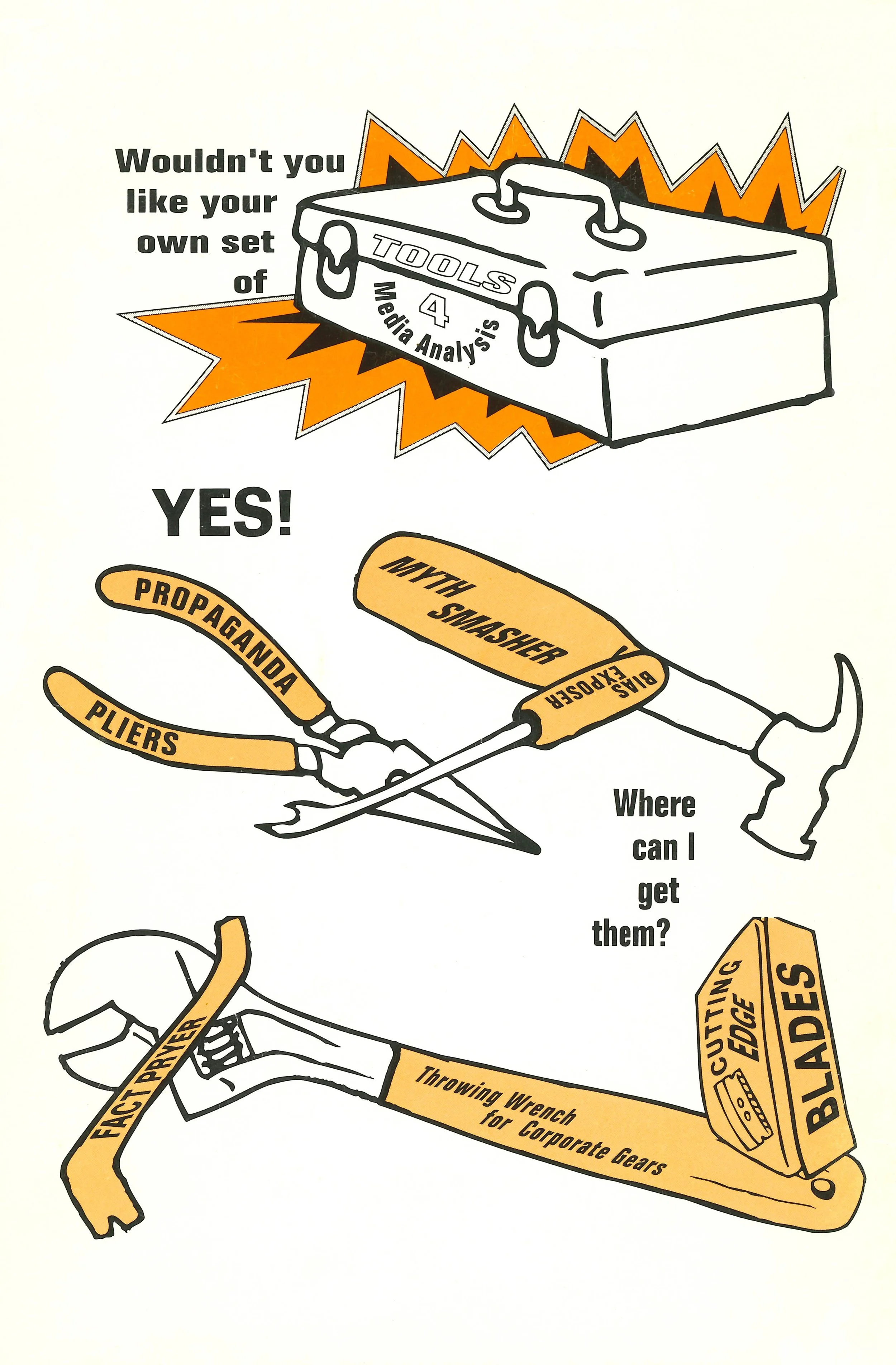
Paper Tiger Television, The Paper Tiger Guide to TV Repair!, 1992.
From the late 1980s on, PTTV’s work moved between contexts. Their programmes entered classrooms, universities, museums, and galleries, supporting critical media education within both activist and institutional frameworks. Across these shifts, its core project remained consistent: to challenge mass media by revealing its mechanisms and to imagine other ways of cultural production and transmissions of knowledge. With projects like the publishing of „ROAR! The Paper Tiger Television Guide to Media Activism“ PTTV became an important nexus in connecting media activism across different platforms, collectives and networks and building alliances beyond their own program.
After more than three hours spent moving between hand-painted set designs, photographs of studio scenes, and viewing programmes (of which I only caught a fraction), what stayed with me is not only the critical force that drove PTTV’s work, but also the palpable joy of collective making that runs through it. With camera operators drifting into the frame, someone stepping onto the set mid-recording to hand the speaker a note, and funky post-production with unruly special effects, the continuous puncturing of an illusion of seamless broadcast evokes the fun and playfulness that went into making. These gestures, as deliberate exposures of process, become moments in which the shared investment in making is both visible and insistent. The persistent crediting of everyone involved, regardless of their role, underscores this ethos, pointing to the passion and dedication that sustained Paper Tiger Television.

Production of Paper Tiger Television, Paper Tiger at The Whitney: Youth and the Media; Escape From Tom and Jerry, 1985.
Photo: Diane Neumaier.
Engaging with PTTV’s project today, the exhibition doesn’t only act as historical but cyclical. In a present shaped by algorithmic feeds, platform monopolies, an overabundance of digital creators, and the promise of self-commodification masquerading as the democratisation of media, the conditions PTTV persistently addressed have not disappeared but intensified. Boundaries between information and spectacle continue to erode, producing an environment in which ideology operates ever more seamlessly. Against the backdrop of rising authoritarianism, ongoing warfare, genocides, censorship and manipulation of information across media platforms, the need for counter-reporting, independent political broadcasting, and media activism becomes even more urgent. In this context, the collective’s question: Do you know where your brains are? does not reads as a provocation from the past, but as an insistence directed squarely at the present.
While the seductive screen may have shrunk to the size of a palm-held smartphone, the imperative remains the same: to shatter it, and to prise apart the infrastructures that sustain its illusions. In this endeavor Paper Tiger Television offers us a manual, the tools and strategies to collectively push back against the domination of the corporate communication industry and envision other forms of broadcasting beyond monopolised social platforms.
Theresa Zwerschke is a writer, artist, and cultural organiser based in London, where she is currently pursuing a PhD in the Visual Cultures Department at Goldsmiths University. Together with Steph Joyce, she co-founded Catwings, an initiative invested in grassroots culture and self-organised art practices. She has previously been part of the team of the street-newspaper Arts of the Working Class.
Double-click to edit...