

Emily Jacoby Kask
“Pläne und Träume – Gezeichnet in der DDR / Plans and Dreams – Drawn in the GDR”
Tchoban Foundation, Berlin, until September 7th
To date, there is no cohesive place or museum that focuses solely and explicitly on East German architecture or building art from the GDR. However, interest in its emergence, expression, and management has increased in recent years. The exhibition “Pläne und Träume – Gezeichnet in der DDR” is now entering its final weeks and offers a unique opportunity to experience a carefully selected concentration of the above.
Background
The exhibition project is based on extensive archive material provided by the Leibniz Institute for Spatial Social Research (IRS), as well as significant loans from public and private archives and collections, and from city museums.
In total, over 140 works in mixed media are on display, divided between two floors, with “Plans” and “Dreams” each given their own space.
The project is not presented as an odyssey through East German architectural history, where the main interest would be a stylistic evolution or individual monumental works. Nor is it the big names that are given space on the two floors. The exhibition should rather be understood as a tribute to the professionals, the individuals behind these works, with the convictions, dreams, and disillusions that served the state but also nourished them. The works and sketches of these individuals are testimonies and stories of a different time, a lost nation, but also moments of something deeply personal and intimate.
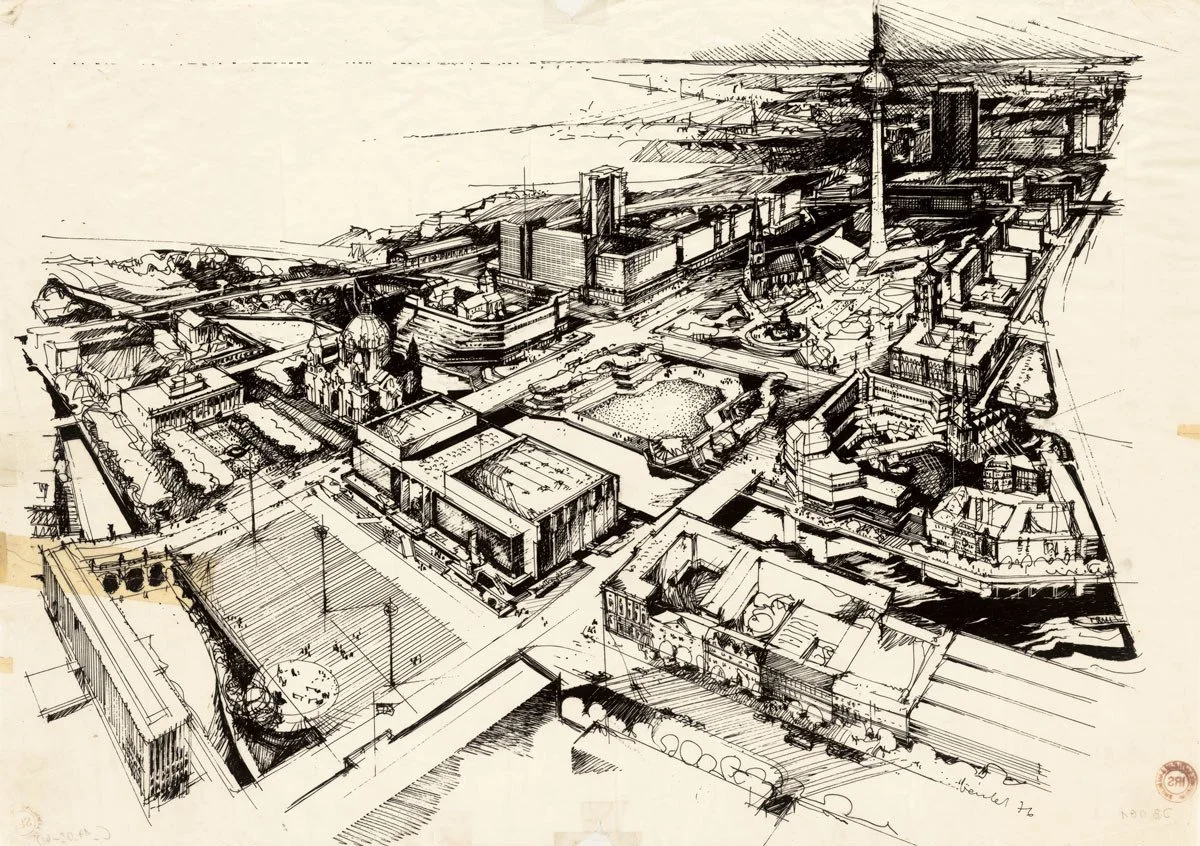
Dieter Bankert. Berlin, city center, birds-eye view, 1976
In the former GDR, a steady stream of architecture students graduated from programs in Dresden, Weimar, and Berlin. They took up a profession that, during the nation's lifetime, would involve significant changes, compromises, and sacrifices of their own creative freedom in favor of state commissions and due to a lack of resources, harsh political circumstances, and conditions. On the one hand, the exhibition depicts the working life of a profession whose tools and skills became an extension of the state, with frenetic hours spent catering to the client and the socialist vision. On the other hand, we see the same individuals expressing their own motivations, dreams, and fantasies, where it is difficult to know where one begins and the other ends.
In other words, the contrast and sometimes perhaps the overlap between these positions is the starting point for “Plans and Dreams.”
Plans
In the plans section, we see both realized and unrealized projects for most East German communities during a period from the 1960s to the 1980s. In addition to views and graphic concepts for cityscapes and street scenes from cities such as Karl-Marx-Stadt (Chemnitz), Dresden, and Leipzig, there is also a selection of ideas and drawings for other Eastern European cities such as Sofia. The sketches convey both the mood and hopes for the city and the potential of the location, as well as different ways of managing and incorporating parts of older buildings and neighborhoods into the socialist project. What may surprise the prejudiced observer is the relatively dense presence of decorative elements and features in some of the earlier sketches.
Some of the contributions and plans presented were later realized, albeit in different versions or formats than those shown in the original drafts, while others were rejected entirely. East Berlin's foremost and still standing landmark, the Fernsehturm (TV tower), was accompanied by the now demolished Palast der Republik. For example, these preliminary designs and early sketches – before Heinz Graffunder put the finishing touches to the design – are displayed on a wall. A competition entry from 1960 for the Kulturpalast in Dresden provides a rare contemporary impression, while another proposal from 1983 suggests what one of Berlin's largest entertainment institutions, the Friedrichstadt-Palast, could have looked like in a strictly postmodernist guise with dreamlike grids in a Kraftwerk-inspired wire model.
Dreams
While the first floor deals with official commissions, competition entries, and working sketches, the second floor is devoted to personal space, both figuratively and literally. Here, private sketches and more unofficial ideas, exam pieces, and other works are displayed, revealing the individual's desire to experiment, but also a kind of regulation of all kinds of emotions.
The desire to play is perhaps most evident in Lutz Brandt's series Balkongdrömmar 1–4 (Balcony Dreams 1–4), in which we encounter four fictional narratives about how citizens choose to furnish their apartment balconies, based entirely on absurd and lawless premises, where one balcony outdoes the other in bulky extensions and meter-thick cables to optimize solar panels or cultivate a lavish palm tree garden that defies the laws of physics. A maxed-out city plan reminiscent of a classic ABC model chooses to optimize the community's infrastructure based on a central swimming lake.
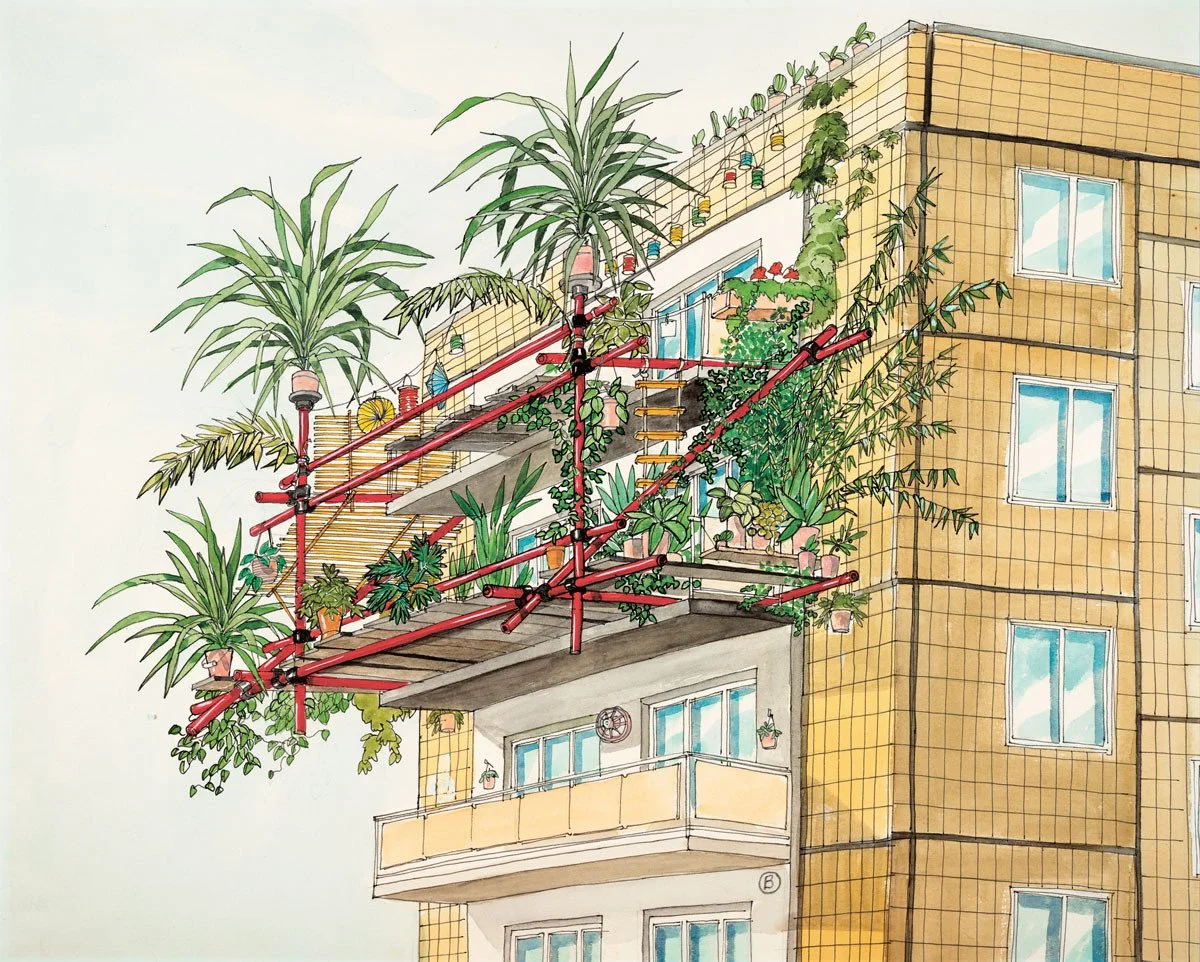
Lutz Brandt, Balkonträumereien 2, 1983
Perhaps most poignant is an unassuming daydream in ink, scribbled without any clear goal or meaning, in a 1988/89 almanac. The almanac series, attributed to Michael Voll, fills date after date with everything from graphic labyrinths and head formations to blackened and lonely forest scenes. What did people dream about in the GDR at this time, so close to its dissolution? In a similar vein, Ursula Strozynski's charcoal drawings from around the same period depict her immediate surroundings with a somewhat listless and cautious gaze.
Intentions
In addition to telling the story of the individuals behind the architectural life of the GDR, the catalog emphasizes a desire to challenge clichés and preconceptions about socialist and Eastern European architecture. This intention is understandable.
As long as million-program boxes and kitsch constitute and are allowed to represent a large part of the Eastern Bloc's visual cultural and architectural references, a rather misleading canon will continue to exist. Both in the intended and the realized, there is a diversity of expression and a stylistic pluralism that should be given its due. In this respect, the exhibition project is fairly successful.
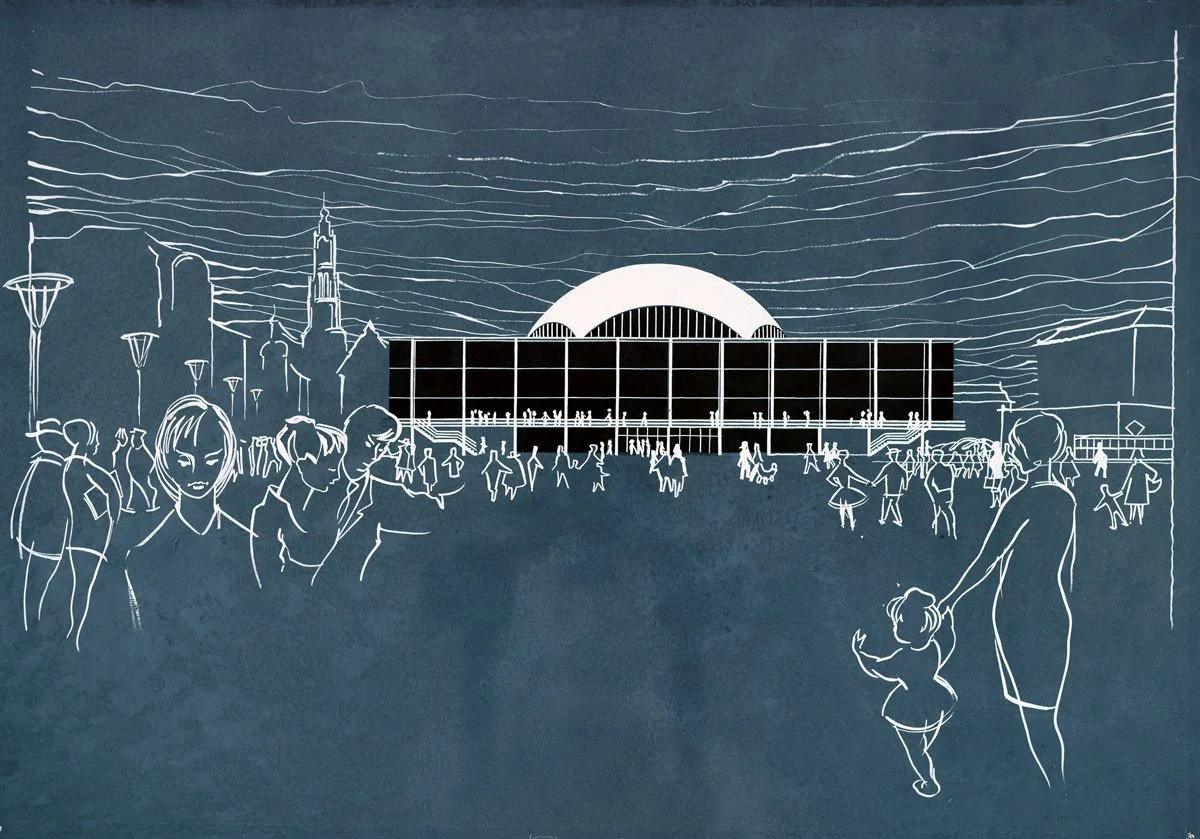
Leopold Wiel, Wiel design collective with Klaus Wever, graphics by Angela Waltz. Dresden, Kulturpalast competition, 1960
In addition, another important thread is illustrated alongside the main content: the absence of a unifying or centralized platform for East German architecture is an expression of a much larger dilemma and challenge in the wake of Germany's reunification and “rebirth” after the Cold War. The fact that thousands of documents, records, and written material linked to the state apparatus were destroyed or scattered to the winds in connection with the fall of the Berlin Wall and the dissolution of the GDR makes it extremely difficult to systematize, preserve, or coordinate material and objects from a nation that no longer exists. The material in this case—sketches and floor plans—is everywhere and nowhere. Much of it is in private hands. This also illustrates the difficulties involved in demarcating and evaluating material, for example, regarding preservation versus use as research material. Kai Drewes at the IRS and co-curator of “Plans and Dreams” chooses to see opportunities and potential in this outcome rather than problems.
Dreams with reservations
The exhibition and its themes span extremes. Embedded in the duality of the exhibition title is the individual's relationship to visions versus conditions, will versus resources, and imagination versus reality. Perhaps it is when we touch on these themes that something truly moves us.
This requires an understanding of what dreams represent in this context. What kind of dreams are we talking about? The dreams of individuals or the dreams of a society? Unfinished projects and sketches are partly an expression of both. Not least, they are both an expression of hypothetical possibilities.
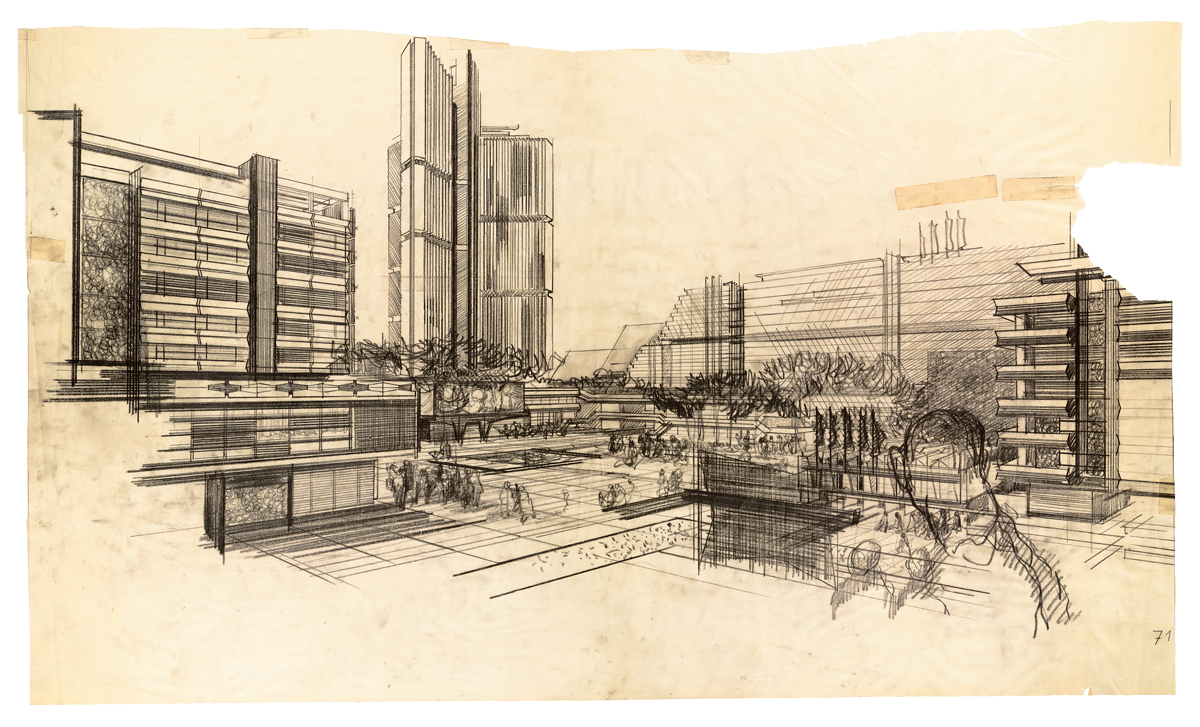
Peter & Ute Baumbach. Gera, sketch for a new city center , 1967/68
“Can you have good dreams in a false life?” is a question posed by the exhibition’s curator, Wolfgang Kil, in the catalogue, which can seem both rhetorical and a trick question. What space was there for individual dreams in a socialist GDR?
The question has been asked before and takes us straight to Michael Philipp’s research project at the Museum Barberini collections in Potsdam, which took a closer look at the art commissioned by the Ministry of Culture for the Palast der Republik prior to its construction in East Berlin in 1976. His project resulted in an exhibition in 2017 entitled “Behind the Mask: Artists in the GDR," followed by a book with the evocative title Are Communists Allowed to Dream? Remarkably, this was the slogan under which the project group for the art exhibition at the Palast der Republik worked as early as 1976, and it guided the type of art that would ultimately be produced and hung in the large foyer.
The project manager for the People’s Palace’s art acquisitions, Fritz Cremer, claimed that the question had already been posed by Lenin himself in his pamphlet What Is To Be Done? In this text, Lenin defends dreams, which are to be understood and interpreted on the basis of their potential as fuel for a vision born of revolutionary will. The dreams of the individual are encouraged, as long as they are compatible with socialist ideals. So there was certainly room for dreams. Dreams with reservations, if you will.
When we leave “Plans and Dreams,” it is ultimately the dream as a hypothetical possibility that we carry with us. An imagined reality that becomes another as we make the necessary sacrifices or compromises at the expense of our visions or our conscience. These conditions are hardly unique to architects as a professional group or even to individuals who lived in the GDR—they are common to most of us. We test life choices and motivations in sliding doors moments, between what became and what could have been. This can apply to individuals as well as to a nation.
Emily Jacoby Kask is a psychologist and art historian based in Gothenburg.
Double-click to edit...