Bergen Assembly 2025
A Grammatic Escape: Learning to Speak Again
“Across, With, Nearby.”
September 11 – November 9, 2025
Frida Sandström
“We already know each other.” The Arabic word barzakh denotes that experience, Hebron-based artist and cultural worker Izz Aljabari explains. In his embroidery, the concepts in Sufi mystic Rumi’s poems are articulated in what he calls a “symbolic geometry that might have an effect on our existence.”[1] These images are also based on his hometown Hebron, a city that in Aljabari’s view once was thought of as constantly growing – until occupation. Rather than imagining Hebron from an airplane view like the Israeli military, embroidery is a way for him to see the city from within its life.
In a recent interview, Palestinian intellectual Addelajawad Omar describes the way in which Palestinian resistance is rendered dangerous because of its proposition: “as a grammar that might traverse borders and languages, that might be taken up in lands far from Palestine, wherever people confront the architecture of managed life and slow death.”[2] The fifth Bergen Assembly, from September through November, is not curated, and rather works through the grammars of resistance, which is how an expanded field of poetry may be understood. The title of the Assembly, “Across, With, Nearby,” is – if understood through Omar’s understanding of grammar, not a metaphor. Similarly, the art institution is used as a means for the language that such grammar may allow, beyond the institution itself.
The Assembly program unfolds in forms of conversations, readings, and performances that all approach the impossibility of culture in times of cultural catastrophe and the current erasure of life and memory that we are seeing in Palestine and beyond. The Assembly engages in these negotiations, which makes the various materializations in the program appear differently. Artists talks and readings suddenly appear as central to the presentation – since the relation with the audience here is central. It all seems like a mixture of Situationist and anti-colonial practices, and the critics flewn in, supposed to cover these events, need to shed their titles and join the collective unmaking of the exhibition format that still hovers over the whole project.
This is the fifth edition of the Bergen Assembly, which initially came into being as a way of rethinking biennale culture. Different from previous versions of the art word’s urge to “get together,” as Nicholas Bourriaud, Claire Bishop or Grant Kester have suggested without reconsidering their own roles in their imperatives for social engagement, this year’s Bergen Assembly abandons the aestheticization of assembly-making and rather uses such practices as ways of showing global and historical practices of communizing sensibilities during genocide. Yet, if Omar underscores how “[c]ritical thought must abandon the premise that international law is a neutral terrain,”[3] the Assembly still has some work to do in abandoning the premise of the art institution.
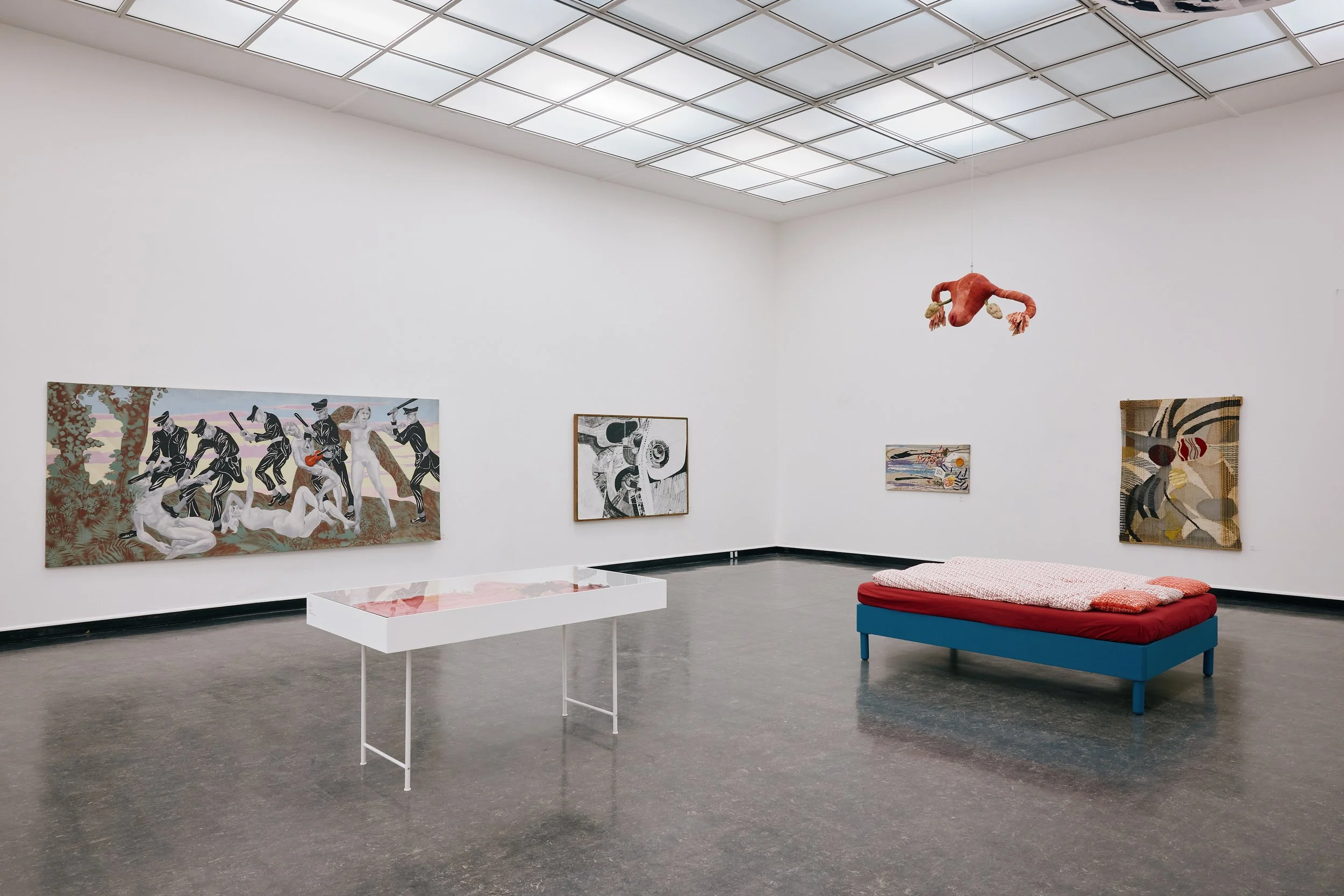
Laurie Grundt, Police Methods, 1972, installation view of Gruppe 66 at Bergen Kunsthall as part of across, with, nearby, Bergen Assembly 2025. Courtesy of KODE. Photo: Thor Brødreskift
Throughout the weekend, I ask myself why we are gathered here, and not at the then ongoing solidarity camp Hurryia in Malmö, which gathered activists in the struggle for Palestinian liberation from near and far. After some days and sessions, I realize that the aesthetic approach to resistance, which does not aestheticize politics but rather engages in the very aesthetics of colonialism, is the duty of everyone working with the arts today. In this sense, there is a way to refunction the art institution that allows for the grammar – or geometry – to unfold. Yet importantly, it cannot neither end with the exhibition project, nor with the review.
One example of refunctioning in a quite old-school Brechtian way is “Archives for Social Change” presented at Strangels Stiftelse in Bergen, a former poorhouse for women founded in the early 17th century. Presenting a montage of archives collected by groups and networks from Norway to Nepal, historic figures in the struggle for reproductive rights and sexual liberation are introduced in reanimated forms. In commissioned texts written from an imagined first-person position, these figures present themselves for the visitors. The title of the project reveals the intention behind the Assembly’s tendency to both map and redistribute memories and relations.
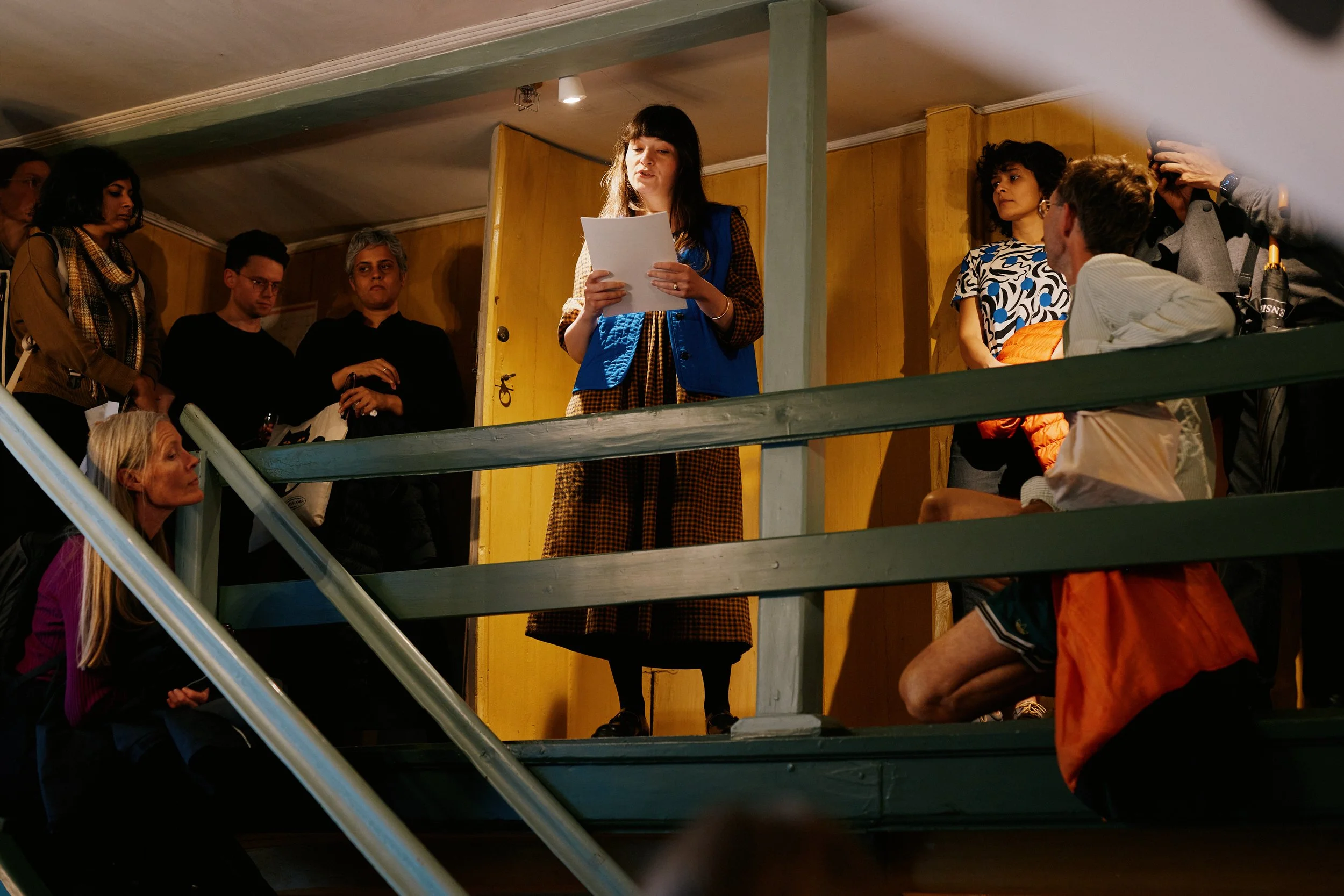
Reading at Stranges Stiftelse as part of Organizing for Social Change, for across, with, nearby, Bergen Assembly 2025. Photo: Abrakadabra Studio
At Bergen Kunsthall, a retrospective of the Norwegian situationist Gruppe 66 first initially stands out as contradictory: is it possible to force situationist practices back into the art gallery? As history shows, this is what Scandinavian situationists did themselves, but not without difficulties. The Bergen retrospective looks back at is the exhibition Common Life/Samliv (1977-78), which – according to an old TV documentary screened in the Kunsthall – school children were not allowed to enter, while museums and collectors refused to borrow works for them to exhibit.
To re-exhibit that which once was banned – such as a big vagina hanging in the air, or a bed where the fabric gestures toward lust – is in itself quite a situationist action. Yet the mix of various exhibitions and contexts disregard the difference in situationist histories that span from 1966 to 1977 – the latter date at which the Situationist International bad already been dissolved. That the two other two exhibitions Gruppe 66 (1966) and Konkret Analyse (1970) materialize the general situationist engagement with the theory-praxis dialectics, though without engaging with questions of sexuality, is telling, and perhaps we need to look elsewhere today if we are to properly abolish history’s alienating aspects, as Guy Debord once suggested.
The Carceral Art Institution
In the film trilogy What’s Going On, Marcus Coates has collaborated with three people who suffer from schizophrenia, and the internalization of these structures echo in Coates’ enactment of their experiences. Through a headphone, he hears voices and tries to understand them, while one of the schizophrenic collaborators, introduced as “The Director,” explains how he should react to this polyphonous experience. Coates is advised not to question the voices, but rather question himself as well as the whole world around him. And so, the schizophrenic conspiracy theories go wild. The setting, a small bedroom, shrinks to the size of a dollhouse and the mental confinement is total – until The Director suggests that Coates draw an image of one of the characters speaking. When asking why, she responds: to get them out of your head. And suddenly, the voices go away. The sensible articulation of confinement – be it psychic, material, or both – seems to be central to Bergen Assembly’s strive to create other forms of living with art. Rather than articulating violence critically and theoretically, these practice-based learning processes within confinement open doors that otherwise seem to be closed.
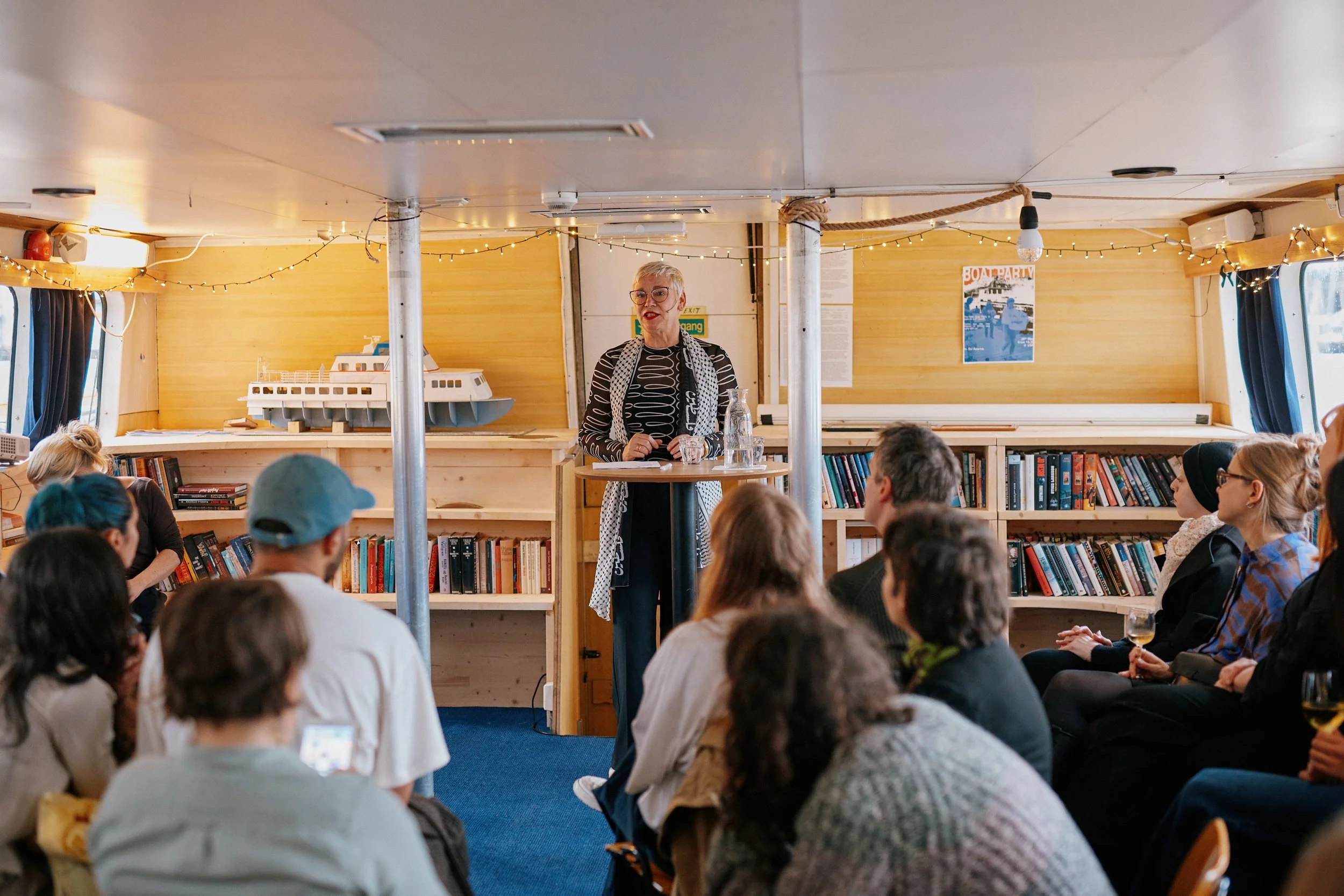
A Blocknotes reading by Christine Otten aboard the Literature Boat Epos as part of across, with, nearby, Bergen Assembly 2025. Photo: Akrakadabra Studio
As part of a retrospective of the Norwegian Situationist Gruppe 66, Rune Schytte’s undated video Prison Project documents detainees in a Danish prison during the process of collective art practice. While the wall-text does not say more, the video speaks clearly. The interns paint the prison walls freely, collectively, and as they like. Like in Jacques Becker’s film Le Trou from 1960, based on José Giovanni's book The Break (1957), in which a group of prisoners together dig themselves out of confinement, it seems as if painting is a way for the Danish detainees to, at least on an imaginary level, get out of the carceral state that they are in. The kind of practices that allow for such breakouts is central for Bergen Assembly, while the carceral aspect is not only the prison or the occupation forces, but the art institution itself.
In Fred Moten and Stefano Harney’s lecture from a teach-in at UC Berkley in 2020, the duo stated that “[t]he institution (the university, the prison, the hospital, the state) is regulatory; and regulation tends towards elimination.”[4] In Bergen it comes across clearly that the art museum and the kunsthall too are destructive machines that one needs to dig or paint oneself out of. Rather than institutional critique, this is a matter of abandoning the institution from within. And this is what the convenors of the Assembly, Ravi Agarwal, Adania Shibli, and Bergen School of Architecture, have enabled some Assembly contributors and audience members to do. The central theme of the Assembly is thus not inscribed in art history but rather in the history of the avantgarde, moreover of the anti-colonial resistance to Western culture as such.
The Assembly’s collaboration with the school of architecture stands out as dangerously anonymous in the way that it overshadows the hierarchies and forms of symbolic representation that every educational institution represents. In this sense, the exhibited works in the school’s workshops feel regulated rather than set free from the white box setting. This is visible in Koki Tanaka’s sharp trilogy of video works from 2010-13/2025, in which five people are asked to do the same thing at once; pottery, piano-playing, and hairdressing. Similar to how the socially engaged artwork Haircuts by Children (2007-) by the art collective Mammalian Diving Reflex materializes the form of control that wage labor has on subjects that are not even included in the wage-labor system (in this case: kids), Tanaka’s scores for collaboration for the camera reveal how the participants realize that “collective intelligence is scary,” and speaks of leadership (“there is no leader; we are all leaders”) rather than imagining what else it could be.
The Communist Museum of Palestine
In one strand of the Assembly, convened by Shibli, assembling gains a different meaning than the autonomist sense of the word. Rather than a gathering at a particular time and date, or as a way to counteract something external, it was a way to gather within that which confines us: the nation state, the prison-industrial system, apartheid, and contemporary art. Here we can again turn to Omar’s reflection, in which he argues that “something is shifting” when it comes to the role of institutions today, be they legal, educational or artistic:
The growing disillusionment with international institutions is not only a crisis—it is an opening. It allows us to speak of law not as salvation, but as terrain. The erosion of liberal legitimacy gives rise to a new political language—one grounded not in appeal, but in assertion. Not in begging for recognition, but in building solidarities that see through the mask of neutrality.[5]
The forms of solidarity initiated by Shibli at Bergen Assembly is materialized at the Communist Museum of Palestine/the De-School. Apart from collecting donated artworks and redistributing them in apartments in the city of Bergen, which the Communist Museum of Palestine does in collaboration with the Oslo-based art platform Tenthaus during the whole period of the Assembly, the De-School unfolds as a collective conversation and learning practice throughout the opening week. The Communist Museum of Palestine is operative since 2018. Initiated as an “Exit Plan,” they describe it as a way to display what communist exhibition making would be. In other words, what is art after or against capitalism and colonialism? These questions hover over the whole Bergen Assembly project, but only come to the fore in The Communist Museum of Palestine itself.
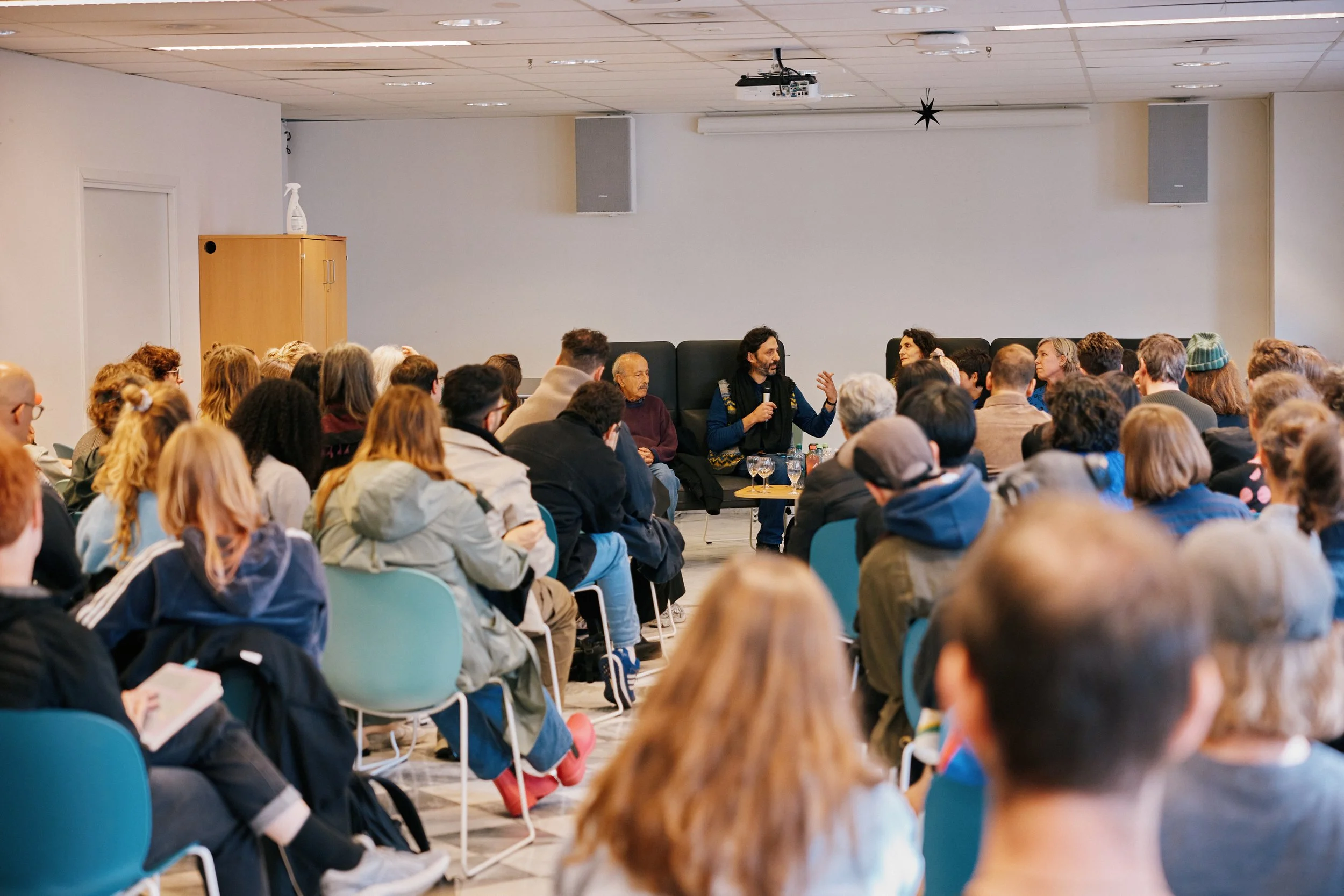
A conversation with Munir Fasheh, Ayreen Anastas, Rene Gabri, and Tenthaus Art Collective at Bergen Katedralskole ‘Katten’, programming by the Communist Museum of Palestine دال-صفر (d-0) as part of across, with, nearby, Bergen Assembly 2025. Photo: Akrakadabra Studio
As the project has developed, art is refunctioned into the sensible relations between people and their histories, materialized in practices in which we can experience and learn in common. Part of the project is the collective formulation of “Exit Plans,” central to the De-school’s discursive strand of the Museum’s investigation into various forms of exodus from what they in Bergen describe as “genocidal culture.” As the first “Exit Plan” from 2020 reads, the three words “communist,” “museum,” and “Palestine” are critically rethought and actualized, rather than instituted. In other words, they can be replaced by others, the question is what they may evoke:
We have developed in conversation the premise that this museum already exists. It exists in every Palestinian home, where a vulnerable archive, important materials, testimonies, stories, sayings, documents, objects of art, tools, recordings, traces, dances, gestures, fragments of history, and culture have been passed on hand to hand and mouth to mouth—embodied, presevered, and cared for. They have been maintained through an inherently anarchist, feminist, decolonial, and communist (from each according to their abilities to each according to their needs) ethics.[6]
Understanding The Communist Museum of Palestine’s contribution to Bergen Assembly through these words, it becomes clear that the homes activated with donated and redistributed artworks in Bergen are woven together with the life practices impregnating homes in Palestine. Although the above formulation was published in 2020, when the first “Exit Plan” was announced, it has only become more relevant. The role as stand-ins that the homes in Bergen assume in relation the homes destroyed by bombing or expulsion underscores the necessity to understand these infrastructures as inherently connected. In a posthumously published essay on what she had introduced as “Infrastructural Critique,” critical theorist Marina Vishmidt writes something that recalls Omar’s above cited words:
Of course, an institution can be a type of infrastructure, but the point is to move from a standpoint that takes the institution as its horizon to one which takes the institution as a historical and contingent nexus of material conditions, amenable to rearrangement through struggle and different forms of inhabitation and dispersal.[7]
It is precisely this approach to the museum that the Communist Museum takes as a starting point for its investigation in the communizing of resources within the art institution and within all the resources that we bring there. Based on the question of Palestine, the project universalizes the life-threatening issues that occupation and apartheid raise to the necessity of thinking alternative life-supporting activities everywhere. As the same “Exit Plan” reads:
How do we reposition Palestine from the perspective of emancipation and liberation of life? Does the condition of Palestine open perspectives for thinking of life and the institutions/infrastructures that claim to support life otherwise?[8]
This is what the 2025 iteration of the Communist Museum of Palestine invites those who thought of themselves as spectators to take part in.
Mujawarah
While the distribution of artworks over Bergen mostly took place behind the radar of general Assembly visitors, the Communist Museum of Palestine unfolded through the De-School. The De-School is an aspiration “to think pedagogy otherwise and by other means.”[9] After having taken place in Ramallah and online for almost ten years, the exiled version of the De-School materializes the forced displacement of the practice itself. The Bergen iteration centers on the participation of Munir Fasheh, who introduces a notion for the practice within the De-school: mujawarah, the Arabic word for neighboring, and making meaning together. Mujawarah is introduced by Fasheh as way to avoid the carceral state of institutions and teaching – as opposed to what he calls learning.
As he explains in Bergen and has done many times before in iterations of the De-School, Fasheh has practiced mujawarah since 1971. This is the year when he abandoned his position as an esteemed professor in mathematics and founded the Tamer Institute for Community Education in response to the 1967 war. Important to the history is the formal occupation of Palestine this year, in response to which Fasheh initiates collective learning methods in Palestine and Jordan. Under occupation, learning stands out as a much more central aspect than unlearning – a notion by means of which alienation (education, assimilation) is already acknowledged as a way of leaving it behind. Learning, as Fasheh introduces it, never accepts occupation, colonization, or assimilation, and rather emphasizes the “innate capacity” to learn that all of us have. Learning is in this regard not a matter of schooling but rather of language itself, our relation to culture and history as common means of living. In Bergen, these practices were introduced the context of an ongoing escalation of the catastrophe, and in the context of an international art event that calls for an assembly without a particular destination.
In a series of unscored conversation sessions, Fasheh invites the participants to speak in a language that does not depend on an institution. A language that is not carceral, that is. In their invitation to the Communist Museum of Palestine, the De-school asks what a genocidal culture might be. My way of interpreting this draws on Frantz Fanon, according to whom Western culture is deculturalizing. That is, alienating cultural life by means of its own institutionalized cultural forms.[10] From a Palestinian perspective, this is Nakba, the catastrophe – ongoing since 1948 and even before that. In Bergen, this perspective is directed toward language itself, inviting the group of participants from the art scene and academia to use non-institutionalized words to tell a story that has nothing with an institution.
The practice that Fasheh and the De-School initiates recall Omar’s above-mentioned description of what he calls an “epistemological resistance” embedded in language itself. Rather than an abstraction, he describes this as a way to resist foreclosed meaning – what Fasheh during the Bergen sessions describe as colonial education that in Fanon’s wording is deculturalizing:
To speak of epistemological resistance today is not to invoke abstraction. It is to name a front of struggle no less decisive than the material one. For what we are witnessing in the wake of Gaza’s ongoing genocide is not only the annihilation of bodies and homes, but the attempted foreclosure of meaning. The repression we see in Western media and institutions—however sophisticated its choreography—is not merely about silence, but about framing, about scripting the visible and the sayable in advance.[11]
Building on Omar’s argument, the way we use our language and the way we make meaning is not only political, but a matter of opposing or supporting the catastrophe. In the same vein, the conversations that developed during the opening days, guided by Fasheh and the De-School, weaved experiences ranging from loss of language to the richness of meaning in words as “social documents,” as Fasheh calls it. For example, he argues that “we need to reclaim poetry as something that is taught in the 12th grade,” while at the same time underscoring that poetry, as he understands it, is literature without being Literature with capital L. As the De-School unfolds, it becomes clear that all words are to have this capacity, and as Fasheh makes increasingly obvious, there are many words in Arabic in which Western categories for ownership or teaching does not exist. Rather than owner, you are friend of a piece of land and, as he underscores, it was the British who introduced Palestinians to ownership. In the context of an international, Scandinavian-based art event, art with a minor a is made a central spur for the collective practice proposed for anyone attending.
Assembling Against Genocidal Culture
As one of the facilitators of this iteration of the De-school suggests, the notion of assembly is as such a way of turning away from capital’s catastrophic logics: “We need a form of assembly or gathering that is equal to what we learn from Palestine.” This form of learning – which, as Fasheh insists, must be separated from teaching and institutional cultivation and assimilation – is a way to realize that meaning is a social practice and not an identity. This non-conceptual and non-dialectical proposal is not an engagement with theory, but with life-saving practices. Thus, the cultural alienation that Fanon described as deculturalization, or the genocidal culture that the De-school tries to articulate, is confronted and at the same time, abandoned grammatically, geometrically, and socially.
Indeed, Nakba is not only about massacring people since 1948, but also about a massacre of language and consciousness since the initiation of colonialism. I’m again turning to notions and practices that I have spent time with, and just like Carla Lonzi once détourned Fanon’s use of the word deculturalization and made it the practice of consciousness raising of histories of sexual difference,[12] I believe that the Bergen iteration of the Mujawarah suggests that we save poetry from poetry and let words have meaning before art. As the culturally supported catastrophe unfolds in real time at the time of writing, facilitated by universities and art institutions in Israel and across the world, Faseh underscores that the representation of Palestinians by numbers imprisons not only the witnesses of the catastrophe, but also social life itself. Refusing mathematics is thus not an institutional critique, but an anti-colonial action.
The relation between the articulated and the unsaid seems to be central to the Assembly’s poetic theme, “Across, With, Nearby.” All these notions resonate with the meaning of the Mujawarah, in which neighboring thoughts form collective learning beyond dialectical relations or network strata. Yet, neighbors are not always kind and as Fasheh, underscores; words are either nurturing or destructive. Prison is a destructive word, bound up with an institutionalized imaginary that reproduce colonial relations, and Fasheh underscores that Israeli education is such a destructive body, which strives to suffocate actual learning processes. In poetic and conversation formats throughout the Assembly, Israeli apartheid and the current catastrophe is connected to prison abolitionist practices in the Netherlands. In the writing project Blocknotes, text pieces from prisoners are read aloud by one of the project’s facilitators.
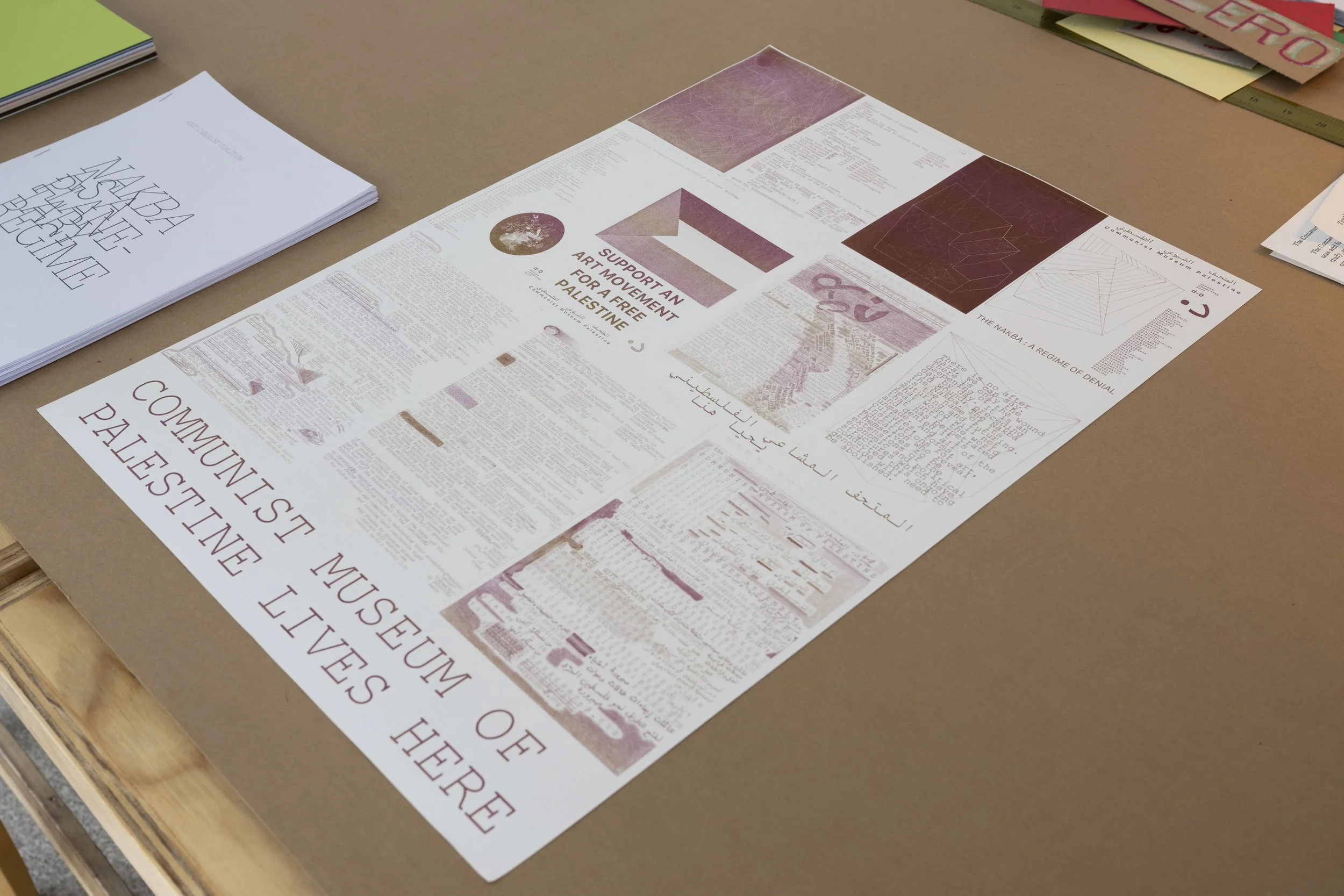
Communist Museum of Palestine دال-صفر (d-0), hosted by P1 — Mobile Studio, installation view at Bergen Katedralskole ‘Katten’ as part of across, with, nearby, Bergen Assembly 2025. Photo: Thor Brødreskift
Materialized in regular writing workshops run within a number of Dutch prisons, Blocknotes is described as a way for the detainees to write themselves out. As is explained by one of Blocknotes’ facilitators, detainees are not allowed to receive books in prison, and most prison libraries are very poor. In a text presented at the Assembly, one of the detainees writes that “learning feels difficult.” This is also Fasheh’s and Omar’s argument: confinement as well as occupation alienate learning and imagination and turns it into forms of assimilation, teaching, and adaption. Just as for the prisoner Frank, who inserts “FUCK” in every third word of his text presented at the Assembly, language is almost lost. Yet, through these collective writing sessions, the remaining words’ capacities are refunctioned, and FUCK becomes the “trou” through which it is possible to write oneself “out” of confinement. The practice of mujawarah, as Fasheh introduces it, has the same meaning. From initially having almost no words that were not connected with institutions and carceral states, the participants collectively actualized their language and the Communist Museum of Palestine awakened sensations that were thought of as lost.
The emphasis on storytelling and oral histories rather than novel-writing, journalism, and critical thinking not only questions tendencies in literature or poetry, but also in the densely discursive language of the art world. Rather than asking what it is for, the Communist Museum of Palestine asks what it can be used for, moreover makes use of it. Just like Aljabari’s embroidery, it is a way of countering colonial architecture and grammar from within the city, and within images and language itself. For people working in the arts, writing art criticism like me, this is an important reminder that what formulate ourselves has a consequence, and that formulations can save lives. It is urgent.
In a reading and artist talk by Layli Long Soldier, an artist, poet, and indigenous rights advocate based in Four Corners region of the Southwest and of Lakota descendent, histories of Northern American colonization are woven together with today’s genocidal culture. Introducing the phrase “Mitákuye Oyás’in,” which in Lakota language means “we are all related” or “all my relatives,” Long Soldier explains that “Mitákuye Oyás’in” is the title of an art an exhibition project based on the collective grief of the hundreds indigenous children which recently were found to be buried in former residential school in Saskatchewan, currently British Columbia. The genocidal aspect of schooling, which Fasheh underscores, could not be clearer. Following the presentation, Long Soldier reads an abstract poem, in which even the printed words are “displaced” on paper. She reads them across and against the printed structure of Western grammar and make a new order of the words each time reading. As Omar said, this is not an abstraction. Rather is it language is moving beyond literature itself. An escape, an opening.
Frida Sandström is a writer and critic based in Copenhagen. She has recently completed her PhD thesis on feminist critiques of art and sexuality; Dropout Subjects. Jill Johnston’s and Carla Lonzi’s Disintegration and Deculturalization of Art Criticism as Social Critique in 1969. (2025)
[1] Izz Aljabari. Artist talk, Bergen Assembly, September 13, 2025
[2] Abdaljawad Omar and Pasquale Liguori. ”The Grammar of Resistance: Rethinking Palestine Beyond.” Monthly Review 77:04, september 2025. https://monthlyreview.org/articles/the-grammar-of-resistance-rethinking-palestine-beyond-pity-and-fear/ (Accessed on September 30, 2025).
[3] Abdaljawad Omar and Pasquale Liguori 2025.
[4] Fred Moten and Stefano Harney. “the university: last words”. Undated, unpaginated.
[5] Abdaljawad Omar and Pasquale Liguori 2025.
[6] The Exit Planning of the Communist Museum of Palestine 1. Phase One. See https://communistmuseum.org/exit/exit-english.htm (accessed on September 29, 2025).
[7] Marina Vishmidt. “Infrastructural Critique: Between Reproduction and Abolition.” E-flux nr. 155, June 2025. https://www.e-flux.com/journal/155/675808/infrastructural-critique-between-reproduction-and-abolition (accessed on 29 September 2025)
[8] The Exit Planning of the Communist Museum of Palestine 1. Phase One. See https://communistmuseum.org/exit/exit-english.htm (accessed on September 29, 2025).
[9] Communist Museum of Palestine. De-School Palestine. https://communistmuseum.org/de-school/original.htm (accessed on 29 September 2025)
[10] Elena Flores Ruíz. “The Secret Life of Violence.” In Byrd, Dustin J. & Miri, Seyed Javad (eds.), Frantz Fanon and Emancipatory Social Theory (Leiden: Brill, 2019), 238.
[11] Abdaljawad Omar and Pasquale Liguori 2025.
[12] Frida Sandström. “Dropout Subjects. Jill Johnston’s and Carla Lonzi’s Disintegration and Deculturalization of Art Criticism as Social Critique.” PhD thesis. Department of Arts and Cultural Studies, University of Copenhagen, August 15, 2025.